The Price Was Real. Was the Value?
Turkey's fund turmoil exposed the fault line between spectacular returns and realizable wealth
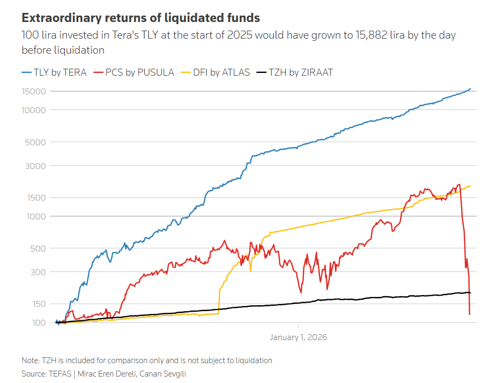
1. A 747% Return - and a Question the Chart Could Not Answer
A reported 747% gain in seven months was bound to attract attention. That was one Turkish hedge fund's lira return between January and July 2025, when it had fewer than 200 investors; by September 2026 it had more than 100,000. But the more consequential question was not how fast a fund's unit price rose. It was whether the assets behind that price could be sold in meaningful size without erasing the gain. Turkey's September 2026 fund intervention brought that distinction into focus: market quotations can look precise even when the market beneath them is thin.
2. When New Money Becomes the Price Signal
Consider a fund holding a large stake in shares with limited free float. New subscriptions allow it to buy more of those shares; relatively small trades can lift their quoted prices, which in turn lift the fund's marked-to-market net asset value. Stronger reported performance may then attract still more subscriptions. This is a feedback loop, not necessarily proof of manipulation. The economic vulnerability is that the same investor inflows that support the valuation can also obscure how little independent demand exists at that price. Concentration amplifies the effect: the larger the holding relative to daily trading volume, the harder it is to exit without moving the market.
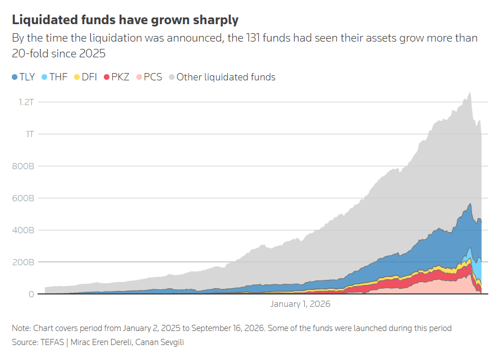
The scale of the inflows is visible in the data. By the time the liquidation was announced, the combined assets of the 131 funds had grown more than 20-fold since the start of 2025, to above TRY 1 trillion.
3. The Liquidity Mismatch Hiding Inside the Return
The mismatch is structural: investors may expect fund units to be redeemable, while the underlying securities cannot be liquidated at comparable speed. A quoted last-traded price is a marginal price; liquidating a block requires a volume-weighted exit price, potentially much lower. When subscriptions reverse, forced sales can depress quotations, lower NAVs and trigger further withdrawals. The relevant stress test is therefore not simply “How much did the fund earn?” but “How much cash could it raise in five trading days, and at what discount?”
4. 131 Funds: A Regulatory Shock, Not a Loss Estimate
In September 2026, Turkey's Capital Markets Board (SPK) ordered the liquidation of 131 funds across seven portfolio managers. The regulator counted 455,758 investors in those funds, and reports put the assets involved at roughly $18-20 billion. Those figures measure the reach of the intervention - not proven misconduct by every fund, and not the ultimate loss to investors. The key governance questions concern valuation independence, related-party exposure, concentration limits, disclosures and whether redemption terms realistically reflect the liquidity of underlying assets.
5. Why a Central-Bank Backstop Has Limits
Reported liquidity measures included raising repo funding to TRY 300 billion. Such support can ease funding stress and reduce contagion through banks and markets. It cannot create end-buyers for illiquid shares at their previous quotes. The distinction matters: a liquidity crisis may be contained quickly, while the slower task of discovering fair prices and distributing liquidation proceeds can remain unresolved. Nor does fund-level distress automatically imply a system-wide banking crisis; transmission depends on leverage, counterparty links and forced-selling spillovers.
6. The Question That Outlives the Crisis
The lesson is not that extraordinary returns are inherently suspect. It is that performance without a liquidity-adjusted valuation can overstate the wealth investors can actually realize. The best due-diligence question is often the simplest: if the largest holders tried to exit tomorrow, who would buy - and at what price?


