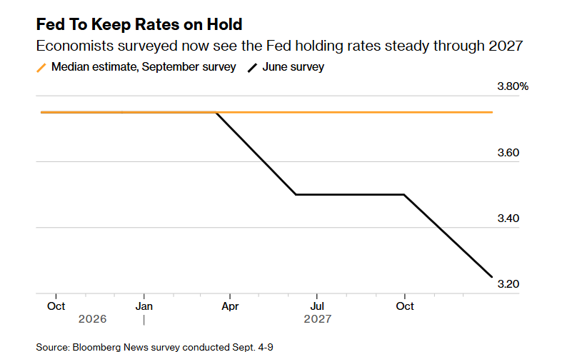
The ECB has already responded to the latest inflation shock with higher rates. The Fed now faces a similar question - but under very different economic and political conditions.
The Fed's September meeting has quickly shifted from an expected hold to a genuine tightening debate. US inflation remains above target, energy costs are feeding into the broader price basket, and the labour market has regained momentum. Yet a hike is still not inevitable.
The ECB's latest decision offers a useful comparison. Both central banks are confronting an external energy shock. What differs is how far that shock has travelled through their economies - and how much room each central bank has to respond.
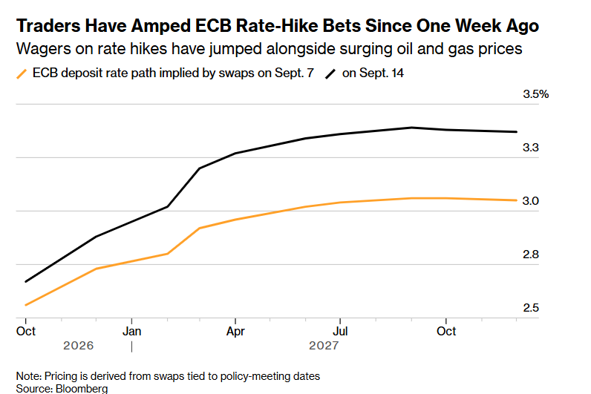
1. The ECB: Why Waiting Became More Expensive
The ECB's September hike was not simply a response to higher oil prices. The more important development was persistence. The ECB now expects headline inflation to average 3.0% in 2026, 2.5% in 2027 and 2.1% in 2028, keeping inflation above target for longer than previously anticipated. At the same time, the euro-area economy has performed better than expected, giving policymakers more room to respond without creating an excessive growth shock.
This changes the policy equation. Central banks can normally look through temporary energy shocks because higher interest rates cannot increase oil supply. But the longer energy prices remain elevated, the greater the risk that they move from fuel and transport into production costs, services, wages and inflation expectations.
The ECB therefore did not hike simply because energy prices rose. It tightened because the probability that an external shock becomes persistent domestic inflation had increased.
2. The Fed: The Data Are Moving Closer to the ECB's Problem
The US is not yet in exactly the same position - but it is moving in that direction. Headline inflation remains at 3.4%, while core inflation has eased to 2.4% y/y but still rose 0.3% m/m in August. Energy remains the clearest source of pressure, with higher gasoline, diesel and transportation costs increasingly feeding through the economy.
Meanwhile, the labour market has become less supportive of patience. Payrolls increased by 162,000 in August, unemployment remained at 4.1%, and previous employment numbers were revised higher. Wage growth at 3.1% y/y is no longer the main inflation threat, but neither does the labour market look weak enough to force the Fed toward easing.
This leaves the Fed with an increasingly asymmetric risk: hiking too early could mean tightening into a supply shock that later fades; waiting too long could allow that shock to migrate into underlying inflation. The ECB has effectively decided that the second risk is now larger. The Fed must decide whether the US has reached the same point.
3. Same Shock - But Not the Same Policy Decision
The ECB decision strengthens the intellectual case for a Fed hike, but it does not mean the Fed must automatically follow. Europe and the US have different inflation compositions, demand conditions and monetary transmission mechanisms. US core inflation is also showing signs of moderation, while wage pressure has eased.
A 25-bp hike would acknowledge that inflation persistence is becoming the dominant risk. A hold would recognize that much of the renewed inflation impulse remains energy-driven and that monetary tightening cannot directly solve a supply shock. A hawkish hold offers a third path: keep rates unchanged while making clear that further evidence of spillover into core prices, wages or inflation expectations would trigger tightening.
The ECB experience supports this more nuanced interpretation. The lesson is not 'energy rises, therefore hike.' It is that persistence changes the reaction function.
4. Warsh's Additional Constraint: Economics Meets Institutional Credibility
For Kevin Warsh, the decision carries an additional layer that the ECB does not face to the same extent. President Donald Trump has consistently advocated lower interest rates, and Warsh's appointment came with a clear public expectation that monetary policy could ultimately become less restrictive. Warsh has said he made no commitment to deliver lower rates, so describing this as a formal agreement would overstate the evidence. But the political expectation surrounding his appointment still matters for how markets interpret the decision.
A hike only months into Warsh's chairmanship could be interpreted as a strong demonstration that the Fed's reaction function remains driven by inflation and employment rather than political preferences. Yet independence should not be confused with deliberately choosing the policy that conflicts with the administration. A genuinely independent Fed should choose the policy justified by the data - even when that decision happens to align with the White House.
Warsh therefore faces a two-sided credibility test: hiking should not be used merely to demonstrate independence, while holding must not appear to compromise it. That institutional dimension makes the Fed's decision more complicated than the ECB's.
5. The Real Turning Point Is Not 25 Basis Points
Markets are leaning heavily toward a September hike, but the more important question is what happens after the meeting. If the Fed hikes and presents the move as an insurance adjustment against inflation persistence, markets may absorb it as a one-off recalibration. If it signals a broader tightening sequence, Treasury yields, the dollar, global financing conditions and emerging-market risk premia would need to reprice.
A hold with a credible tightening bias could also be consequential: September could become the meeting at which the Fed changed its reaction function without yet changing its policy rate.
For the GCC, a higher-for-longer US rate path would transmit relatively quickly through dollar pegs into domestic financial conditions and funding costs. For Egypt, the effect is less mechanical but still important: tighter US policy increases competition for portfolio flows and can narrow the room for domestic easing.
Bottom line: The ECB has already concluded that the cost of waiting has become greater than the cost of tightening. The Fed is not necessarily there yet - but it is getting closer. For Warsh, the challenge is to distinguish between a temporary supply shock and a persistent inflation problem while ensuring that the decision is seen as economically grounded and institutionally independent. The real question is therefore not simply whether the Fed hikes by 25 bps, but whether the US has reached the same point as Europe where inflation persistence has made waiting the bigger risk.