Investors are demanding higher returns to lend for longer — and the pressure could spread far beyond bond markets.
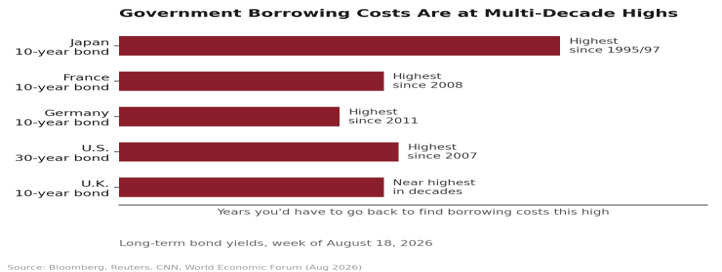
Something important is changing in global markets: investors are becoming more expensive lenders. During the week of August 18, 2026, long-term government bond yields moved sharply higher across the U.S., UK, France, Germany, Japan and parts of Asia. The U.S. 30-year Treasury yield climbed to 5.34%, its highest since 2007, while the 10-year yield reached 4.74%.
The message behind these numbers is simple: investors are increasingly asking governments to pay more to borrow for longer. This is not just about one disappointing bond auction or the next central-bank decision. Markets are reassessing what it costs to lend money for 10, 20 or 30 years in a world of heavier debt, persistent inflation risks and greater uncertainty.
Why has money become more expensive?
For long-term investors, today’s interest rate is only part of the equation. What matters more is what the next decade could look like. Will inflation remain elevated? How much more debt will governments issue? Will currencies retain their value? And what return is enough to compensate investors for locking away their money for decades? Right now, the answer appears to be more than before.
Oil is bringing inflation risk back into focus. Energy remains one of the fastest channels through which geopolitical risk reaches the global economy. With U.S.-Iran tensions surrounding the Strait of Hormuz keeping oil markets on edge, investors are pricing in the possibility that energy costs could remain elevated. Higher oil prices mean more expensive transportation and production, and ultimately greater pressure on consumer prices. If investors expect inflation to stay higher for longer, they naturally demand higher bond yields to protect their real returns. Oil therefore matters not only for inflation — it can indirectly raise the price of money itself.
Governments need more money — and investors know it!
At the same time, governments are borrowing heavily. The U.S. federal budget deficit reached around USD 1.8 tn during the first ten months of 2026, requiring substantial debt issuance. The mechanics are straightforward: when governments need to sell more bonds but investors become more selective, yields have to rise to attract buyers. And the U.S. is not alone. Across the world, governments are refinancing old debt at much higher interest rates while simultaneously funding large fiscal deficits. That creates a difficult cycle: more borrowing → more bond supply → higher yields → more expensive borrowing.
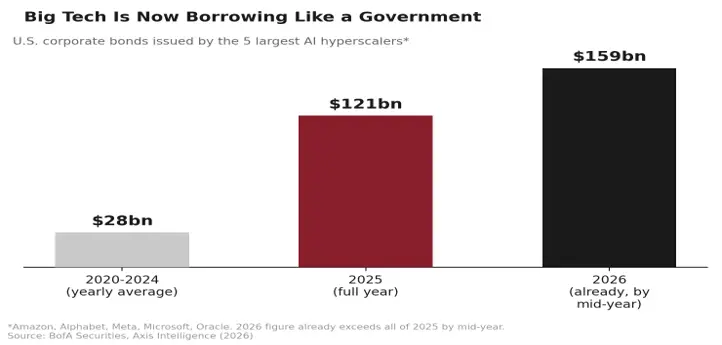
Big Tech is competing for the same money. Governments are also facing an unusual competitor for investors’ capital. The AI boom requires enormous spending on data centers, chips, power and infrastructure. U.S. investment-grade corporate bond issuance is expected to reach around USD 1.9 tn in 2026, up from USD 1.4 tn in 2025. AI-focused technology giants alone have issued around USD 220 bn of bonds in 2026, compared with USD 108 bn in 2025. Governments are therefore no longer competing only with other governments for capital. They are increasingly competing with some of the world’s largest companies. When everyone wants to borrow at once, capital becomes more valuable — and more expensive.
is no longer the same source of cheap money
For decades, near-zero Japanese interest rates encouraged investors to borrow cheaply in yen and invest abroad in higher-yielding assets, including U.S. Treasuries. But that equation is changing. As Japanese inflation and bond yields rise, domestic investments are becoming more attractive. Japanese investors therefore have less incentive to send capital overseas. One of the world’s most important sources of cheap global liquidity is becoming less cheap — and less global.
The buyers are changing too. Central banks and official institutions are playing a smaller supporting role in the U.S. Treasury market, leaving private investors increasingly important. And private investors constantly compare U.S. Treasuries with Japanese bonds, European debt, corporate bonds and other assets. If the return does not compensate them for the risk, they can simply move their money somewhere else. Governments therefore increasingly have to compete for capital rather than assume it will always be available cheaply.
Why should emerging markets care? For emerging economies, this global repricing can arrive through three doors: debt, currencies and energy. Higher global yields increase the cost of issuing and refinancing debt. At the same time, attractive developed-market yields can pull capital away from emerging markets, putting pressure on local currencies. A weaker currency then makes imported oil, food and other goods more expensive, adding another layer of inflation. Central banks can consequently face an uncomfortable choice: raise rates to support currencies and fight inflation or tolerate weaker growth. The most difficult scenario is when all three pressures arrive together: higher global yields + weaker currencies + higher energy prices.
The bigger message
The market is not necessarily questioning whether major governments can repay their debts. The bigger question is how much investors should be paid to carry that risk for decades. For years, abundant global liquidity made cheap capital almost feel guaranteed. That environment is changing. Governments are borrowing more. AI companies are absorbing enormous amounts of capital. Japan is keeping more money at home. Inflation risks remain alive. And private investors have more alternatives for where to put their money.
This points to a deeper shift: from a world where money was looking for borrowers to one where borrowers are increasingly competing for money. If that shift continues, higher yields will not remain a bond-market story. They will feed into corporate financing, mortgages, government budgets and currencies — and eventually into economic growth. The real signal from today’s bond market is not simply that yields are rising. It is that the era of reliably cheap long-term money may be fading — and the global economy is beginning to adjust to a higher price of capital.


