The market that expected too much oil is now worried about too little.
Before the Iran war, major Wall Street banks expected Brent to average around USD 59 per barrel in 2026, as supply growth outpaced demand. Today, crude is trading near USD 99, and Goldman Sachs sees a possible rise to USD 120 if attacks on Middle Eastern shipping intensify.
The shift is striking: a market once focused on excess supply is now pricing the risk that oil cannot reach its buyers. But USD 120 is a risk scenario, not a base-case forecast. Reaching it would likely require three pressures to reinforce one another: further military escalation, a deeper disruption of Hormuz flows, and attacks on the alternative routes keeping exports moving.
1. Hormuz: Closed on Paper, Still Flowing in Practice
The conflict is moving from an economic blockade toward a direct confrontation over shipping. Washington is tightening restrictions on Iranian oil, while Tehran is seeking to break the blockade and reassert control over Hormuz. Tanker attacks raise the risk that the economic squeeze becomes a wider military clash.
Yet the physical oil market tells a more nuanced story than vessel counts alone. Traders estimated that 7–8 million barrels per day were still crossing Hormuz in late August, while Vortexa’s seven-day average was close to 10 million barrels per day. That means the strait remains severely disrupted, but not completely shut to oil flows.
Why it matters: The next price shock depends less on whether Hormuz is described as closed and more on whether the remaining barrels can continue moving. A sustained interruption to those flows would remove a critical cushion from the market.
2. The Escape Routes: The Market’s Last Line of Defence
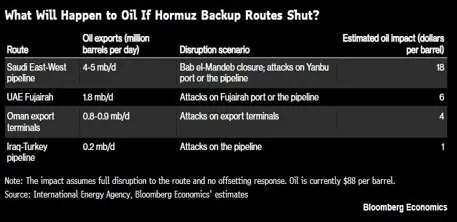
As Hormuz has become less reliable, oil producers have shifted exports through alternative routes: Saudi Arabia’s East–West pipeline, the UAE’s Fujairah facilities, Oman’s export terminals and the Iraq–Turkey pipeline.
These routes are now strategically important because they prevent a regional disruption from becoming a much larger global supply shock. But they are not risk-free. Houthi attacks have already affected Saudi exports, while Iran has threatened to widen restrictions beyond Hormuz.
Bloomberg Economics estimates that a full disruption of Saudi Arabia’s East–West route, with no offsetting response, could add around USD 18 per barrel. Comparable estimates are USD 6 for Fujairah, USD 4 for Oman’s terminals and USD 1 for the Iraq–Turkey pipeline. These are scenario estimates, not additive forecasts.
Why it matters: The oil market’s vulnerability has shifted from one chokepoint to a network of export corridors. If several routes are disrupted simultaneously, the ability to replace lost barrels becomes much more limited.
3. The $120 Question: Supply Shock Versus Demand Destruction
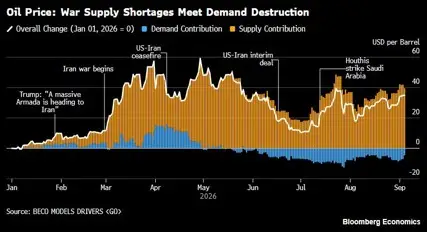
The war has already pushed prices higher through supply shortages and geopolitical risk. However, expensive oil also weakens the global economy: it raises inflation, keeps interest rates higher for longer and reduces consumption and industrial activity.
This creates a counterforce. The longer oil remains elevated, the more demand destruction begins to offset the supply shock. Bloomberg Economics’ decomposition of 2026 oil-price movements illustrates this tension, with supply disruptions pushing prices up while weaker demand increasingly pulls in the opposite direction.
The key question is therefore not simply how high oil can rise, but how long the global economy can absorb the shock. A move toward USD 120 would intensify inflation and growth pressures, while also increasing the probability of a subsequent demand-led correction.
Conclusion: The Risk Has Moved Beyond Hormuz
The market has undergone a fundamental repricing—from an expected surplus to a geopolitical supply premium. The next leg higher will depend on whether the conflict disrupts the remaining oil flows and the alternative routes that have helped contain the damage.
For MENA economies, the consequences will be uneven. Oil exporters may benefit from higher prices only to the extent that they can maintain export volumes, while importers face higher energy bills, inflation and financing pressures. The central risk is a prolonged supply shock that weakens global demand before the region can fully benefit from higher prices.
The bottom line: USD 120 oil is plausible under a deeper disruption scenario, but it is not inevitable. The balance between lost supply, alternative export capacity and demand destruction will determine whether the market faces another surge—or begins to correct.


