

The UAE plans to introduce a 9% tax on corporate profits from June 2023 as part of its plan to diversify the economy from oil and gas revenues. While the country's tax-free status has long attracted global business, the finance ministry said new tax regime will be "amongst the most competitive in the world.“ Among the key points of the new tax regime are:
- Zero tax rate for taxable profits up to 375,000 AED (102,000 USD)
- No corporate tax will apply on personal income from employment, real estate and other investments
- No corporate tax on free zones
- No capital gains and dividends tax
- Another exception are oil and gas companies, which are subject to their own tax schemes.
The UAE plans to introduce a 9% tax on corporate profits from June 2023 as part of its plan to diversify the economy from oil and gas revenues. While the country's tax-free status has long attracted global business, the finance ministry said new tax regime will be "amongst the most competitive in the world.“ Among the key points of the new tax regime are:

The measure comes as the UAE seeks to align itself with new international standards, particularly the move toward a global minimum tax on multinational corporations endorsed by the Group of 20 major economies last year. The ambitious plan aims to eventually set 15% as the base levy to stem international competition to offer more attractive rates.
UAE CT will have to be filed electronically once for each financial period without a requirement for advance UAE CT payments on the basis of provisional tax returns. UAE group companies can form a tax group and file a single tax return for the entire group, and transfer tax losses to other members of the group. The UAE CT regime will have transfer pricing rules and documentation requirements in line with the OECD Transfer Pricing Guidelines.
Quick Takeaways

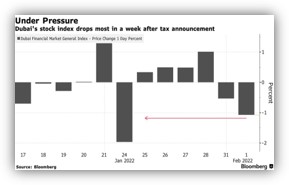
- Dubai’s benchmark stock index fell the most in the Middle East a day after the UAE unveiled plans to tax corporate earnings from next year. The Dubai Financial Market General index dropped as much as 1.3%, making it the worst performer among emerging markets, with Emirates NBD Bank PJSC and Emaar Properties PJSC leading losses. Abu Dhabi’s benchmark stock index also declined before turning positive.
- Corporate taxes on profit is expected to reduce the net profit for companies outside of the free zone properties creating a bearish sentiment in the market. Additionally, increasing geopolitical tensions between the UAE and Yemen are weighing heavily on the local bourses While the plan will broaden the government’s income base, Moody’s Investors Service warned the new levy would negatively affect the credit profiles of companies operating in the Middle East business hub.
- Dubai Islamic Bank PJSC, Abu Dhabi Commercial Bank PJSC and Abu Dhabi National Oil Company for Distribution PJSC were most likely to be affected by the new taxes.
Key Questions:
What does the new tax mean for businesses and the government in GCC's second biggest economy?
Support for government finances
The tax comes as part of a series of measures--including the introduction of a value added tax in 2018 by the UAE to reduce the dependence on hydrocarbon revenues and ease fiscal pressures. According to Moody’s the introduction of the corporate income tax is the most significant fiscal reform since 2018. The UAE is a magnet for the globe’s ultra-rich, in the UAE’s free zones, foreign companies can operate under light regulation and foreign investors take 100% ownership in companies. Most other Gulf nations levy corporate taxes on foreign companies, but only Oman taxes domestic ones too. The new tax will broaden the revenue base for the federal government and, most likely, also for the individual emirates, in line with the current approach to distributing VAT receipts representing a new source of revenue in additional to license fees, service fees and volatile land sales. UAE and other Gulf oil-producing countries are seeking ways to make their economies less reliant on oil.
Effect on small businesses
The fact there will be no tax on profits of up to 375,000 AED, is a move that will help and support small businesses and startups. According to Moody’s, tax is broadly credit negative for domestic UAE corporates because it will reduce their operating cash flows. However, the overall impact on the credit profile of large corporates will be muted because they have several offsetting levers, such as increasing product or service prices, optimizing their cost structure and reducing shareholder dividends.” We believe that the tax is not expected to directly affect start-ups and small companies as there is minimum threshold announced. This will give space for start-ups and companies making limited profits below this threshold to build their businesses and operations before they are captured by the terms of this new law.
On UAE’s ability to attract new businesses and talents
The challenge for the UAE now is to remain competitive, regionally and globally, despite the new corporate-tax regime. We believe that while the corporate tax regime may initially disrupt the business environment and investors may also consider looking at other prospects for a brief period, this will eventually settle down. The tax is designed to support the strategic ambitions of the government which will drive growth for businesses in the longer run. It is possible that this is part of a series of strategic announcements that helps UAE be positioned as an essential part of the global system but still a relative tax haven. With Golden Visas and nationalities being issued they have given all the right signals for attracting long term investment.


