Donald Trump’s return to the White House—this time with full Republican control of Congress—has triggered a swift and aggressive return to protectionist trade policies. Among the first major moves was a sweeping tariff package, applying a baseline 10% duty on virtually all U.S. imports, including from allies such as Egypt and the GCC. The move, widely perceived as indiscriminate, extends even to strategic partners that have historically maintained favorable trade balances with the U.S.
The tariff structure was even more severe for top trading partners: China now faces a 34% tariff, rising to 54% on select goods like iPhones; the EU faces a 20% rate; Japan 24%; and Vietnam a sharp 46%. Despite the broad sweep, it was particularly surprising for the GCC, given that the region:
1. Follows a Common External Tariff structure with most imports taxed at just 5%—far lower than what the U.S. is now imposing.
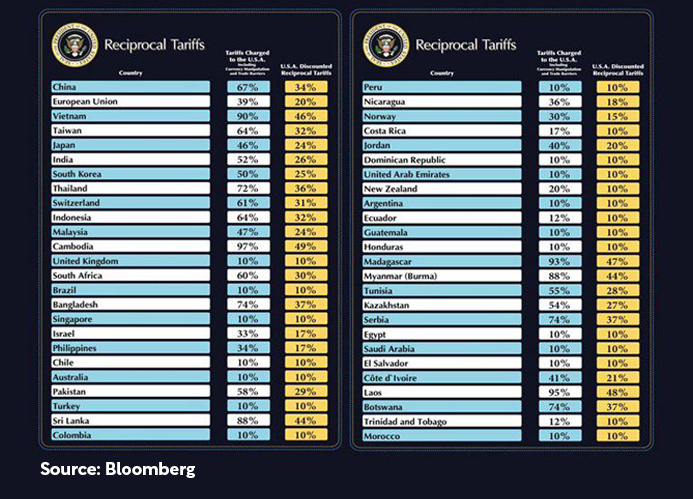
2. Has a trade surplus with the U.S., including an estimated $20 billion surplus with the UAE and $500 million with Saudi Arabia as of 2024, according to USTR.
The lack of clear justification for the tariffs on these economies, especially those aligned with the U.S. both politically and economically, points to a broader strategy: prioritizing uniform protectionism over reciprocal trade logic. The message is clear—under Trump 2.0, no trading partner is exempt.
Markets React Sharply to Structural Shock
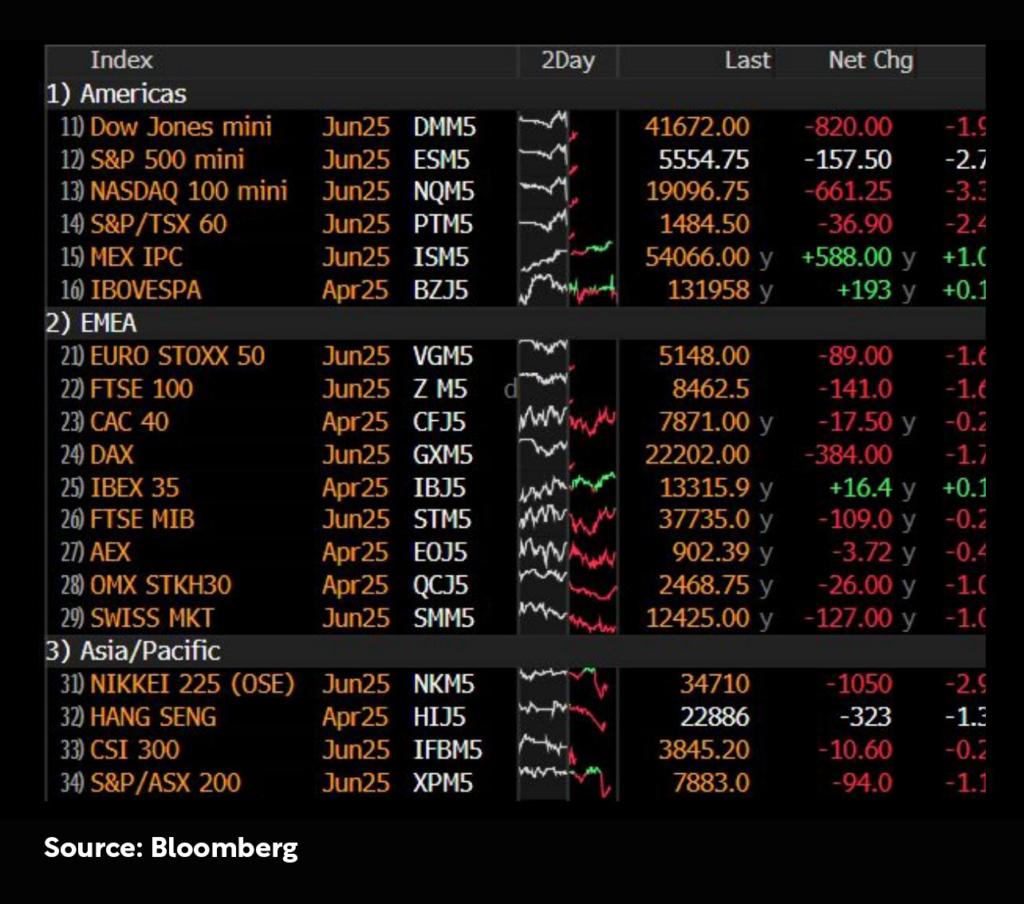
Financial markets responded forcefully. The Dow Jones fell 1,679 points (4%), the S&P 500 dropped 4.8%, and the Nasdaq plunged 6%. Tech and consumer-facing giants bore the brunt: Apple lost nearly 9%, Nike plunged 14%, and Amazon slid 9%, as investors priced in the impact of disrupted global supply chains and rising input costs. These declines reflect not just volatility but a repricing of global trade risk.
Emerging Markets Enter an Era of Uncertainty
For emerging markets, Trump’s protectionist comeback marks a structural pivot. Higher U.S. tariffs and inflationary pressures are likely to extend the Fed’s hawkish posture, limiting the policy space available to EM central banks. Egypt and Turkey, already contending with external imbalances, may now face additional stress in the form of rising debt costs, foreign outflows, and inflation tied to higher import prices.
The Egyptian pound could come under renewed depreciation pressure, and sectors such as import-heavy industries, banks, and logistics could see heightened volatility. Suez Canal revenues, a critical FX source, may also come under pressure if global trade volumes falter.
GCC Economies: Oil, Pegs, and Policy Dilemmas
For the Gulf, the newly imposed 10% tariff lands amid broader macroeconomic pressures. GCC currencies remain pegged to the USD, making them vulnerable to a weaker dollar and imported inflation. At the same time, oil prices have fallen 2–3% on global demand concerns, further straining fiscal balances, especially in Saudi Arabia, where Vision 2030 projects are already being executed under a “deficit by design” approach.
Lower oil revenues could push governments to recalibrate spending or return to external borrowing, tightening liquidity further. Additionally, as the GCC emerges as a strategic trade corridor between East and West, any slowdown in global trade flows will have amplified regional repercussions—from infrastructure to investment flows to logistics hubs.
The Bigger Picture: The Global Trade Order Is Being Rewritten
This is no longer about tactical tariffs or short-term trade disputes. Trump’s return marks a redefinition of the global trade architecture—where tariffs apply uniformly, allies are no longer spared, and trade becomes a tool for domestic leverage. For emerging markets, especially those in MENA, this calls for a deep re-evaluation of economic positioning.
Diversified funding, trade adaptability, and strategic reserve management will be crucial. The next phase of this trade war may not follow traditional battle lines; it may be driven by economic nationalism and unpredictability, forcing EMs to build resilience and redefine engagement strategies.
Bottom-line:
Trump’s trade policy isn’t just a flashpoint—it’s a fault line. Markets are no longer just pricing risk—they’re pricing in a new economic reality. For EMs, and particularly Egypt and the GCC, the choices made now—fiscally, diplomatically, and structurally—will shape their trajectory for years to come.


