
A Fundamental Transformation: 2017 vs. 2025
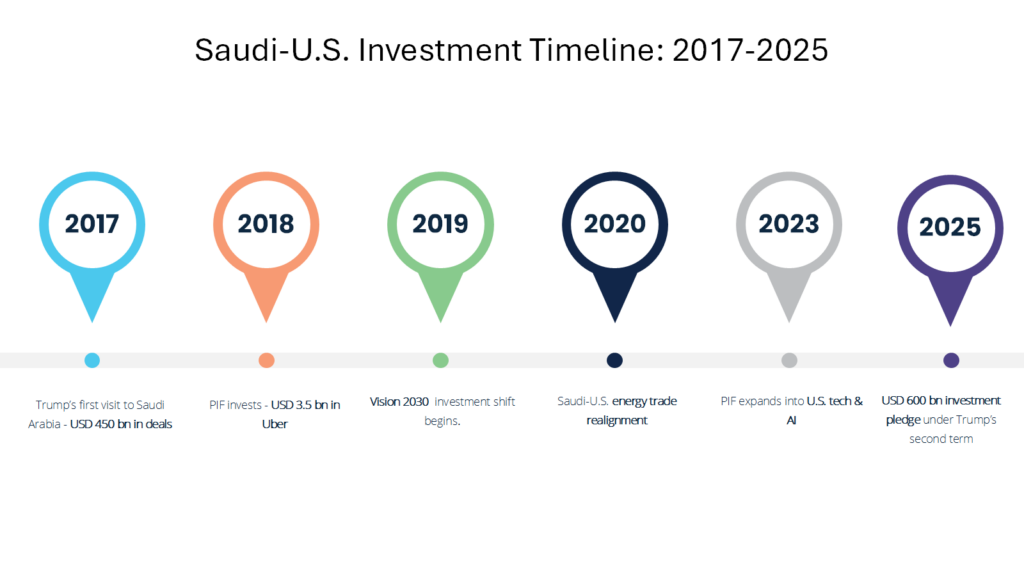
Over the past eight years, Saudi Arabia’s investment approach in the U.S. has evolved significantly, reflecting broader shifts in economic priorities under Vision 2030 and adapting to changing geopolitical dynamics. The Kingdom’s past focus on oil, real estate, and defense contracts during Trump’s first term (2017-2021) has now pivoted toward AI, advanced technology, and renewables in 2025, aligning with its ambitions for economic diversification and technological leadership.
With Trump returning to the White House in 2025, Saudi Arabia has reaffirmed its economic commitment to the U.S. by pledging USD 600 bn in investments over the next four years. However, this renewed engagement is fundamentally different from 2017—not just in scope but in strategic intent.
2017: The Oil & Defense-Centric Investment Playbook
During Trump’s first term, Saudi-U.S. economic ties were heavily defined by traditional sectors that had long underpinned their relationship. Trump’s administration provided a business-friendly environment for Gulf investments, securing major deals across:
• Energy & Petrochemicals – Saudi Aramco deepened its presence in U.S. refining and petrochemicals, reinforcing the oil-dependent economic partnership.
• Real Estate & Financial Markets – Saudi sovereign and private capital aggressively expanded into high-profile commercial properties across the U.S.
• Defense & Security – Trump’s first foreign visit to Riyadh sealed USD 450 bn in economic agreements, with a heavy focus on U.S. arms sales to Saudi Arabia.
In 2017, while Vision 2030 was in its early stages, its impact on Saudi investments was limited. The Public Investment Fund (PIF) began experimenting with technology investments—such as a USD 3.5 bn stake in Uber and participation in SoftBank’s Vision Fund—but these were more opportunistic than strategic.
Fast forward to 2025, and Saudi Arabia’s investment strategy is no longer oil-dependent or defense-heavy. Instead, Riyadh is positioning itself as a leading global investor in AI, digital transformation, and sustainable energy, reflecting its broader economic transformation goals.
The USD 600 bn commitment announced by Crown Prince Mohammed bin Salman is expected to target:
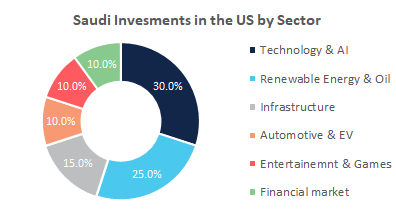
• Technology & AI – With rising U.S.-China tech tensions, Saudi capital is stepping in to fund AI research, semiconductor production, and cloud computing, strengthening its global tech footprint.
• Renewable Energy & Hydrogen – The Kingdom’s Green Initiative has driven substantial investments in solar, wind, and hydrogen technologies, particularly in U.S.-based clean energy startups and infrastructure.
• Infrastructure & Smart Cities – Saudi-backed funds are expanding into logistics, smart infrastructure, and urban innovation, mirroring the ambitions behind NEOM’s mega-project.
• Biotech & Healthcare – The post-pandemic reality has heightened Saudi interest in pharmaceutical R&D, medical technology, and life sciences, fostering deeper U.S.-Saudi collaboration in health innovation.
Unlike in 2017, the PIF is no longer a passive investor. Instead, it has transformed into a proactive global player, seeking direct acquisitions and strategic joint ventures with leading U.S. firms.
The Trump Factor: Policy Alignment vs. Market Realities
Trump’s return in 2025 provides a familiar political backdrop for Saudi investments, but the economic and geopolitical landscape has changed significantly.
• 2017: An Era of Energy Dominance – Trump’s first term focused on energy expansion, deregulation, and defense deals, creating an environment where Saudi investments naturally gravitated toward oil, arms, and real estate.
• 2025: A Global Power Shift – The world has moved toward AI, clean energy, and supply chain resilience, forcing a strategic recalibration. While Trump’s pro-business stance remains an advantage, Saudi Arabia’s investment decisions are now more driven by Vision 2030 imperatives than U.S. political cycles.
This means that while Trump may seek to revitalize oil and defense ties, Saudi capital is likely to flow where long-term economic returns and strategic influence are strongest—technology, renewables, and advanced infrastructure.
Moreover, with U.S.-China tensions escalating, Saudi Arabia is positioning itself as a key intermediary, leveraging its capital to secure strategic footholds in U.S. technology while maintaining its economic ties with Beijing.
The USD 600 bn pledge is not just about strengthening bilateral relations—it is a calculated effort to anchor Saudi influence in industries that will define the next economic era.
Looking Ahead: The Future of Saudi-U.S. Investments
Saudi Arabia’s investment playbook in the U.S. is no longer just about oil and defense contracts—it is about technology leadership, economic diversification, and long-term influence.
Looking beyond 2025, we expect:
• Deepened Saudi involvement in AI, semiconductors, and electric vehicles, leveraging U.S. innovation to accelerate Vision 2030 goals.
• A continued shift in energy cooperation, balancing Saudi oil exports with increased investments in U.S. hydrogen and renewable energy.
• A rise in direct acquisitions by PIF in key U.S. tech firms, reinforcing Saudi Arabia’s ambition to be a global investment powerhouse.While Trump’s 2017 era was shaped by oil, arms deals, and real estate, the 2025 era is defined by AI, digital infrastructure, and clean energy.
As Saudi Arabia moves toward a post-oil future, the U.S. remains its most strategic economic partner—and the next four years will be crucial in defining the next phase of their investment relationship.