More than 130 acquisitions since the mid-2000s — but the real footprint could be much bigger
Europe is focused on the rise of Chinese cars. But China has been making another, quieter move: buying into the companies that supply Europe's carmakers. Since the mid-2000s, Chinese companies have acquired more than 130 European auto-parts businesses, mainly in Germany and France and this may only be the visible part.
Why Is China Buying?
The strategy is simple: buy technology, get closer to customers and produce inside Europe. Instead of building everything from scratch, Chinese companies can acquire European suppliers that already have: advanced technology and engineering know-how; relationships with major European carmakers; factories and workers already inside Europe; easier access to the European market.
And China is not relying only on acquisitions. Companies are also using joint ventures, minority stakes and new factories across Europe and nearby markets such as Turkey, Serbia and Morocco.
Why Are Europeans Selling?
Because many European suppliers need the money. The sector employs around 1.7mn people, but high costs, weak demand and pressure from cheaper Chinese competitors have squeezed margins. Bosch, Valeo and Forvia alone have announced more than 100,000 job cuts over the past two years. That changes the equation. For struggling European suppliers, Chinese investment can look more like a lifeline than a threat. Germany's Leoni is a good example. When China's Luxshare agreed to buy it for EUR 525 mn, some European customers supported the deal because they wanted access to China's faster technology and development cycle.
Why 130 Deals May Understate the Story
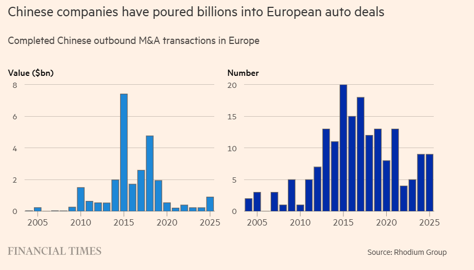
Not every Chinese investment carries a Chinese name. Many investments are held through European holding companies, offshore entities or local partners, while smaller transactions can stay below disclosure thresholds. Sayari found that roughly four out of five Chinese-controlled automotive assets it mapped in Germany were indirectly held. So, Europe may be looking at the number of acquisitions while missing the bigger picture: how much of its supply chain is already connected to Chinese capital.
Why Europe Has a Problem
Brussels wants to reduce its dependence on China. But there is a catch. If Europe makes Chinese imports harder while requiring more components to be produced locally, Chinese companies have an obvious response: Don't export to Europe. Produce in Europe. That could accelerate Chinese investment in European factories and suppliers rather than stop it. At the same time, Chinese ownership is becoming politically sensitive. Pirelli is already facing pressure because its Chinese shareholder Sinochem could complicate access to the US market under tighter restrictions on Chinese-linked automotive technology.
What Comes Next?
We expect three trends: more Chinese production inside Europe which makes tariffs and local-content rules make local manufacturing increasingly attractive; more scrutiny of who owns suppliers — Europe and the US will focus increasingly on ownership structures, not just where a component is produced; more European suppliers willing to sell — if the sector remains under financial pressure, Chinese capital will continue to find opportunities.


