Signed in One Day, Conditioned the Next… and the Gulf's Nuclear Rulebook Just Changed
What Happened?
On 22 July, the US and Saudi Arabia signed a Section 123 civil nuclear cooperation agreement in Washington, alongside a bilateral safeguards instrument. Energy Secretary Chris Wright signed for the US; Saudi Energy Minister Prince Abdulaziz bin Salman joined by video from Riyadh.
It closes nearly two decades of stalled talks and opens a decades-long, multi-billion-dollar build-out to American suppliers. It also hands Riyadh terms no US partner in the region has secured before.
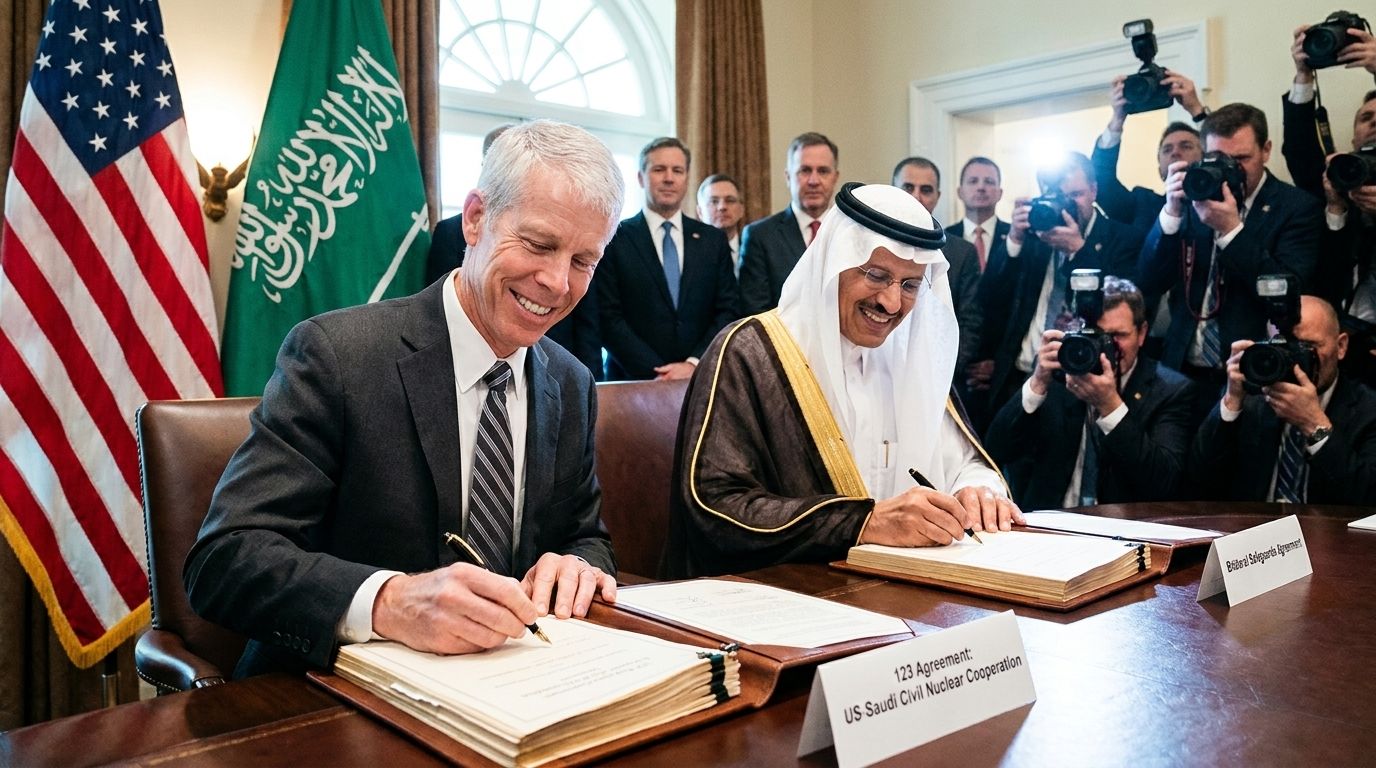
Why This Deal Is Different
Washington's benchmark has been the 2009 UAE agreement, the so-called “gold standard”: Abu Dhabi legally renounced uranium enrichment and reprocessing, and adopted the IAEA Additional Protocol. Saudi Arabia did neither.
- No Additional Protocol. Safeguards are bilateral and undisclosed, not IAEA short-notice inspections.
- No renunciation of enrichment. Instead, a two-year study of whether enriching on Saudi soil is commercially viable. If it isn't, Riyadh defers enrichment for 10 years.
A deferral is not a renunciation. That distinction is the entire argument.
Trump Adds a Condition Nobody Negotiated
One day after signing, President Trump said the agreement was “totally subject to” Saudi Arabia joining the Abraham Accords, and insisted there would be no enrichment. Neither point was in the negotiated text, and per CNN the condition surprised the US negotiators themselves. The White House confirmed that without accession, the deal is off.
Riyadh's position has not moved: normalization follows a credible path to Palestinian statehood. The condition is therefore attached to an agreement Saudi Arabia has already signed and is unlikely to meet on Washington's timeline.
Why Markets Should Pay Attention
The pipeline is real. The World Nuclear Association has long sized Saudi ambitions at roughly 16 reactors over 20–25 years, an $80bn+ programme. Westinghouse's AP1000 is the reference design, with Bechtel, BWXT and Centrus positioned across the supply chain.
But the read-across matters more than the awards. The 2009 UAE agreement lets Abu Dhabi reopen its terms if a regional peer secures better ones — and one just did. Egypt, Jordan and others will reprice Western supply now that the fuel-cycle condition is negotiable rather than mandatory.
What Comes Next
Congress has 90 days of continuous session to disapprove. Blocking the deal needs a two-thirds majority in both chambers to survive a veto — arithmetic that favours the administration. Our base case is for:
- Entry into force, with noise rather than obstruction from Congress.
- The normalization condition softened or quietly dropped rather than enforced.
- No contractable awards before the text and its proliferation assessment are published.
- Regional programmes repricing their fuel-cycle assumptions.
The signature is not the trade. Until Congress clears the text and the normalization question is settled, the Saudi programme is a very large pipeline with nothing contractable in it. Build the scenarios now and commit capital on the awards, not the announcement.


