
You might consider the Fed to be dovish, but recent data challenges that notion


You might consider the Fed to be dovish, but recent data challenges that notion.
The January payroll was exceptionally strong at 517k and significantly ahead of all economist forecasts with unemployment now at 3.4%.
The ISM Services Index was also the strongest since June 2020 and came in well ahead of the survey. Suddenly, the biggest event of next week is when Fed Chair Powell will be interviewed by David Rubinstein at the Economic Club of Washington. Powell had stated the disinflationary process had started. Other than suggesting that ongoing increases will be data dependent, he had said that inflation had eased somewhat but remains elevated. The Fed hiked policy rates by 25bp to 4.25-4.75% and while the December SEP is still 5.1%, market pricing has fallen to 4.9% implying that a final 25bp in March could see the Fed pausing in May.
The data releases on Friday immediately challenge that thesis. Irrespective of whether the Fed pause in May, June or July, Chair Powell barely pushed back on the idea of looser policy in 2H23 and repeatedly cited “disinflation”. He will undoubtedly be tested on these points in the weeks ahead as well the cohort of Fed speakers. Both the VIX and MOVE volatility indices had been in a tailspin lower and trended back down to March 2022 levels, which remains a theme of 2023 thus far. The ECB and BOE decisions on Thursday added further fuel to the rally, only to retreat on Friday. Both 10-year bunds and gilts rallied by significant margins, which was trigged by the BOE stating that the UK was turning the tide on inflation. It now looks increasingly likely that after the tenth consecutive interest rate hike, the BOE may end with a final 25bp hike rather than 50bp which was previously anticipated. The UK terminal rate has fallen from 4.5% to 4.3% after the policy increase to 4.0% over the past week.
It wasn’t just G10 interest rates that rallied as the S&P struck a five-month high and the FTSE 100 reached an all-time high. In fact, the Nasdaq entered bull-market territory after rallying 20% off the lows set in late December. The data from Friday suggests there could be further upside in the near-term, with total call option volumes reaching their highest levels ever on Thursday. Elsewhere, Chinese PMIs were softer than expectations, but the IMF World Economic Outlook overshadowed this. The IMF projects global growth of 2.9% in 2023, which was revised up from 2.7% and inflation is now expected to halve in 2024. The major upward revisions in growth were for China (4.4% to 5.2%), the Euro-area (0.5% to 0.7%), Mexico (1.2% to 1.7%), Russia (-2.3% to +0.3%) and the U.S. (1.0 to 1.4%). The other major news event was the price action in the 10 Adani Group entities after the Hindenburg claim that the offshore shell entities were used to inflate revenues and manipulate stock prices.
Turkey’s Opposition Alliance parties unveil a memorandum of joint policies but have not agreed on a Presidential candidate yet
 Turkey’s Opposition Alliance parties unveil a memorandum of joint policies but have not agreed on a Presidential candidate yet" />
 The “Nation Alliance”, Turkey’s main opposition block comprised of six political parties, published a joint document outlining the main policies the Alliance intends to pursue in the event they ascend to power in Presidential Elections scheduled for mid-May.
The Joint Policy Memorandum, an extensive 250-page document listing various policy priorities for the opposition, is an important step in the direction of forming a viable political coalition ahead of the May 14 Presidential and Parliamentary elections. The economic policy priorities outlined in the document would be a dramatic departure from Turkey’s current distorted macroeconomic policy mix and a return to an orthodox economic framework. Such a post-election policy environment would be seen as strongly welcomed by markets. However, the critical question remains pending: would the opposition be able to produce a competitive joint candidate who can defeat President Erdogan in May and start translating market-friendly intentions into real world policy actions.
There have been promising signals that the Nation Alliance’s leaders might be able to reach a deal on a united candidate by mid or late February, however, significant disagreements appear to remain lingering. Any delay beyond February or a failure to reach a compromise on a suitable name to face Erdogan would likely enhance the incumbent’s re-election chances amid a relatively stable macro environment in recent months and a barrage of pre-election populist measures by the Administration.

Lebanon’s FX devaluation not a game-changer for parallel economic and political crises
" />
Lebanon’s FX devaluation not a game-changer for parallel economic and political crises
Lebanon’s authorities announced a new official exchange rate of 15,000 Lebanese pounds (LBP) against the U.S. dollar in a large devaluation from the previous rate of 1,500 LBP that was in place since the 1990s.
Although devaluing the currency has been one of IMF’s main recommendations for Lebanon, this step is highly unlikely to nudge the country closer to resolving economic and political turmoil in the absence of a complete political system reboot. The new official rate will be used for withdrawals from USD-denominated bank deposits in the bankrupt local bank system that are capped at around $1,600 equivalent per month, while the current black-market rate is around LBP 50,000 for US$1.
From that perspective, the devaluation would have no meaningful impact on the overall macroeconomic environment. Easing Lebanon’s economic turmoil hinges on profound reforms to the country’s highly complex and dysfunctional political system but ability and/or willingness to implement change has proved limited despite a series of major economic and social shocks in recent years.
Bank of England Signals Worst Years for Growth Since Great Depression
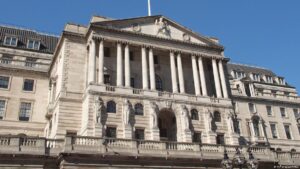 Bank of England Signals Worst Years for Growth Since Great Depression" />
 Growth set to average just 1% a year between 2006 and 2025. Dismal outlook piles pressure on Prime Minister Rishi Sunak.
The assessment delivered by the Bank of England this week made for dismal reading. The UK is now in recession, and a shrinking labor force means the economy has little scope to make up ground once the slump is over. As the Resolution Foundation think tank pointed out, Britain is in the midst of the worst 20 years for growth since the Great Depression, assuming the BOE forecasts are correct. The central bank now thinks UK output can grow no more than 0.7% a year without adding to the inflation pressures bedevelling the economy — a quarter of the pace in the decade prior to the 2008 financial crisis. Productivity growth has been anemic since the crash, and the BOE sees little improvement in the medium-term.
But the main development weighing on potential supply is the loss of hundreds of thousands of people from the labor force since the coronavirus pandemic, particularly older workers. Many cite long-term sickness for dropping out, and, according to the BOE, they are probably not coming back. By historical standards, the recession forecast by the BOE is shallow. From peak to trough, output falls by less than 1% over five quarters in the BOE’s outlook. The recessions of 1980 and 2008 lasted no longer, but each cost the economy around 5% of GDP on average. Rather than a rebound in 2024, however, the BOE predicts stagnation with the economy still smaller in early 2026 than it was before the Covid-19 pandemic and an extra 500,000 people unemployed.
That’s bad news for Prime Minister Rishi Sunak, whose Conservative Party is far behind the Labour opposition in opinion polls. Fixing the structural issues hampering the economy will take time, not the two years the government has before it must hold a general election. The BOE is even more pessimistic than the International Monetary Fund, which earlier in the week warned that Britain faces the bleakest two years of any major industrial nation — including Russia under widespread sanctions.
The BOE has always thought that Britain would pay an economic price for leaving the European Union. It still does, and fears that the damage is happening much sooner than feared. Business investment is expected to keep falling, and new analysis by BOE staff suggests trade with the EU has been weaker than official figures suggest. Since trade barriers were imposed in January 2021, official data shows a 7% fall in trade. But the BOE reckons the decline is closer to 14% once adjustments are made for data issues, such as delayed customs declarations.
 China sharply rebukes US over decision to shoot down spy balloon" />
China sharply rebukes US over decision to shoot down spy balloon
Beijing says Biden administration violated international conventions when it downed craft.
Beijing has lashed out at the US decision to shoot down a Chinese balloon that flew across North America this week, accusing the Biden administration of “seriously violating international conventions”. The Chinese foreign ministry said it “repeatedly” told the US the balloon was for “civilian use” and had entered American airspace by accident due to bad weather — a claim the US has dismissed. China’s ministry of defence on Sunday said the US executed an “excessive attack” on a “civilian” balloon. “We solemnly protest against the US move and reserve the right to use the necessary means to deal with similar situations,” it added.
The salvo came hours after an American F-22 fighter jet shot down what the US insists was a spy balloon. The US is now recovering the debris to glean more information about the surveillance equipment carried on the craft. The fighter fired an air-to-air missile at the balloon at 2.39pm local time on Saturday when it was six nautical miles off the coast in US airspace and over its territorial waters. US defence secretary Lloyd Austin said President Joe Biden had on Wednesday authorised that the balloon be shot down “as soon as the mission could be accomplished without undue risk to American lives”.
The Pentagon said the US military had started trying to recover the debris, which is spread across seven miles of sea. A senior defence official said the US had determined that the balloon had a “broad array” of intelligence capabilities but would learn more after analysing the debris. The Pentagon on Wednesday revealed the presence of the balloon as it was flying over a sensitive military installation in Montana where the US bases some of its nuclear intercontinental ballistic missiles. A senior defence official said the craft entered US airspace on January 28 near the Aleutian Islands in Alaska. It flew into Canadian airspace two days later and re-entered US airspace over Idaho on January 31.
The defence official said the craft shot down was part of a fleet of Chinese spy balloons operating over five continents. the Pentagon earlier said a second Chinese spy balloon had been detected over Latin America but did not elaborate. US secretary of state Antony Blinken on Friday cancelled a visit to China because of the discovery of the balloon. He had been expected to meet President Xi Jinping. He would have been the first Biden administration cabinet secretary to visit China.
Stay up to date
More Newsletter to Check



SUBSCRIBE TO NEWSLETTER
Subscribe to download our daily economics and business roundup


×
![]()