
Vladimir Putin vows to send more invaders, The West should arm Ukraine faster

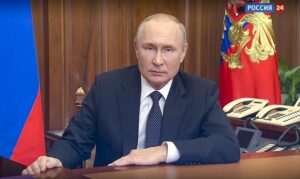
Vladimir Putin vows to send more invaders. The West should arm Ukraine faster
Russia’s President, Vladimir Putin, announced in a televised address to the nation that as many as 300,000 reservists are being called to military service in a partial mobilization. Meanwhile, preparations for so called “annexation referendums” in four Ukrainian regions occupied by Russian troops have been accelerated and the Kremlin has vowed to support the “decisions taken” by the votes scheduled to take place between September 23 and 27.
After months of labeling the invasion of Ukraine a “special military operation” and criminalizing the use of the term “war” to describe it, Russia’s partial mobilization, the first to take place in the country since World War II, seems to be a clear confirmation that the situation in Ukraine has quickly deteriorated from the Kremlin’s perspective. The mobilization is unlikely to be a game-changer on the battlefield as it is almost certain to present a major logistical challenge for Russia’s stretched military and will take months to yield tangible results, if any.
In the meantime, Ukraine’s military appears to be enjoying an increasingly stronger momentum and is determined to continue to press its advantage further. This is a concerning combination, especially in the context of the upcoming referendums in the four Russia-occupied regions of Ukraine: the so-called Donetsk and Luhansk People’s Republics, Kherson and Zaporizhzhia. There is little doubt that all four referendums will approve Russia annexing the regions. Most of the international community will not recognize the results, but President Putin has already committed to “support the decisions taken”.
As such, we believe the conflict is entering yet another more dangerous stage as Ukrainian forces are likely to continue their efforts to liberate areas that Russia would now consider its “sovereign territory” and has threatened to use “all the means at our disposal” to defend them. In this context, we see significant risks of escalation in diplomatic rhetoric between Russia and the West and increasing geopolitical risks for global markets in the coming weeks just as they are grappling with the effects of rising U.S. rates.
Lebanon’s banks to close ‘indefinitely’ after heists by angry depositors
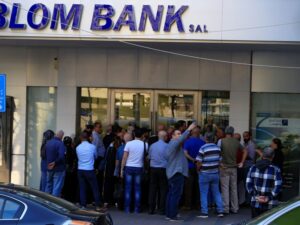
Lenders shut doors after spree of armed robberies staged by customers desperate to get their cash out.
Lebanon’s banks will remain closed “indefinitely” following a spate of armed robberies by angry depositors desperate to gain access to their savings. The stressed country’s banking association said on Thursday that banks would stay shut “in the absence of assurances” about security from the state. The grouping, which represent most banks, cited “the continued risks to bank employees and customers inside branches, and in light of the ongoing atmosphere of incitement”.
Banks shut their doors to customers after a spree of heists at seven bank branches last week as the nation’s three-year financial crisis deepens and the situation for many Lebanese becomes increasingly dire. The banking sector has frozen deposits for more than two years and put limits on how much money people can withdraw, at a time when three-quarters of the population has been plunged into poverty. Many Lebanese blame the financial sector and the central bank for the crisis, and in August a man drew widespread attention and public support after he held up a Federal Bank branch and walked out with 35,000 USD of his own money. He was not charged with a crime.
In what appeared to be copycat incidents, other disgruntled customers stormed branches last week in seven separate incidents, wielding handguns, replica and pellet guns, demanding that teller’s hand over their deposits. Some were successful, and handed over bags of cash to family before being taken into custody or going into hiding. Others were arrested. Five of the robberies were on Friday, after which banks announced they would close for three days as they called on the government to beef up security at branches. They were due to open on Thursday.
Authorities, bank owners and employees have condemned the hold-ups. But activists and depositors argued that banks and shareholders have profited from the crisis, and are prioritising the banks over their clients, who have lost their savings.
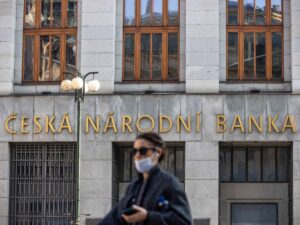
Global monetary tightening dominates. The combination of the Fed’s 75bp hike, with G10 tightening weighed on markets across the UK, Norway, and Switzerland
It didn’t stop there as EM central banks out of South Africa, Taiwan, Indonesia and the Philippines also lifted policy rates. In fact, there were sixteen central bank policy updates within 24 hours of the Federal Reserve decision. However, Brazil had taken the first step in ending its hiking cycle as it kept rates unchanged at 13.75% followed by Egypt who kept as well its rates fixed for the second time, but less can be said for Turkey’s 100bp cut.
The DM theme of a Powell pivot at the July FOMC is firmly in the rear-view mirror after Jackson Hole and the latest, more hawkish FOMC. The bleaker U.S. outlook in 2022 carries forward into 2023, but the focus on inflation-over-growth has seen rates rise for the wrong reasons. Indeed, the strength in DXY hit a 20-year high with U.S. Treasuries widening 14-35bp. More pressure came from Europe as German bunds and UK gilts widened 11-37bp and 50-93bp, respectively. The major headlines were that the U.S. 2-year Treasury broke through 4% and the 10-year note rose above 3.50%, as the entire curve inverted across every tenor variant.
The BoE may have only hiked 50bp but the focus was on the mini-Budget and unnecessary tax cuts causing GBP to plummet to lows not seen since 1985 and the 5-year gilt widened by its largest factor in a single day ever (57bp intraday widening). Meanwhile, the Bank of Japan remained dovish and YCC is set to remain, although FX intervention for the first time since 1998 saw a brief respite in JPY. Weekend developments will focus on elections. Italy is increasingly closer to electing a far-right leader (Georgia Meloni) from the Brothers of Italy party, while Russian-enforced local referenda will take place in the Ukrainian provinces of Luhansk, Donetsk, Kherson and Zaporizhzhia and run until Tuesday.
Argentina reaches a staff-level agreement (SLA) with the IMF on the second program review
The IMF announced that its staff and the Argentine authorities have reached an SLA on an updated macroeconomic framework and associated policies necessary to complete the second review under Argentina’s 30-month EFF arrangement. Upon completion of a review and approval by the IMF Executive Board, Argentina would have access to about 4.0 billion USD.
The agreement was largely expected by markets as it was well telegraphed by the IMF’s Managing Director, Kristalina Georgieva after meeting with Argentina’s Economy Minister, Sergio Massa last week. Nevertheless, it is a clear confirmation that the program is on track and the two sides remain interested in cooperating.
In a statement accompanying the agreement, the IMF commended the authorities for decisive policy actions aimed at correcting earlier setbacks that are helping to restore confidence and strengthen macroeconomic stability, including by rebuilding international reserves. At this stage, the IMF’s Executive Board approval in the coming weeks appears to be only a formality. Overall, the relationship between the Fund and Argentina’s authorities appears to have benefited significantly under Massa pragmatism and ability to execute policy has helped ease market concerns triggered by Guzman’s departure and Batakis’ very brief stint as Economy Minister.
Looking ahead, economic policy management is likely to become more challenging as we get closer to the October 2023 elections. However, we remain of the view that as long as Massa is successful in engineering a muddle through between now and the elections, it should help to re-anchor the floor and set the stage for gradual credit-positive moderation in policy approach over the medium-term.
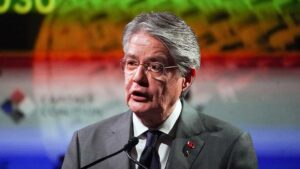
Ecuador secures better repayment terms on existing loans from China and targets a new IMF program in 2023
Ecuador’s government announced that an agreement has been reached with two Chinese state-owned banks on more favorable repayment terms for 3.2 billion USD of existing debt. Meanwhile, the Minister of Finance, Pablo Arosemena signaled that the authorities are looking to secure a new IMF program when the current one expires in December.
The agreement was largely expected by markets as it was well telegraphed by the IMF’s Managing Director, Kristalina Georgieva after meeting with Argentina’s Economy Minister, Sergio Massa last week. Nevertheless, it is a clear confirmation that the program is on track and the two sides remain interested in cooperating. In a statement accompanying the agreement, the IMF commended the authorities for decisive policy actions aimed at correcting earlier setbacks that are helping to restore confidence and strengthen macroeconomic stability, including by rebuilding international reserves.
At this stage, the IMF’s Executive Board approval in the coming weeks appears to be only a formality. Overall, the relationship between the Fund and Argentina’s authorities appears to have benefited significantly under Massa pragmatism and ability to execute policy has helped ease market concerns triggered by Guzman’s departure and Batakis’ very brief stint as Economy Minister. Looking ahead, economic policy management is likely to become more challenging as we get closer to the October 2023 elections. However, we remain of the view that as long as Massa is successful in engineering a muddle through between now and the elections, it should help to re-anchor the floor and set the stage for gradual credit-positive moderation in policy approach over the medium-term.
Stay up to date
More Newsletter to Check



SUBSCRIBE TO NEWSLETTER
Subscribe to download our daily economics and business roundup


×
![]()