
There is more inflation complexity ahead


There is more inflation complexity ahead
As US inflation gradually eases, the claim that today’s inflationary pressures are the result of a temporary supply shock has re-emerged. While this thesis may be comforting, it could also encourage dangerous complacency, making an already serious problem much harder to solve.
“Transitory” is a comforting notion suggesting a short-lived, reversible phenomenon. Critically, the concept assumes away the need to adjust behaviors. After all, if an inflation scare is only temporary, the best way to deal with it is simply to wait it out (or, to use a policy and market term, “look through it”). That is why this narrative is particularly dangerous. By encouraging complacency and inertia, it could exacerbate an already serious problem and make it harder to solve.
The US Federal Reserve’s initial response to rising inflation is a case in point. In 2021, the world’s most powerful and influential central bank rushed to characterize higher inflation as transitory. It doubled down on this approach even after the data went against it, refusing to pivot for too long. The Fed’s repeated mischaracterization delayed crucial policy responses at a time when the persistence of inflation was starting to influence corporate price-setting and workers’ wage demands. As a result, the Fed not only lost credibility but also inflicted unnecessary pain on millions of American households, particularly the most vulnerable segments of the population.
While a few economists have never given up on the transitory inflation thesis, the vast majority already realized last year that it was a regrettable analytical and policy error. That makes the current re-emergence of this narrative even more perplexing. While US inflation has been slowing, it is dangerous to suggest that the problem is behind us. Looking ahead to the rest of the year and early 2024, three possibilities stand out for us. The first is orderly disinflation, also known by critics as “immaculate disinflation.” In this scenario, inflation continues to come down steadily toward the Fed’s 2% target without damaging US economic growth and jobs. The dynamics involve primarily a labor market that avoids excessive wage increases while continuing to anchor strong economic activity. Given what else is going on in the economy, I would put the probability of this scenario at 25%.
The second scenario is one in which inflation becomes sticky. The inflation rate continues to decrease but then gets stuck at 3-4% over the second half of this year as goods prices stop declining and services inflation persists. This would force the Fed to choose between crushing the economy to get inflation down to its 2% target, adjusting the target rate to make it more consistent with changing supply conditions, or waiting to see whether the US can live with stable 3-4% inflation. I do not know what the Fed would choose in such a case, but I would put the probability of such sticky inflation at 50%, so I hope it has given this scenario some thought.
Lastly, there is the possibility of what we can label “U inflation”: prices head back up late this year and into 2024, as a fully-recovered Chinese economy and the strong US labor market simultaneously drive persistent services inflation and higher goods prices. I would put the probability of this outcome at 25%. This is not just about multiple scenarios with no single one dominating. It is also about probabilities that must be viewed with caution. The sense of uncertainty is evident in the short-term outlook for economic activity, prices, and monetary policy, as well as long-term structural shifts like the clean-energy transition, the rewiring of global supply chains, and the changing nature of globalization. Heightened geopolitical tensions also play a role. Finally, the base case here, is that it will take some time. And we will have to do more rate increases…
Hard landing to soft landing to no landing

Hawkish Fedspeak from Mester and Bullard was unsurprising, but stronger economic data with CPI had set the scene. The improved market tone was reaffirmed by an upbeat PPI release that was the highest since March 2022.
After a blowout NFP, several other indicators pointed to an improved growth picture and the Fed’s Atlanta GDP now rose to 2.5% for 1Q. Expectations of Core PCE inflation have now risen to 0.55%, which has created further upside pressure on core rates in the near-term. As the Fed’s Williams had put it, there is sand in the gears of goods deflation. The December SEP on Fed Funds is currently at 5.1% and is set to be pushed up to 5.3%, which is where GS and BoA revised expectations to last week. The U.S. terminal rate has risen 44bps in February to 5.30% as U.S. Treasuries widened 60bps from the intra-month low of 3.32%. Unsurprisingly, the ETF tracking +20-year U.S. Treasuries (TLT) is down 4.4% over the past month. The Fed is also losing a dovish member, as Vice Chair Brainard is set to be appointed as Biden’s top economic advisor.
Elsewhere, the Japanese government appointed Kazuo Ueda as BoJ Governor. Larry Summers’ had branded the incoming Governor as Japan’s Ben Bernanke. Yet, Ueda previously stated in 2022 that the long-term yield curve control isn’t suited for “policy tweaks” as once raised, there is simply speculation for another hike. A theme developing within EM is where governments are adopting IMF policies in the hope of securing board approval for a program. Zambia and Suriname have waited 30 and 27 months, respectively, and are still waiting. Sri Lanka and Pakistan are working more expeditiously, with the former hiking electricity prices by 65% and the latter raising VAT to 18% and approving a mini-budget. However, it seems like the momentum is mostly behind Tunisia after positive and supportive comments from Kristalina Georgieva.
Meanwhile, Ghana’s domestic debt exchange secured an 80% approval, even if the Finance Ministry had reduced the eligible securities to manufacture a larger approval ratio. Turkey’s stock market also reopened on Wednesday after a five-day suspension given the earthquake. The Borsa Istanbul jumped 10% on Wednesday with the ETF ending the week up 16%. The Turkish government remain engaged with numerous supportive measures from favorable tax on share buybacks, to fiscal stimulus and tightening the funding of FX forward contracts, meaning the Turkish lira was largely unchanged over the week. In a surprising move, AKP-supporting journalists suggested that the election is still likely to occur on May 14, which was supported by an AKP spokesperson on Friday.
In Latin America, social unrest in Peru caused weakness across the mining companies, political reform troubled Colombian corporates and Brazilian distressed credit has become a larger focal point. However, Mexico’s outperformance was visible as the best performing country in EM equities as EWW ended the week up 3.7%, although sovereign spreads had widened around 23bps (-3.3% in total return).
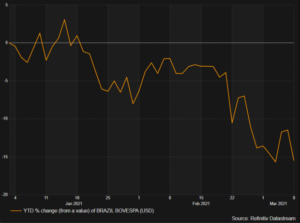
Evolution of Lula vs Campos Neto relationship set to drive market sentiment in Brazil
This week in Brazil was heavy on news flow around the evolving relationship between the new Lula Administration and the Central Bank (BCB) under the leadership of its President, Roberto Campos Neto.
Campos Neto gave a high-profile TV interview in which he appeared to try to decrease the temperature between the BCB and President Lula who since taking office in January has been piling pressure on the BCB to cut interest rates as soon as possible. Additionally, a much-anticipated meeting of Brazil’s National Monetary Council (the first under President Lula’s third term in office) that includes Campos Neto, Finance Minister, Fernando Haddad, and Planning Minister, Simone Tebet, resulted in no change to BCB’s inflation target for 2024.
In a TV interview that attracted high market attention, BCB Governor Roberto Campos Neto appeared to be trying to build some bridges to Lula and the administration. Since his return to the presidency for a third time, Lula has been piling pressure on the Central Bank to cut rates as soon as possible. However, markets have been concerned that Lula’s ambitious fiscal spending plans could delay or even derail the prospects for monetary easing by BCB due to un-anchoring of medium-term inflation expectations. Campos Neto’s message to Lula was straightforward: if the administration presents a credible fiscal framework (i.e., a new fiscal rule to replace the constitutional spending cap that Lula wants to abolish) to re-anchor inflation expectations, the BCB will likely be in a position to start cutting rates soon in a constructive environment, given decelerating current inflation and the highest real interest rates across EM.
This would be a win-win situation and represents the upside risk for local assets that should rally materially in that scenario, in our view. A negative scenario could materialize if Lula were to escalate fiscal populism to such a level that would make it impossible for the BCB to cut rates in 2023 and may even bring tightening of monetary policy back on the table. Also, if Campos Neto were to leave or get fired by Congress under Lula’s pressure, that would likely trigger a material risk-off across Brazilian markets. However, both scenarios carry a low probability at this stage, in our assessment.
President Lasso’s unexpected referendum defeat re-ignites market concerns about political risks in Ecuador
On Sunday, February 5, Ecuadorians voted in local elections and a parallel national referendum called by President Lasso’s Administration with eight questions on various political/social topics.
All eight questions were rejected by voters and the left-wing party associated with former President Rafael Correa emerged as the big winner in local elections, capturing the mayorships of Quito, the capital, and the main commercial center Guayaquil.
Gramercy commentary: Market expectations pointed to President Lasso prevailing on at least some of the referendum questions, which was seen as a potential avenue toward easing Lasso’s domestic political challenges related to a lack of governability and an extremely difficult relationship with a left-leaning national assembly. Now that the referendum has backfired, investors have grown concerned again about the prospect of a return to power by the populist party of former President Rafael Correa and even the risk of Correa’s potential return to the Ecuador from his exile in Belgium since 2017. We see such concerns as pre-mature at this stage.
Although, there are a couple of theoretical scenarios in which Lasso is forced to quit the Presidency that would trigger credit negative early elections in the current context, our base case is that the Administration will be able to finish its term and remain in office until 2025. This should catalyze a gradual reassessment by markets of medium-term political and credit risks in Ecuador, in our view. Our outlook may change if we were to see increasing social pressures on Lasso to step down, especially renewed violent street protests like the ones that erupted in the summer of last year, paralyzing economic and political life in the country.

Man United Bidding Heats Up as Ratcliffe, Elliott Enter Fray
Qatari offer could value Manchester United at about 6 billion USD. Paul Singer’s Elliott to offer financing, not bid for club.
A member of the Qatari royal family and Britain’s richest man submitted offers to acquire Manchester United Plc, while Elliott Investment Management LP is prepared to provide financing, as the bidding process for the English football giant heats up. Billionaire Paul Singer’s Elliott Management offered a proposal to help finance offers for the club, according to a person familiar with the matter. Elliott is not bidding for the club itself, the person said.
Elliott’s interest was confirmed after Jassim bin Hamad bin Jaber Al Thani, the chairman of Qatar Islamic Bank and son of the country’s former prime minister, declared his bid to acquire the English Premier League club in an emailed statement Friday. The Qataris’ opening offer could value Manchester United, currently owned by the US Glazer family, at about 5 billion EUR (6 billion USD). On Saturday, British billionaire Jim Ratcliffe, a Manchester United fan who’s already lined up financing from banks including Goldman Sachs Group Inc., and his company Ineos Group also said they had submitted a bid for majority ownership of the club. “We would see our role as the long-term custodians of Manchester United on behalf of the fans and the wider community,” according to the statement. Promising to put “the Manchester back into Manchester United,” Ratcliffe and Ineos said they would focus on winning the Champions League.
Initial bids for the club were due Friday. The debt-free offer from the Qatari group includes investment in the team, training center and stadium, and will be made via Sheikh Jassim’s Nine Two Foundation. The amount of the offer wasn’t disclosed in the statement. The Qatari group includes Sheikh Jassim’s father, Hamad bin Jassim bin Jaber Al Thani, who was head of the Qatar Investment Authority as well as prime minister, Bloomberg has reported. Sheikh Jassim, who was previously a Credit Suisse Group AG board member, was educated in the UK at the Royal Military Academy Sandhurst and is a lifelong Manchester United fan, according to the statement.
A deal for Manchester United could represent the biggest takeover of a professional sports club on record, potentially surpassing the $4.65 billion paid last year by a group led by Walmart Inc. heir Rob Walton for the Denver Broncos NFL team. New York bank Raine Group is advising the Glazers on the sale of the club, whose New York-listed shares have doubled since November as buyout speculation has grown, giving the company a market value of about 4.3 billion USD. UK and European teams are increasingly attracting interest from investors abroad. That includes the 2.5 billion EUR acquisition of Chelsea Football Club by a US group led by Clearlake Capital and Todd Boehly. AC Milan, Atletico Madrid, Crystal Palace and Genoa CFC are all among the clubs with private equity owners, including from the US.
Stay up to date
More Newsletter to Check



SUBSCRIBE TO NEWSLETTER
Subscribe to download our daily economics and business roundup


×
![]()