
The minutes from the March FOMC meeting published this week sent out hawkish signals to markets

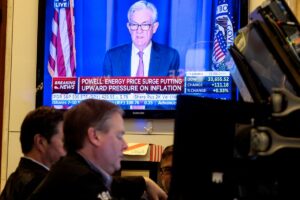
The minutes from the March FOMC meeting published this week sent out hawkish signals to markets
The minutes showed that several policymakers saw a 50bp hike as appropriate to kick off the Fed’s tightening cycle last month but resisted the temptation given added uncertainty emanating from the global geopolitical environment/the war in Ukraine. However, FOMC members indicated that one or more 50 basis point hikes in the target range could be appropriate at upcoming meetings.
The minutes also revealed details around the Fed’s plans for balance sheet normalization, signaling 95 billion USD/month cap for asset runoff, split between 35 billion USD MBS and 60 billon USD Treasuries. This would be double the pace of the 2017 to 2019 cycle and the start of Fed Balance Sheet reduction is set to be approved on May 3-4. As the Fed appeared to be comfortable with moving to a neutral posture ‘expeditiously’ and signaling that even tighter policy may be warranted, the USD received a boost and the U.S. Treasury Yield Curve (UST) curve continued to steepen.
Away from U.S. monetary policy, the spotlight on the Ukraine war this week shifted on alleged war crimes against civilians uncovered by Ukrainian forces in areas recently liberated from Russian occupation. Global anger at the murders mounted as graphic images and videos surfaced throughout the week, strengthening momentum behind proposed anti-Russia measures internationally. The U.S. imposed sanctions on Russia’s largest banks (Sberbank, Alfa) and Putin’s two adult daughters and eliminated a previous exception allowing the use of existing funds in U.S. financial institutions to service debt, potentially pushing Russia closer to technical default.
Additionally, the EU was close to reaching a consensus on banning Russian coal exports to Europe and member-states appeared to seriously consider eventually restricting oil and gas exports, which would be an extremely difficult political decision given many members’ heavy energy-dependence on Russia. On Thursday, the UN General Assembly voted to suspend Russia from the UN Human Rights Council. Meanwhile, China March PMI data moved into contractionary territory largely on tightening of virus-related restrictions which at their recent peak encompassed about one third of GDP. The NBS and Caixin Markit Composite PMIs were 48.8 pts and 43.9 pts, respectively, with the latter’s softness driven by a collapse in services.
Russian forces appear to be refocusing their offensive in Ukraine on the Donbas region; mounting allegations of war crimes against civilians trigger further sanctions by the West

Reports about suspected murders and war crimes committed by Russian forces against civilians started to emerge this week as the Ukrainian army liberated territories in the Kyiv province that have been under Russian occupation since the start of the war in late February. Meanwhile, faced with fierce Ukrainian resistance, Russian forces appear to have withdrawn completely from the areas around Kyiv, signaling a possible shift in the Kremlin’s strategy away from attempting to take the capital and toward redoubling efforts in the East and South.
Bucha, a quiet and relatively affluent suburb north-west of Kyiv, appears to have been one of the epicenters of alleged atrocities committed by Russian forces. As the occupiers left the areas that they held since the first days of the war, advancing Ukrainian units and international media appear to have discovered the bodies of hundreds of murdered civilians and evidence of widespread violence. The revelations in Bucha and other Kyiv suburbs have further strengthened momentum behind maintaining the flow of military aid to Ukraine and sanctions against Russia by the West.
However, restricting Russian exports of oil and gas that continue to generate revenues of roughly 1 billion USD per day for the Putin regime from EU customers remains politically a very difficult task in Europe due to many member-states heavy energy-dependence on Russia. Yet, as evidence regarding alleged war crimes mount in the coming weeks and the Russian offensive against Donbas potentially intensifies, we expect the motivation behind EU sanctioning Russian energy exports to get stronger, leading to more significant restrictions over time. As such, the outlook for international energy/food prices and inflation dynamics emanating from the war appear to be deteriorating, driving higher stagflation risks globally.

China economic activity weakens amid Omicron
China March PMI data moved into contractionary territory, largely on tightening of virus-related restrictions which at their recent peak encompassed about one third of GDP. The NBS and Caixin Markit Composite PMIs were 48.8 pts and 43.9 pts, respectively, with the latter’s softness driven by a collapse in services. Price input components remained elevated with the NBS and Caixin input indices up roughly 6 pts and 3 pts, respectively, and delivery times down 1.7 pts and 0.9 pts, respectively.
The current dynamic places downward pressure on 2022 growth assumptions despite the authorities’ growth target of 5.5% set at the NPC last month. While market consensus remains around 5.0% (down from 5.2% last month), we see growth more likely to be in the range of 4.5-5.0% particularly if the government’s zero-tolerance COVID strategy is upheld throughout the year. We think there could be room for a move away from the zero-tolerance approach after this wave passes. In this backdrop where further targeted macroeconomic easing is deployed, growth pressures could begin to stabilize and improve into mid-year. Globally, this wave of lockdowns should temporarily reverse some of the incremental improvement witnessed in supply chain conditions late last year into this year, complicating further inflationary pressures already exacerbated by the war.
Lebanon reaches a Staff-Level Agreement (SLA) with the IMF for a four-year Extended Fund Facility (EFF)
The Lebanese authorities reached a SLA with the IMF on economic policies for a four-year EFF. The agreement is conditional on Lebanon meeting a set of challenging measures prior to IMF Board’s consideration.
Lebanon’s reaching an SLA with the IMF is a positive surprise relative to a market base case that a Fund program could potentially materialize only after parliamentary elections scheduled for May. However, the agreed program is subject to the Lebanese authorities delivering on several critical reform pre-conditions ahead of a potential IMF Board review and approval. This keeps us cautious as we believe implementation risks are significant amid a highly dysfunctional political environment and mounting social pressures.
We continue to believe that sustained economic and credit improvement in Lebanon is unlikely until a transformational structural political change has taken place. Engagement with the IMF is certainly a constructive signal and a step in the right direction, but impediments to tangible economic stabilization amid Lebanon’s unprecedented crisis remain challenging as long as a complete “reset” of the status-quo political system has not occurred.
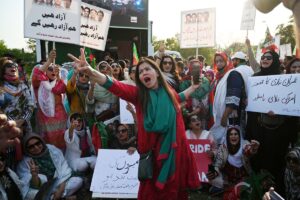
Pakistan lurches further into political uncertainty amid constitutional crisis
Prime Minister, Imran Khan was set to face a no-confidence vote over the weekend, however, the vote was pulled last minute with claims of U.S. involvement in an opposition and military strategy to exile Khan. The Supreme Court since ruled the action unconstitutional and the no-confidence is now set to move forward this weekend. Meanwhile, the Central Bank hiked rates 250 bps to 12.25% bringing the real policy rate near zero with March inflation at 12.72%.
The political and governability uncertainty adds to the previous risks stemming from intentions to reverse subsidy policies over the recently resumed IMF EFF facility. The seventh and eighth reviews were previously slotted for March and June of this year and associated with roughly 2 billion USD worth of disbursements. While the rate hike should be an incrementally constructive action in stemming capital flight, energy and food import costs are likely to outweigh these effects, straining the balance of payments position in the near-term. Resolution of the political crisis and clarity on the IMF program are needed to alleviate these vulnerabilities. We think there is a significant chance Khan loses the vote and is replaced by opposition leader Shehbaz Sharif. He may obtain a brief window to pass the budget and at least qualitatively provide assurance that the IMF program is set to resume albeit with high risk on execution. Fresh elections will likely still be called in the coming months keeping political uncertainty high with growing room for social unrest amid elevated inflationary pressures.
The spotlight next week will be on the results from the French presidential elections’ first round on Sunday, U.S. CPI on Tuesday, and monetary policy decisions by the European Central Bank (ECB) and the Bank of Canada. Highlights in EM include China PPI and CPI, Turkey’s February Current Account balance and monetary policy decision (hold at 14% expected), Ukraine’s rate decision and Poland’s CPI. Additionally, EU foreign ministers will be meeting in Luxembourg to discuss additional measures against Russia, while Sri Lanka is scheduled to hold talks with the IMF and the World Bank in Washington amid an intensifying political crisis in the country.
Stay up to date
More Newsletter to Check


SUBSCRIBE TO NEWSLETTER
Subscribe to download our daily economics and business roundup


×
![]()