
The decision to temporarily suspend some international companies from the list of companies approved to export to Egypt was due to their failure to comply with factory registration requirements

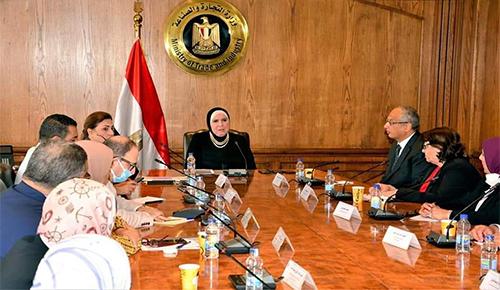
For our top talks today, first, the decision to temporarily suspend some international companies from the list of companies approved to export to Egypt was due to their failure to comply with factory registration requirements, the Trade Ministry said in a statement. The ministry’s General Organization for Export and Import Control (better known by its acronym, GOEIC) regularly reviews documents including quality certificates and trademarks, the ministry said, and companies whose documents have expired are given a two-week warning ahead of suspension decisions, the ministry said. Some 122 companies have already submitted their updated documents since the beginning of the year, and are no longer suspended, according to the statement, while other companies manufacture their products in local factories and no longer need to export products to Egypt.
- Second, Egypt is set to initiate the pilot application of the advance cargo information (ACI) system at airports as of mid-May, while the full application will be on October 1st, Minister of Finance Mohamed Maait stated.
The new system will update and automate customs through simplification and digitalization of procedures, Maait said, adding that the system will reduce customs clearance time and the cost of both imports and exports. The Minister noted that the ACI system will boost trade activity and promote Egyptian exports. Maait called on importers to apply for the ACI at www.nafeza.gov.eg. All importers and their agents shall submit all documents of cargos before air shipment to receive an ACID number. (Arab Finance)
- The Egyptian economic growth rate is expected to slow down to 5% during the fiscal year (FY) 2022/2023, compared to 5.5% in FY 2021/2022.
Egypt was hit hard by the ramifications of the Russian-Ukrainian conflict, the report said. The World Bank projects inflation to exceed the 7% target set by the Central Bank of Egypt (CBE) due to depreciation and imported inflation. “Going forward, enhancing public expenditure efficiency and revenue mobilization will be crucial to avail the fiscal space needed to advance human and physical capital for the population of above 103 million,” the international financial institution’s report remarked. The report highlighted measures taken by the Egyptian government to address economic challenges including devaluation of the EGP and the hike in interest rates. In March, the CBE decided on a special meeting to raise the overnight deposit rate, overnight lending rate, and the rate of the main operation by 100 basis points. (Arab Finance)
- The government raised fuel prices by c. 3% over the weekend amid a rise in global oil prices on the back of Russia’s invasion of Ukraine.
In its latest quarterly meeting, the fuel pricing committee decided to raise prices by another EGP 0.25 per liter for 95, 92 and 80 octane fuel for Q2-2022. As of Monday: 95-octane is EGP 9.75 per liter, up 2.6% from EGP 9.50; 92-octane is EGP 8.75, up 2.9% from EGP 8.50; 80-octane is EGP 7.50, up 3.4% from EGP 7.25 Diesel is unchanged at EGP 6.75. Mazut fuel oil prices rose 9.5% to EGP 4.6k per ton for all industries except food and electricity producers, which will continue to purchase a ton of the fuel for EGP 4.2k. This is the fifth consecutive price hike: Fuel prices have now risen by 15-20% since April last year, when the government first hiked prices in response to an upswing in commodity prices. Additional EGP 0.25 increases came into effect in July, October, and February. These rates will remain fixed through to the end of 2Q 2022, when the committee next meets to set prices. (Egypt Ministry of Oil)
- Also in the news today,the first direct flight between Tel Aviv and Sharm El Sheikh took off today under an agreement made between President Abdel Fattah El Sisi and Israeli Prime Minister Naftali Bennett in March, according to Arab News and Al Arabiya.
The flight was operated by Israel’s El Al airlines and landed in Sharm earlier this morning. EgyptAir has been operating a direct route between Cairo and Tel Aviv since last October. (Mubasher)
- Egypt’s unemployment rate declined by 0.5% year-on-year (YoY) to reach 7.5% in 2021, according to report released by the Central Agency for Public Mobilization and Statistics (CAPMAS).
Total labor force increased by 3.2% to register 29.358 million in 2021, from 28.458 million a year earlier. Labor force in urban areas reached 13.109 million, while it hit 16.249 million in rural areas. In terms of gender, data highlighted that 24.296 million of Egyptian labor force were males, while only 5,062 million were females. Meanwhile, the number of the unemployed reached 2.17 million in 2021. Unemployment among males recorded 5.6% of total male labor force participation, while unemployed females made up 16% of total female labor force participation. (CAPMAS)
- Egypt has added India among its approved wheat suppliers. A delegation from the Egyptian Ministry of Agriculture has visited India and inspected Indians systems for plant health and control of grain exports.
On a similar note, Head of the Central Administration for Plant Quarantine (CAPQ) Ahmed El Attar told Al Mal News that the agriculture ministry is considering buying wheat from Mexico and Pakistan. It is worth noting that Egypt’s General Authority for Supply Commodities (GASC) recently launched a limited tender to buy wheat from Europe only, of which the deadline for receiving bids would be on April 13th. Egypt aims to supply around six million tons of local wheat at a value of EGP 36 billion in 2022. (Arab Finance)
- Finally, Egypt’s current account deficit rose by 2.63% to 7.8 billion USD in the first half (H1) of the fiscal year (FY) 2021/2022, from 7.6 billion USD in the same period a year earlier, according to a report by the Central Bank of Egypt (CBE).
The increase in the current account deficit was caused by a 24.2% year-on-year (YoY) increase in non-oil trade deficit, recording 23.8 billion USD, while non-oil merchandise imports grew by 8.1 billion USD YoY to 36.5 billion USD. The increase in non-oil merchandise imports was the result of a rise in imports of production inputs including propylene polymers and inorganic or organic compounds, along with the increase in imports of agricultural products including soybeans, wheat, and corn. (CBE)
- Furthermore, there were some factors that mitigated the increase in current account deficit, including improvements in oil trade balance, tourism revenues, transport receipts, workers’ remittances, and capital and financial account.
Egypt reported a surplus of 2.1 billion USD in oil trade in H1-FY 2021/2022, compared to a deficit of 54.2 million USD in the year-ago period. Tourism revenue grew to 5.8 billion USD in the July-December period, from 1.8 billion USD the year before. Transport receipts surged 27.9% YoY to $4.7 billion in the first six months of the fiscal year, on the back of a 16.6% YoY hike in Suez Canal revenue, which amounted to 3.4 billion USD. Remittances of Egyptian expats inched up by 0.4% YoY to 15.6 billion USD in H1-FY 2021/2022. Meanwhile, capital and financial account reached 11.4 billion USD, up from 9.2 billion USD a year earlier. The aforementioned data caused the balance of payment (BoP) deficit to reach $14.1 million. (CBE)
Stay up to date
More Newsletter to Check


SUBSCRIBE TO NEWSLETTER
Subscribe to download our daily economics and business roundup


×
![]()