
Russia Is Wiring Dollars to Turkey for 20 Billion USD Nuclear Plant

Russia Is Wiring Dollars to Turkey for 20 Billion USD Nuclear Plant
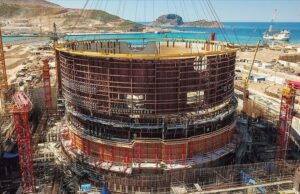
A Russian state-owned company is transferring money to a subsidiary that’s building a 20 billion USD nuclear power plant on Turkey’s Mediterranean coast, alleviating concerns the project could be delayed by war sanctions.
Rosatom Corp. last week sent around 5 billion USD to the Turkey-based builder, formally known as Akkuyu Nuclear JSC, with two other similar dollar transfers planned for this week and next. Rosatom said in a statement although the construction site is the largest of its kind worldwide. The power plant is considered critical for Turkey if it’s to satisfy ever-growing energy needs, slated to meet 10% of the country’s domestic electricity demand once all four reactors become operational. Russia and Turkey have economic ties going back decades, and Turkish President Recep Tayyip Erdogan has been careful not to alienate the Kremlin since Russian troops invaded Ukraine. The project has received finance from Russia’s biggest lender, Sberbank PJSC, which has been sanctioned by the US and European Union, and also from Sovcombank, also sanctioned. Rosatom, the sole owner of the Turkish project, and its subsidiary that’s building plant haven’t been sanctioned.
As well as an oil refinery built by the former Soviet Union near the town of Aliaga in the 1970s, Russian engineers developed other pillars of Turkey’s industrial heartland, including an aluminum plant, textile and glass-making facilities. Turkey has also bought missile defenses from Moscow after having failed to secure a deal with traditional NATO allies including the US. Ankara cited advantages of the Russian system such as price and the transfer of technology.
Russia remains a critical source of energy supplies for Turkey. It provided a quarter of Turkey’s crude oil imports and around 45% of its natural-gas purchases last year, giving Moscow a huge surplus in bilateral trade. The two countries are now working on a mechanism that would allow Turkey to pay for a part or all of its energy purchases from Russia in liras, the Turkish central bank said on Thursday.
Recognizing Ankara’s economic vulnerabilities, European allies and the U.S. have held off pressuring Erdogan to fall in line with their sanctions on Russian companies and officials. While refraining from joining most Western sanctions, the North Atlantic Treaty Organization member Turkey has been vocal about its support for Ukraine. A company headed by Erdogan’s son-in-law provided dozens of armed drones to bolster the Ukrainian military.
The U.S. enters a technical recession given two quarters of negative growth

The other concerning feature was Chair Powell’s intent to push ahead in tackling inflation even if it risked a recession, yet there is perhaps more focus on the NBER’s recession definition. However, he did flag in the FOMC presser that the “unusually large” increase in policy rates (75bps) will be data dependent on a meeting-by-meeting basis, which was read as dovish and reduced the forecasted rate hike in September to 50bps.
The sell-side are now questioning when a Fed pivot could occur, with a comparison to the ECB’s tightening path in 2008 and 2011. Back in 2008 and 2011, the ECB hiked because of high spot inflation, but was forced to reverse its course. Given these risks to credibility, both the ECB and Fed have opted to scrap forward guidance given the uncertainty. The FOMC did offer some hints that we are now closer to the end, rather than the beginning of this tightening cycle. Powell’s suggestion that the current policy is closer to the terminal U.S. rate was another dovish development, where the June SEP longer-term rate is 2.50%. These features within the press conference allowed U.S. Treasuries and global equities to rally, against a weaker dollar which lifted EM currencies.
Prior to the FOMC, the IMF released its world economic outlook with its most severe downgrade in relation to the U.S. economy. The U.S. growth forecast was cut by 140bps in the latest release to 2.3% for 2022. Similarly, China’s GDP growth is forecast to grow at only 3.3% which reflects a -110bps revision to the prior forecast, and is now below market expectations of 4.0%. However, Latin America, Italy, Russia and South Africa had their respective GDP growth estimates increased. In a further twist, the IMF remains optimistic on Euro-area growth at 2.6%, while GS, JPM and Citi are now all calling for a recession as the energy crisis bites. Citi also commented on the weak IFO Expectations survey, which deteriorated significantly and could be one of the early signposts of recessionary risks. Notwithstanding, the slight dip in German inflation in June was quickly reset in July and is trending up toward the all-time high from May.
And for the week ahead, U.S. payrolls, the Bank of England decision, OPEC+ and the slew of earnings will fill up next week’s calendar. However, after the recent bout of disappointing confidence indicators, China’s PMI is in focus. The Economic Surprise Index for Europe reached lows not seen since the pandemic this week and while China’s surprise index has improved over the past three-months, the PMI reading on Sunday is becoming an important indicator for global sentiment. The secondary focus will be China’s FX reserves and trade data. Interest rate decisions are also due out of Brazil (13.25%), Czech Republic (7.0%), India (4.9%) and Romania (4.75%). Another key fixture is Turkey’s inflation release. The challenge for policy-makers is that consensus is already 80.2% and it comes just after the CBRT raised the year-end forecast to 60.4% from 42.8%. We will also have inflation updates out of Colombia, Indonesia, Peru, Philippines and Thailand.

Europe’s lenders have endured a painful decade waiting for interest rates to rise
But just as central banks finally start to move, the long-awaited earnings windfall is being threatened by looming recession and fears that cash-strapped governments might hit lenders with new taxes.
Last week, the European Central Bank raised interest rates for the first increase since September 2011, by half a percentage point to zero. That followed more aggressive hikes at the Federal Reserve and the Bank of England in attempts to control inflation that is forecast to soon break into double digits. The parallel developments of beneficial rate rises and harmful consumer and corporate distress have split opinion on how Europe’s banks will fare after a decade that has seen their earnings stagnate and their share prices dramatically underperform their US peers.
Many are bullish for the first time in years. The rate hikes were hailed as a “game changer” for the sector. Higher base rates mean greater profits as net interest income (NII) improves, a measure of the difference between what a bank pays for deposits and charges for loans. We think Eurozone rate hikes are the biggest structural catalyst for European banks. Those with large balance sheets and loan books stand to benefit the most. HSBC, for example, sits on a global deposit surplus of 700 billion USD and has estimated that a 1% jump in rates would generate an additional 5 billion USD of NII annually — equivalent to a tenth of last year’s 50 billion USD of revenue.
The ECB is examining how it can prevent banks earning billions of euros of extra profit from its 2.2 trillion EUR subsidised lending scheme, which was started to avoid a credit crunch during the pandemic. Some analysts had estimated that lenders could earn a collective 24 billion EUR by depositing cheap debt back with the central bank to benefit from the current higher rates than when the loans were issued. But, while there remains much debate over the profitability of the European financial system, few are concerned about its solvency. Recent stress tests indicate most lenders could shoulder even extreme economic strain after being forced to build substantial capital buffers after the 2008 crisis. Some even see surviving yet another crisis as an opportunity for banks to shake off the persistent negativity surrounding them.
Emerging markets hit by record streak of withdrawals by foreign investors

Global recession fears and rising interest rates drive rush for the exit
Foreign investors have pulled funds out of emerging markets for five straight months in the longest streak of withdrawals on record, highlighting how recession fears and rising interest rates are shaking developing economies. Cross-border outflows by international investors in EM stocks and domestic bonds reached 10.5 billion USD this month according to provisional data compiled by the Institute of International Finance. That took outflows over the past five months to more than 38 billion USD — the longest period of net outflows since records began in 2005.
The outflows risk exacerbating a mounting financial crisis across developing economies. In the past three months Sri Lanka has defaulted on its sovereign debt and Bangladesh and Pakistan have both approached the IMF for help. A growing number of other issuers across emerging markets are also at risk, investors fear. Many low and middle-income developing countries are suffering from depreciating currencies and rising borrowing costs, driven by rate rises by the US Federal Reserve and fears of recession in major advanced economies. The US this week recorded its second consecutive quarterly output contraction.
Investors have also pulled 30 billion so far this year from EM foreign currency bond funds, which invest in bonds issued on capital markets in advanced economies. The foreign currency bonds of at least 20 frontier and emerging markets are trading at yields of more than 10 percentage points above those of comparable US Treasury bonds. Spreads at such high levels are often seen as an indicator of severe financial stress and default risk. It marks a sharp reversal of sentiment from late 2021 and early 2022 when many investors expected emerging economies to recover strongly from the pandemic. As late as April this year, currencies and other assets in commodity exporting EMs such as Brazil and Colombia performed well on the back of rising prices for oil and other raw materials following Russia’s invasion of Ukraine. But fears of global recession and inflation, aggressive rises in US interest rates and a slowdown in Chinese economic growth have left many investors retrenching from EM assets.
The IMF lowered its real GDP growth estimate for 2022 and 2023 by 40bps and 70bps, respectively, to 3.2% and 2.9%.
Developed markets 2022 and 2023 forecasts were lowered by 80bps and 100bps, respectively, while emerging markets revisions were less aggressive at 20bps and 50bps, respectively.
Global inflation for end-2022 was increased to 8.3% from 6.9%. The report emphasized that uncertainty remains elevated, and risks are tilted to the downside from the ongoing Ukraine war and associated price shocks, broad sticky inflation, and unknown prospects around disinflation. While the July WEO, in our view, is a fair reflection of the ongoing challenges of elevated inflation and stalling growth amid broader geopolitical uncertainty, we do not see the assessment as overly worrisome particularly relative to market expectations with consensus 2022 global growth already at 3%. Additionally, the fund’s assumptions support prospects for an improved EM-DM growth differential into 2023.
Meanwhile, this week, the IMF published its standard ex-post review of Egypt’s 2020 SBA that in summary highlighted that the program reached its primary objective of macroeconomic stability and the government delivered on policy implementation in line with targets. The assessment did note that greater FX flexibility and deeper structural reforms to boost competitiveness, improve governance, and strengthen resilience are outstanding areas of focus, despite the authorities having met all reform targets under the 2020 SBA. Lastly, in hindsight, the Fund elaborated on the strong performance on FX reserve targets in the context of better than envisaged external conditions, which could have been better managed with evolution and broadening of the target to more sustainably restore external buffers and reduce vulnerabilities going forward.
We see the conclusion of the report as a necessary precursor to a new program as part of the IMF’s exceptional lending process. While commitment to greater FX flexibility and deeper reform momentum pose challenges for the Egyptian authorities and are likely complicating ongoing program discussions, we think an ultimate deal will be reached later this year. In the meantime, pledged GCC project and deposit support have helped to temporarily stabilize the external profile.
Stay up to date
More Newsletter to Check



SUBSCRIBE TO NEWSLETTER
Subscribe to download our daily economics and business roundup


×
![]()