
Only 14% of US voters say Joe Biden has made them better off

Only 14% of US voters say Joe Biden has made them better off
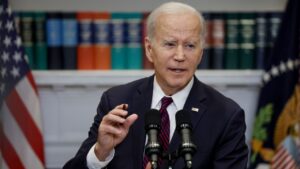
Only 14% of American voters believe they are better off financially now than when Joe Biden took office, in the latest sign that the president’s economic record could undermine his re-election prospects. A poll found that almost 70% of voters thought Biden’s economic policies had either hurt the US economy or had no impact, including 33% who said they believed the president’s policies had “hurt the economy a lot”. Only 26% said his policies had helped. The new monthly poll conducted for the Financial Times and the University of Michigan’s Ross School of Business will seek to track how economic sentiment affects the race for the White House. In 1980, Republican Ronald Reagan famously asked voters whether they were better off than they were four years earlier, setting the stage for his landslide victory over incumbent Democrat Jimmy Carter.
A similar poll conducted for the FT four years ago showed that most Americans felt they had not improved their financial position under then-president Donald Trump, but their pessimism was far less pronounced. In November 2019, only 35% of voters believed they were better off under Trump, while 31% said they were worse off. The new poll results showed that inflation continues to cloud the Biden campaign’s efforts to convince voters of “Bidenomics”, the president’s strategy to rejuvenate the country’s industrial sector and reverse years of middle-class wage stagnation.
Asked what was the source of their biggest financial stress, 82% dents said price increases. Three-quarters of respondents said rising prices posed the most significant threat to the US economy in the next six months. “Every group — Democrats, Republicans and independents — list rising prices as by far the biggest economic threat . . . and the biggest source of financial stress,” said Erik Gordon, a professor at Michigan’s Ross School. “That is bad news for Biden, and the more so considering how little he can do to reverse the perception of prices before election day.”
Rising prices have been a persistent problem during Biden’s three years in office, and while inflation is down from last year’s annual peak of 9.1%, the latest official figures show that the consumer price index rose 3.7% in September compared with the same time last year, well above the Federal Reserve’s 2% target. In response to inflationary pressures, 65% of voters said they had cut back on non-essential spending such as holidays or eating out, while 52% said they had reduced spending on food or other everyday necessities. The negative view of the White House’s economic record comes despite record jobs growth and almost three years of economic expansion under Biden. The president’s political allies believe that voters can still be won over as the campaign heats up and more Americans scrutinize his achievements. More than half of the poll’s respondents — 52%— said they had heard “a little” or “nothing” about what the president was doing to try and improve the economy.
Opec+ weighs further oil production cuts as anger mounts over Gaza

Saudi Arabia prepares to prolong reductions into spring after price hits four-month low of 77 USD. Saudi Arabia is preparing to prolong oil production cuts into next year as Opec+ weighs further reductions in response to falling prices and rising anger over the Israel-Hamas war. After prices hit a four-month low of 77 USD a barrel this week, four people familiar with the Saudi government’s thinking said it was highly likely to extend its 1 million barrel-a-day cut at least until the spring. The voluntary measure, due to expire at the end of this year, was introduced in the summer as a temporary step on top of wider cuts by the oil cartel. At present, Saudi Arabia produces about 9mn b/d, compared with a maximum of about 12mn b/d. Further cuts, which could inflame tensions with the US, are under discussion by Opec+ as it prepares to meet in Vienna on November 26.
While the oil price drop is the main cause, members are also indignant at Israel’s war on Hamas and the humanitarian crisis in Gaza. An additional Opec+ cut of up to 1mn b/d could be on the table, one informed person said, describing the cartel as “galvanised” by the conflict. Kuwait, Algeria and Iran are among the Opec members most agitated by the conflict. “You should not underestimate the level of anger there is and the pressure leaders in the Gulf feel from their populations to be seen to respond in some manner,” said another person close to senior Opec figures in the Gulf. The person said there would be no repeat of the oil shock of the 1970s, when Arab states halted exports to the west. But they added: “People have become complacent about the potential to tighten oil supplies to send a subtle message, which will be well understood both in the streets and Washington DC.”
US President Joe Biden is facing a difficult re-election battle next year, possibly against his predecessor Donald Trump, and the White House is already struggling to convince voters that the country’s economy is healthy. The people close to Saudi Arabia’s thinking stressed that no final decision had yet been made. They emphasised that any public statements by Saudi Arabia’s energy minister, Prince Abdulaziz bin Salman, would keep the focus on the oil market, rather than the Israel-Hamas war.
Prince Abdulaziz recently hit out at hedge funds that have increased their bets against oil, amid expectations that the market may move into a small surplus next year because of the weak global economy and rising supplies outside Opec. Christyan Malek at JPMorgan said Opec+ could carry out an additional 1mn b/d cut to pre-empt “potential demand weakness” in the first half of next year, with Saudi Arabia looking to other members to “share the load” of any further cuts.

US. and UK inflation moderated and triggered a strong rally last week
Stronger U.S. retail sales and Empire State manufacturing supported the notion of U.S. exceptionalism, but that sentiment was short-lived as initial jobless claims rose and house price data fell. Both U.S. and Eurozone government bonds are now pricing in 100bps of cuts in 2024. The ECB’s Villeroy said halting the rate hiking cycle was fully justified, but Fedspeakers cited risks to credibility if they declared victory over inflation too soon. There are still some central banks who have been late to the game and the Bank of Japan’s Governor highlighted that negative rates and YCC may not be a Central Bank strategy for much longer.
Elsewhere, President Biden and Premier Xi held what was a tightly scripted diplomatic encounter, which did not lead to any surprises. Crude oil traded down 2-3% over the week due to higher U.S. inventories, which also did not lead to any shocks. Going back to the weaker U.S. CPI release, it is important to take stock of the volatility. We witnessed the largest one-day move in DXY (U.S. dollar index) since November 2022, allowing EMFX to rally substantially. Unsurprisingly, EM local currency bonds are set to record the strongest monthly performance this year. The risk-on momentum was equally visible in USD fixed income as EM sovereign investment grade returns this month are the strongest since July 2020 and it is likely to be the second-best month for U.S. high yield this year. A special mention also goes to the S&P 500 which is up 7.5% this month which stands to be the best monthly performance since November 2020.
And for the week ahead, Japan’s Central Bank Governor has already hinted that negative rates and YCC may be scrapped, and the inflation report for October could validate that notion. Some focus could also be on the UK’s Autumn Statement given fiscal concerns and the sensitivity to the bond market. Within EM, China is likely to keep the one-year and five-year loan prime rates unchanged at 3.45% and 4.20%, respectively. Other key EM interest rate decisions are due from Hungary (12.25%), Indonesia (6.0%), Kazakhstan (16%), Nigeria (18.75%), South Africa (8.25%), Sri Lanka (10%) and Turkey (35%). We can also expect some focus on FOMC minutes, although the market has taken the lead with more than 100bps of cuts priced in through to the end of 2024.
Petrobras aims to transform Brazil into global energy power
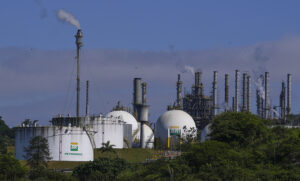
From a speck on the horizon where sea and sky merge, a pilot flame is the first thing visible to helicopter passengers flying towards one of the newest offshore oil platforms transforming Brazil into a global energy power. Anchored 200km from Rio de Janeiro, the P-71 floating production unit is among more than 30 run by national oil company Petrobras over a hydrocarbon-rich stretch off the country’s south-eastern Atlantic coast. The expanse is known as the “pre-salt” region because its crude deposits — 11.5 billion proven barrels at the last count — lie under a thick crust of sodium chloride, deep beneath the ocean floor. It was home to an oil discovery considered the western hemisphere’s most significant for 30 years in the first decade of this century. The South American country’s overall output of the commodity grew 4% in 2022 to 3mn barrels a day, with three-quarters from pre-salt areas, ranking it as the planet’s ninth-largest oil-producing nation.
Rising output from these vast deepwater reserves underpins an ambitious target by the Brasília government to reach fourth place by the end of the decade with 5.4mn b/d, ahead of the likes of Iran, Canada and Kuwait. At the forefront of that drive is 99 billion USD valued Petrobras. Latin America’s largest oil and gas business is state-controlled but with outside shareholders and a stock market listing. While the Rio de Janeiro-based group was given priority over the pre-salt resources and dominates the activities, it operates many fields in consortiums with international groups such as Shell, TotalEnergies, QatarEnergy, Malaysia’s Petronas and China’s Cnooc, among others.
First found in 2006 and chiefly located in the Santos Basin, the pre-salt deposits presented technical challenges. At depths of up to 7km beneath the water’s surface, including layers of rock and 2,000 metres of salt to be drilled through, development required colossal amounts of capital. The resource is now a cash gusher — both for the national coffers and outside investors in Petrobras, founded 70 years ago as Petróleo Brasileiro. Pre-salt production rose from 41,000 b/d in 2010 to 2.3mn last year, fuelling record annual profits of 39 billion USD.
Stay up to date
More Newsletter to Check



SUBSCRIBE TO NEWSLETTER
Subscribe to download our daily economics and business roundup


×
![]()