
Markets continue to navigate paradigm changes and concerns about policy credibility


Markets continue to navigate paradigm changes and concerns about policy credibility
The European Central Bank (ECB) hiked interest rates by 75bp, bringing the main refinancing rate to 2% from 0% just three months ago.
Amid record high inflation driven by high energy prices, this marks the most aggressive tightening cycle in the history of the monetary union as it took the ECB 18 months or more to increase rates by 200bps during its two previous hiking cycles. However, the ECB seems to still be trying to walk a fine line and not send overly hawkish forward guidance signals against the backdrop of the war in Europe and a recession that appears unavoidable. Meanwhile, speculations that the Fed might be mulling a potential pivot toward slowing the pace of tightening in 2023 drove UST yields lower and pushed the DXY index to a three-week low, although some reversal took place on Friday.
Against that backdrop and a sharp drop in European natural gas prices to below 100 EUR/MWh for the first time since mid-June, global equities advanced and the EUR/USD briefly moved above parity for the first time since mid-September. In the UK, former Chancellor Rishi Sunak was confirmed as the new Prime Minister, becoming the third one this year. Despite signals that UK’s medium-term budget will be delayed to November 17 from October 31, the pound strengthened. In one of his longest public appearances since the war in Ukraine broke out, Russian President Putin delivered a speech at the annual meeting of the “Valdai Discussion Club” in Moscow. Putin warned that humanity is facing “the most dangerous, unpredictable and, at the same time, important decade since the end of World War II” and that the West would have to talk to Russia and other major powers about the future of the world.
A busy week ahead filled with central bank meetings across DM and EM. Consensus expects that the Fed’s FOMC meeting will produce a 75bp rate hike given that YoY core inflation continues to trend higher. The Bank of England (BoE) appears likely to deliver a hike of the same magnitude as the Fed, although a less hawkish 50bp move also seems to be on the table given recent political/policy pivot by the government. The Reserve Bank of Australia (RBA) appears likely to go back to larger rate hikes, moving away from its earlier brief more dovish tilt. Across Asia, PMI reports will be scrutinized by markets for signals on diverging growth outlooks. In EMEA, CPI inflation data in Turkey and Poland is likely to confirm that inflation remains on an upward trajectory in those economies.
Strong dollar forecast to wipe 10 billion USD off US company earnings in Q3
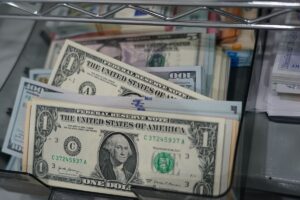
The currency is unlikely to weaken much until the Fed begins cutting interest rates
The rapacious rise of the dollar is set to wipe more than 10 billion USD from US corporate earnings in the third quarter, analysts estimate, piling pressure on companies that are already grappling with high prices and a gloomy domestic outlook. The dollar’s strength has been eating into US earnings all year, taking its toll on makers of everything from children’s toys to cigarettes. The trend is becoming increasingly difficult for investors to ignore as concerns grow about its knock-on impact on demand.
The translation problem refers to the way a stronger dollar reduces the relative value of sales made in foreign currencies when they are converted back into dollars for quarterly financial reports. Measured against a group of other developed-market currencies, the dollar rose 17% in the first three quarters, reaching its strongest level in more than 20 years.
Jonathan Golub, head of US equity strategy at Credit Suisse, estimates that for each 8 to 10 percentage point rise in the dollar index, these translation effects knock 1 percentage point from earnings per share across the S&P 500. With estimated earnings of 480 billion USD before earnings season kicked off, this year’s move would cut third-quarter profits by around 10 billion USD. Some investors estimate the translation effects could be even higher. Many investors are willing to look through such effects if they are confident in the underlying strength of a business. When Microsoft slashed its revenue forecasts by around 500 million USD earlier this year, for example, its stock recovered from a brief blip to close the day in positive territory. More concerning, however, is the potential for demand to fall as rivals that produce and sell in weaker currencies now look cheaper.
Moreover, one key reason for the dollar’s recent strength is the brighter economic outlook in the US compared with many other countries, meaning demand may fall even without additional competition.
Besides a slightly less bleak economic outlook in the US, the dollar’s strength has been encouraged by rapidly rising US interest rates. While the dollar has fallen from its highs in late September as investors have bet on a slowdown in the Fed’s interest rate increases, a meaningful weakening of the dollar is unlikely until the Fed actually begins cutting rates. The central bank has signalled it is not prepared to do so until inflation reaches its 2% target. Apple this week predicted that foreign exchange impacts on its business would get even worse throughout the rest of the year, knocking an estimated 10% from its revenue in the next quarter.

Is Europe winning the gas war with Russia?
The energy crisis is far from resolved given the scale of the remaining challenge on supplies
Prices have dropped by almost 65% since hitting an all-time peak in August. Storage caverns across the continent are filled to bursting point ready to supply homes and industry this winter. Even seaborne liquefied natural gas tankers, which desperate buyers had to fight to pry away from Asia, are now so plentiful there are traffic jams forming outside European terminals as they wait to unload.
After months of fearing a winter beset by shortages and misery caused by Russia’s weaponisation of gas supplies, most traders will cautiously concede that Europe’s fortunes have improved. Warmer-than-normal weather in the past few weeks has delayed the start of heating season, leaving a bigger buffer of gas for the winter months, while European businesses have cut consumption sharply. But a heavy note of caution still hangs in the air. Daring to believe that the energy crisis has somehow been resolved is dangerous given the scale of the remaining challenge.
Prices remain eye-wateringly high, particularly for early next year, and when the cold weather finally hits there remain concerns Europe could quickly burn through its gas reserves, potentially still leading to extreme tightness in supplies after Christmas. Gas at around 115 USD per megawatt hour is still equivalent to almost 180 USD a barrel in oil terms. Contracts in December and January are above 230 USD a barrel equivalent.
Europe has already tapped almost every available source of gas, from increased LNG imports to asking Norway to maximise production for months. There’s little in the way of supply additions expected globally until the middle of this decade. The EU will boost its ability to import LNG through floating terminals in Germany and the Netherlands but they’ll be competing for the same limited pool of supply. And without Russian gas, the EU will need even more LNG over the next 12 months. So, the current relatively low price for gas might be as good as it gets for a while. The futures market is already reflecting these concerns, with contracts trading above 200 USD a barrel equivalent even for the first quarter of 2024.
Lower prices might still materialise. Energy executives in Europe think the full extent of demand destruction is yet to be seen, as some companies have still been shielded by long-term contracts supplying them with gas at prices well below market rates. As the contracts roll off in the coming months, we should expect more businesses vulnerable to energy price shocks to fold. It’s the market’s classic way of lowering demand. But don’t expect those who lose their incomes to cheer that gas might get a bit cheaper as a result.
If France can sort out its maintenance-racked nuclear fleet there might be a more positive reprieve, as less gas will need to be burnt for electricity across the continent. But the most likely outcome remains that governments are going to still be on the hook for significant support to households over the next 18 months. Tightening of middle-class household budgets also is likely to add to economic pressures. So, is Europe winning? Long-term, it is demonstrating that market economies can find a way through. But sadly, there’s a lot of pain to come.
Elon Musk moves to address content issues as he takes control of Twitter

Billionaire faces scrutiny from advertisers on arrival at social media company
Elon Musk faced questions about how he will police content on Twitter as he took control of the social media company on Friday following a turbulent 44 billion USD takeover. With concerns already arising about how he will handle a sea of Twitter moderation issues, Musk promised to create a council with “widely diverse viewpoints”, and said that “no major content decisions or account reinstatements will happen before that council convenes”. He later added: “To be super clear, we have not yet made any changes to Twitter’s content moderation policies.”
On Friday, Musk was accompanied at Twitter’s headquarters by his personal lawyer and trusted lieutenant Alex Spiro, who is focused on assessing legal and policy issues at the company, while Musk is evaluating how its engineering and product departments work. General Motors said it had “temporarily paused” paid advertising on the platform “as is normal course of business with a significant change in a media platform”, though it would continue to use the site to interact with customers. GM competes against Tesla, Musk’s electric vehicle company. The US car manufacturer added that it was “engaging with Twitter to understand the direction of the platform under their new ownership”. The announcements came less than 24 hours after Musk, a self-declared “free speech absolutist”, closed the deal to take Twitter private for 54.20 USD a share late on Thursday.
Musk has previously said he wants to loosen content restrictions and repeal permanent bans, sparking fears among some advertisers, which account for the majority of Twitter’s 5 billion USD in revenues, that the platform could become a hotbed of toxicity and abuse. Musk has already started his ownership of Twitter with characteristic bombast, firing top executives, including chief executive Parag Agrawal and head of safety Vijaya Gadde, and writing one-liners on the platform. “The bird is freed,” he wrote hours after the deal closed, having already changed his public profile to “Chief Twit”. Reopening the site to controversial speech was welcomed by right-leaning groups but raised concerns among others that it would result in a wave of hate, harassment, misinformation and extremism. It could also prompt a backlash from companies that Twitter depends on for advertising.
Musk addressed a tweet to “Twitter Advertisers” on Thursday, saying he wanted the site to resemble a “common digital town square” but not a “free-for-all hellscape”. However, a small set of users took to the platform to share obscenities, which remained online. Tesla has led the way in popularising electric vehicles, a path GM and other traditional carmakers are now spending billions to follow.
Neither Ford nor Stellantis, formed from the merger of PSA and Fiat Chrysler, could immediately be reached to comment on whether they, too, will suspend advertising. Twitter’s press team did not respond to any requests for comment on Friday.
How the US chip export controls have turned the screws on China
Washington is trying to slow Beijing’s advanced semiconductor development and military modernization
The US in October introduced expansive chip export controls in an effort to slow China’s progress in artificial intelligence and super computers and make it harder for the country to manufacture advanced semiconductors. The controls are arguably the toughest measures President Joe Biden has taken against China and his first serious attempt to slow its military modernisation by targeting the technologies behind everything from nuclear weapons modelling to hypersonic weapons development.
How will they impact China’s semiconductor industry? China’s top chipmaker Semiconductor Manufacturing International Corporation, which makes logic chips that power computers, will be hit by the restrictions as they bar US companies from supplying technology for chips that are more advanced than 14 nanometres or, in some cases, 16nm. The rules will make it harder for SMIC to continue production at the 14nm level because they will impact areas like maintenance and equipment replacement.
Memory chipmakers such as Yangtze Memory Technologies Corp and ChangXin Memory Technologies will also be impacted. Their more advanced products already meet the thresholds the US has set for memory chips. In the case of YMTC, for example, the US has put restrictions on the export of technology to manufacture Nand memory chips with 128 layers or more — the level of the Chinese company’s most advanced chips. Without access to US technology, China will struggle to maintain its fast expansion in artificial intelligence and supercomputing — two areas important to the Chinese military — as well as cloud computing.
What US companies will be hit? The impact depends on how aggressively the US applies the controls. Many US firms that produce chips or chipmaking tools list China as their biggest market. China accounts for 33% of sales at Applied Materials, 27% at Intel and 31% at Lam Research. Applied Materials said the restrictions would cut about 400 million USD, or 6%, from next quarter’s sales. Nvidia, which will be unable to export its advanced GPUs (graphic processing units) used in machine learning systems to China, also put the quarterly impact on revenues at 400 million USD, or 7% of its sales.
Stay up to date
More Newsletter to Check


SUBSCRIBE TO NEWSLETTER
Subscribe to download our daily economics and business roundup


×
![]()