
IMF’s Georgieva warns of increased risks to financial stability

IMF’s Georgieva warns of increased risks to financial stability
Fund head warns uncertainties in the world economy remain “exceptionally high”
IMF managing director Kristalina Georgieva has warned of increased risks to financial stability and the need for vigilance following the recent banking sector turmoil in advanced economies. Speaking at a conference in Beijing, the IMF head said uncertainties in the world economy remained “exceptionally high”, with global economic growth expected to slow below 3 per cent this year because of the Ukraine war, “scarring” from the Covid-19 pandemic and monetary tightening.
“Risks to financial stability have increased at a time of higher debt levels,” Georgieva told the annual China Development Forum, a gathering for global chief executives and senior Chinese policymakers. “The rapid transition from a prolonged period of low interest rates to much higher rates necessary to fight inflation inevitably generates stresses and vulnerabilities, as we have seen in recent developments in the banking sector.” The global financial sector was shaken by the collapse of this month of a midsized US lender, Silicon Valley Bank, which led to the fall of another American institution and the takeover of Credit Suisse by UBS.
Bank shares declined again on Friday, this time led by Deutsche Bank, forcing German chancellor Olaf Scholz to insist there was “no reason to be concerned” about the institution. “We also have seen policymakers acting decisively in response to financial stability risks and we have seen advanced economy central banks enhancing the provision of US dollar liquidity,” Georgieva said. “These actions have eased market stresses to some extent but uncertainty is high and that underscores the need for vigilance.”
The IMF in January estimated global growth would slow from an estimated 3.4 per cent last year to 2.9 per cent in 2023, then rise to 3.1 per cent in 2024. “Even with a better outlook for 2024, global growth will remain below last decade’s average of 3.8 per cent,” Georgieva told the forum. She also echoed the warnings voiced by several other speakers at the conference about the dangers of the world fragmenting into economic blocs, saying this would be “a dangerous division that will leave everyone poorer and less secure”.
The most positive development in the world economy this year was the expected strong economic rebound in China after it relaxed its strict Covid controls at the end of 2022, she said. The IMF forecasts growth of 5.2 per cent in China in 2023 compared with 3 per cent a year earlier. China’s growth would account for about one-third of global growth this year, she said. “A 1 percentage point increase in GDP growth in China leads to 0.3 percentage growth in other Asian economies,” she said. Several global business chiefs have also attended the conference in Beijing despite rising trade and geopolitical tensions between the US and China.
Among other speakers, Tharman Shanmugaratnam, the chair of the Monetary Authority of Singapore, the city state’s de facto central bank, said the recent macroeconomic challenges were only the “early consequences” of instability caused by a long period of low and negative real interest rates in advanced economies. He described this extended period of easy monetary policy as the “largest mistake in macroeconomic policy in 70 years” and called for co-operation between the US and China as well as competition.
What’s different between Credit Suisse (CS) and Banco Popular Español? Both AT1 instruments were written down to zero, however in 2017, the equity of the Spanish entity was written down first

Market perception is that the difference in equity treatment re-writes the rules of the game (similar to India’s Yes Bank Basel III AT1 instrument in 2020).
Contagion was a natural consequence as global AT1s were under material pressure but subsequently rallied as the market diagnosed this as a unique problem to Swiss banking regulation. Against this backdrop, UBS agreed to take over Credit Suisse and the Fed, along with five other major central banks, announced coordinated actions to enhance dollar swap lines and provide liquidity. This brings us to the second theme of the week, which was whether risks associated with CS and U.S. retail banks could dissuade the FOMC from pressing ahead with fighting sticky inflation.
Faced with complex choices and elevated uncertainty, Fed policymakers opted for what appears to be seen as a workable compromise: they delivered a 25bps rate hike but softened forward guidance from “ongoing increases” in the target range to “some additional policy firming”. Chair Powell also noted that the banking concerns would inevitably “tighten financing conditions”. In reaction to the perceived dovish outcome, risk sentiment improved in the aftermath of the Fed decision and press conference while the USD remained under pressure. The UST yield curve bull-steepened as the front end outperformed on the back of a downward assessment in the expected Fed policy rate path. Stronger market sentiment was somewhat tempered as the week ended amid renewed liquidity concerns, especially for smaller banks, and U.S. jobless claims data pointing to continued labor market tightness potentially maintaining inflation pressures.
Sticky inflation has become a problem for the Bank of England as well after headline CPI rose to 10.4%, but this was explained as a one-off with higher food and restaurant prices. Across EM, the Central Bank of the Republic of Turkey held rates unchanged at 8.5%, but the Philippines Central Bank raised its policy rate by 25bps and signaled another hike if inflation risks remain to the upside. Mexico’s latest bi-weekly inflation is trending down to 6%, but another 25bps hike next week seems likely. Elsewhere, the IMF formally approved Sri Lanka’s program that would make around 3 billion USD available over four years in exchange for reforms. This will likely unlock further financing from other multilateral/development sources in a major step toward resolving the countries’ economic crisis and debt sustainability issues.
IMF approves 4-year 3 billion USD program for Sri Lanka
Having reached a Staff Level Agreement (SLA) with the Sri Lankan Government on a program back in September 2022, the IMF formalized the Agreement this week when its Executive Board approved a 48-month Extended Fund Facility (EFF) arrangement for around $3 bn, $333mm of which will be available for immediate disbursement.
The IMF’s final stamp of approval on a program is a big step toward resolving Sri Lanka’s series of economic, political and social crises. The 3 billion USD of forthcoming IMF funding will go a long way to alleviate the economy’s external capital needs and will likely catalyze fresh financing support from other multilateral and development partners. Importantly, it is also a credit-positive development and opens the door to making tangible progress in the sovereign’s negotiations with private creditors over a debt restructuring. This could be a prelude to Sri Lanka’s return to global capital markets in the near future, provided the debt restructuring concludes without major delays and the IMF program remains on track in the coming years.
The IMF has called for close and timely collaboration between Sri Lanka and all its creditors in order to achieve a debt treatment that will restore debt sustainability consistent with the program’s parameters and equitable burden sharing among creditors. As a reminder, in order to receive Board approval, the government was required by the IMF to obtain specific and credible assurances from its major official bilateral creditors (i.e., Paris Club, China, India) that debt relief measures consistent with the IMF program assumptions will be provided.
The next step would be to complete negotiations with private creditors on around 15 billion USD of Eurobonds outstanding. Against the backdrop of the latest developments, we expect ultimate recovery values to provide a decent upside relative to current trading levels for the sovereign bond complex; we see scope for potential further enhancement in the form of GDP warrants that could provide additional upside in the event Sri Lanka’s economy recovers faster than expected over the medium-term.
Argentina evolved tactics to manage challenged macroeconomic backdrop

Argentina’s Minister of Economy, Sergio Massa, announced new decrees in which public agencies will have to exchange their holdings of NY law USD sovereign bonds (4 billion USD) for ARS bonds and then be delisted as well as sell their holdings of local law USD sovereign bonds (7 billion USD) in the market.
Over two-thirds of the proceeds are to be used to participate in future tenders of the Treasury and the remaining to finance budget expenditure. This also allows the government to circumvent the IMF requirement to avoid use of FX reserves to intervene in the FX market. The development is on brand for this administration which has taken a mixed approach in terms of managing macroeconomic fragilities and wants to avoid a devaluation ahead of the election. While this will likely be moderately effective in the short-term, it risks exacerbating ongoing challenges and imbalances and is an uncomfortable action in spite of the IMF’s guidance.
Nevertheless, we anticipate the authorities will continue to deploy similar tactics to muddle through between now and the election. The diminishing return of such measures, particularly amid the ongoing drought and increasingly challenged economic backdrop, is likely to keep asset volatility elevated. If this administration is eventually forced to adjust the official FX rate and it is done orderly, we think investors would view it constructively. Meanwhile, 4Q22 real GDP data showed a 1.5% contraction in sequential terms while recent monthly activity indicators have also moved comfortably into negative territory, reinforcing the country’s familiarity with the unfortunate combination of negative growth and high inflation, and driving demand for policy change.
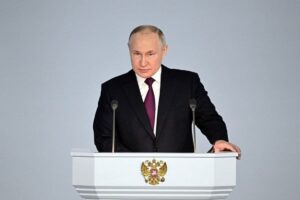
Putin plans to deploy tactical nuclear weapons in Belarus
Russia’s president denies the move would violate Moscow’s non-proliferation obligations
Vladimir Putin has said Russia plans to deploy tactical nuclear weapons in Belarus, marking Moscow’s latest attempt to use the threat of a nuclear war to ramp up tensions with the US and Nato over the invasion of Ukraine. Russia’s president said work would be completed on building storage units for tactical nuclear weapons in Belarus on July 1, a move he likened to US nuclear deployments in Europe.
Though Putin said Russia would not transfer control of the tactical nuclear weapons to Belarus or violate its nuclear non-proliferation obligations, the decision is one of the Kremlin’s most significant steps with its arsenal since it invaded Ukraine more than a year ago. Putin said the deployment was in response to a longstanding request from Belarus’s autocratic leader Alexander Lukashenko, who has allowed Russia to use the country as a launch pad for attacks on Ukraine, thereby moving his country deeper into the Kremlin’s embrace.
It was unclear when work began on the nuclear storage facilities in Belarus or when Russia would deploy the weapons there. Putin said Russia had already equipped 10 Belarusian aircraft with the capability to carry tactical nuclear weapons. Russia will begin training Belarusian forces on the Iskander missile complex, which can carry the tactical nuclear weapons, in April, Putin added. Putin has regularly made veiled threats to use “all the means at our disposal” to defend Russia’s territorial conquests and warn off western support for Ukraine’s military.
In the autumn, when nuclear tensions with the west were at a peak, Putin considered using a tactical nuclear weapon in Ukraine but eventually decided it would give Russia no real battlefield advantage, according to people familiar with the matter. Unlike strategic nuclear warheads — which are designed to be launched from thousands of miles away on submarines, long-range bombers or intercontinental ballistic missiles, and can obliterate entire cities — tactical nuclear weapons carry a smaller payload for destroying targets in a specific area.
Whereas the US gave up all but 230 of its tactical nuclear warheads after the end of the Cold War, Russia still maintains 2,000 of them and can deploy them from some conventional systems, such as the Iskander missile complex. The Russian president said he had made the decision after the UK announced earlier this week it had supplied anti-tank rounds containing depleted uranium to Ukraine, a move he framed as part of a nuclear escalation of the conflict. The US and the UK dismissed Putin’s claim, saying the rounds — which are more dense than lead and valued for their armour-piercing capabilities — only have conventional uses. US National Security Council spokeswoman Adrienne Watson said the US has not seen any signs Russia is moving towards using a nuclear weapon.
Stay up to date
More Newsletter to Check



SUBSCRIBE TO NEWSLETTER
Subscribe to download our daily economics and business roundup


×
![]()