
ECB half-point march rate hike very likely, Lagarde says

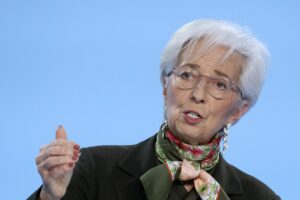
ECB half-point march rate hike very likely, Lagarde says
European Central Bank is set to raise borrowing costs by another half point at its March decision, according to President Christine Lagarde.
“It is very likely that we will raise interest rates by 50 basis points,” Lagarde told El Correo when asked what would happen later this month. “This was a decision that was indicated at our last monetary policy meeting and all the numbers we have been seeing in recent days are confirming that this interest rate hike is very, very likely.” A move of that size would take the ECB’s rate increases since July to 350 basis points. What happens beyond March 16, is less certain.
With inflation still more than four times the central bank’s 2% target, and the underlying rate at a record, some officials have suggested another half-point hike could be required in May and investors are betting on a 4% rate peak — compared with a current deposit rate of 2.5%. “I cannot tell you how high rates will go,” Lagarde said in the interview published on the ECB’s website on Sunday. “I know that they will be higher than they are now and we still have more work to do because we cannot declare victory. We are making progress, but we still have work to do.”
The ECB is scheduled to present new economic forecasts after the next rate decision, though Lagarde wouldn’t be drawn on details. “But I am confident that headline inflation will go down in 2023, while core inflation will be stickier in the near term,” she said. “And I expect somewhat better economic growth compared with the stagnation in the last quarter of 2022.” “The projections by ECB staff do not include a recession in 2023,” Lagarde said. “We anticipate positive growth and increased activity over the course of the year. But it’s true there is huge uncertainty.” Asked about rate hikes potentially hurting economic growth, Lagarde reaffirmed her insitution’s priorities. “My main concern is inflation,” she said. “We don’t want to break the economy; that’s not our goal. Our goal is to tame inflation.”
The risk of undertightening is greater than the risk of overtightening
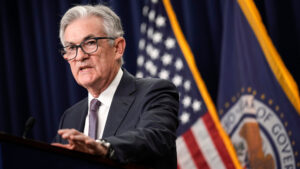
Not only Lagarde but Fed’s Daly says US rates likely to be higher for longer. Comments reflect increasing concern about persistent inflation and global trends fuelling price pressures.
Federal Reserve officials are converging around the need to keep US interest rates high for longer, reflecting concern about recent hotter-than-expected inflation data and worries about global economic trends that could fuel price pressures. “In order to put this episode of high inflation behind us, further policy tightening, maintained for a longer time, will probably be necessary,” Mary Daly, president of the San Francisco Fed, said on Saturday in remarks at Princeton University. “Restoring price stability is our mandate and it is what the American people expect. So, the FOMC remains resolute in achieving this goal,” she added.
Daly’s remarks follow a series of hawkish comments from other senior officials at the US central bank, reacting to economic indicators showing that US inflation is not subsiding as rapidly as hoped. The US labour market also remains remarkably strong. They come ahead of a pivotal month for Fed policy and economic data. Next week, Jay Powell, the Fed chair, will testify before Congress in comments that will set the stage for a highly anticipated Fed policy meeting on March 21-22 including new economic projections and interest rate forecasts.
In between, new data on inflation and the US jobs market could determine whether the Fed presses ahead with a new 25 basis point interest rate increase, as has long been expected, or is forced to be more aggressive and move interest rates up by 50 basis points!
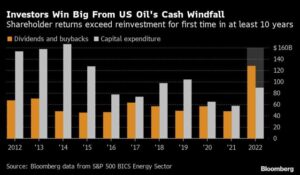
Oil investors get 128 Billion USD handout as doubts grow about fossil fuels
Shareholders envisioning the imminent peak of petroleum demand want executives to focus on short-term returns rather than long-term projects that risk becoming stranded assets.
Worldwide oil demand is racing toward an all-time high and some of the smartest minds in the industry are forecasting $100-a-barrel crude in a matter of months, but US producers are playing the short game and looking to turn over as much cash as possible to investors.
Shareholders in US oil companies reaped a 128 billion USD windfall in 2022 thanks to a combination of global supply disruptions such as Russia’s war in Ukraine and intensifying Wall Street pressure to prioritize returns over finding untapped crude reserves. Oil executives who in years past were rewarded for investing in gigantic, long-term energy projects are now under the gun to funnel cash to investors who are increasingly convinced that the sunset of the fossil-fuel era is nigh.
For the first time in at least a decade, US drillers last year spent more on share buybacks and dividends than on capital projects. The 128 billion USD in combined payouts across 26 companies also is the most since at least 2012, and they happened in a year when US President Joe Biden unsuccessfully appealed to the industry to lift production and relieve surging fuel prices. For Big Oil, rejecting the direct requests of the US government may never have been more profitable.
At the heart of the divergence is growing concern among investors that demand for fossil fuels will peak as soon as 2030, obviating the need for mutlibillion-dollar megaprojects that take decades to yield full returns. In other words, oil refineries and natural-gas fired power plants — along with the wells that feed them — risk becoming so-called stranded assets if and when they are displaced by electric cars and battery farms.
There are no domestic equity investors’: why companies are fleeing London’s stock market
Bulk of goods transported under contracts set at higher rates. The worst is over, but price pressures remain!
More UK companies are drawing up plans to shift their stock market listings to the US, bankers say, in a growing exodus that threatens to undermine London’s effort to reinvent itself as a vibrant hub for global equities. CRH, the world’s biggest building materials company, on Thursday became the latest business to seek an exit from London, following in the footsteps of gambling group Flutter whose shareholders are due to vote on a secondary US listing in April. Boards of other companies are discussing similar moves, drawn by a larger, deeper market, higher valuations and the prospect of a government willing to spend hundreds of billions of dollars on infrastructure, according to senior investment bankers.
The string of departures and prospective moves from London underline the UK’s difficulty in attracting and retaining companies, despite the British government’s attempts to reinvigorate the City and lure businesses away from rival exchanges. Executives see the US as an environment that embraces higher growth, while they bemoan the lack of interest from UK-based investors in their home market, particularly pension funds that have increasingly shunned British stocks over the past two decades.
UK investors are considered more risk-averse and comfortable with the traditional sectors that dominate London’s indices, such as mining and energy, subsequently hampering the UK’s ability to retain newer companies in sectors such as technology and help them grow. They also tend to be overly dependent on dividends for returns, leading to under-investment.

Break up of Turkey’s opposition alliance introduces yet another major political twist two months prior to historic presidential and parliamentary elections
Meral Aksener, the leader of the iYi (Good) party, the second largest opposition force in Turkey, announced that her party is withdrawing from the so called “Table of Six” anti-Erdogan coalition and will not support the leader of the main opposition party CHP, Kemal Kilicdaroglu, as a joint candidate to stand against President Erdogan in the first round of presidential elections. Madame Aksener also called for popular CHP figures Ekrem Imamoglu and Mansur Yavas, the mayors of Istanbul and Ankara respectively, to formally enter the presidential race against Erdogan and offered her support to them.
The unraveling of the anti-Erdogan opposition coalition around two months before the presumed election dates of May 14th or June 18th carries a multitude of political implications and could trigger game-changing scenarios for what many observers consider the most important and consequential elections in Turkey’s post-Ottoman history. The direction in which this newest chapter in Turkey’s pre-election drama and the implications for the electoral outcome are completely uncertain at this stage and will depend on the next moves by the key opposition players – Mr. Kilicdaroglu and Mme Aksener as well as the reaction of the Istanbul and Ankara mayors who have been called upon by Mme Aksener to enter the presidential race.
For context, the two CHP mayors have consistently been shown by polls to stand a significant chance of defeating President Erdogan in a one-on-one basis, much more so than their party’s leader Mr. Kilicdaroglu. As a reminder, Mr. Imamoglu, the popular Istanbul mayor, faces pending legal action against him that is widely seen by independent observers as politically motivated and could disqualify him from participating in politics if found guilty, which complicates matters even further. For his part, President Erdogan who might have been weighing his options around potentially postponing the elections beyond the constitutionally mandated cutoff date of June 18th, could now face a new landscape with the opposition falling into further disarray and might be incentivized to go to elections as soon as possible.
As for markets, given that all these major political events have taken place on Friday, investors will enter the weekend facing even more elevated uncertainty than before and will be eagerly awaiting any signals from the main players next week.
Stay up to date
More Newsletter to Check



SUBSCRIBE TO NEWSLETTER
Subscribe to download our daily economics and business roundup


×
![]()