
Crimean bridge explosion leaves Russian supply lines exposed

Crimean bridge explosion leaves Russian supply lines exposed
Ukrainians celebrate symbolic blow to cornerstone of Moscow’s control of annexed territories
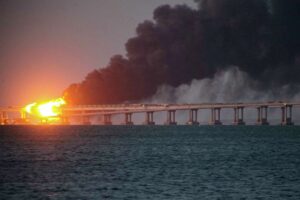
An explosion tore through Russia’s bridge across the Kerch Strait to Crimea early on Saturday, killing at least three people and severely damaging its structure in a major blow to Vladimir Putin more than seven months into his invasion of Ukraine. Russia’s anti-terrorist committee said a truck exploded on the bridge’s roadside in the early hours of Saturday morning and caused seven fuel tanks on the railway bridge which runs alongside it to ignite.
Putin, Russia’s president, ordered officials to step up security measures at the bridge and investigate the explosion, which sent huge clouds of smoke into the sky as a blaze raged, caused two road spans of the bridge to collapse and scorched part of the railway. The 12-mile bridge was devised when Russia annexed Crimea from Ukraine in 2014 and completed in 2018. It is an engineering feat — the Wehrmacht and Red Army both tried and failed to cross the waters between the peninsula and the Russian mainland during the second world war — and had become a symbol of Russian prestige.
It is a key artery for shipping as it spans routes connecting export ports on the Azov Sea to the Black Sea. It is also a major conduit to supply Russia’s war effort in south-eastern Ukraine, where its troops have made substantial retreats in the last week from territory Putin claimed as Russian after annexing four Ukrainian regions. Putin has shown no indication he is seeking an end to the war. Hours after the attack, the defence ministry said it had promoted Sergei Surovikin, Russia’s air force chief, as the primary commander of Russia’s invasion efforts.
Opec oil production cuts bad for global economy
Saudi Arabia and Russia’s agreement to cut oil production in defiance of Washington may upend the global energy order
On Wednesday, the Jewish holy day of Yom Kippur, Saudi Arabia and its oil allies — which now include Russia in the Opec+ group — moved to upend the world’s energy order again. Their decision to slash 2mn barrels a day from production targets, or 2 % of global supply, might sound modest. But doing so while Brent crude was trading at a lofty $90 a barrel — almost twice its long-term historical price — is a threat to a global economy stalked by inflation and mounting consumer anxiety about energy prices and shortages. And it marks a new and perhaps dangerous breach between producer and consumer countries, especially between the US and Saudi Arabia.
The timing of the cuts for the US was especially telling, coming just two and a half months after President Joe Biden had exchanged fist bumps with Saudi Crown Prince Mohammed bin Salman in Jeddah, and five weeks before November’s midterm elections. Days earlier, envoys from the White House had travelled to Saudi Arabia to implore the kingdom not to cut. Instead, Prince Mohammed’s half-brother, energy minister Prince Abdulaziz bin Salman sealed the deal to slash supply at the Opec headquarters. Alongside him was Vladimir Putin’s deputy prime minister Alexander Novak, only days after he was slapped with sanctions by the US.
For Saudi Arabia, which has long depended on the US for military support as part of an energy-for-security alliance that has endured through two wars in the Gulf and the 9/11 attacks, it underscores a new confidence that it can break free of American pressure and act in its own commercial and diplomatic interests. While the Biden administration was bracing for the decision to cut, the reaction in Washington was still shock at the breach in the alliance.
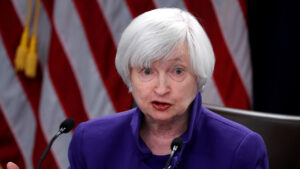
US Treasury secretary Janet Yellen said the move by Opec+ to cut oil production was “unhelpful and unwise” for the global economy, particularly emerging markets already struggling with high energy prices. The Biden administration has been loudly critical of the decision by the oil cartel backed by Saudi Arabia and Russia this week, which took the step in defiance of US pressure to keep global oil prices down. The US and G7 allies are entering the final stretch of talks to set a price cap on Russian oil exports, in order to deprive Moscow of vital energy revenues to finance the war, but also keep some oil flowing from the country in a way that does not lead to a jump in prices around the world.
In Opec’s view, Washington had also started to interfere in their market. The Biden administration’s decision to begin releasing crude from its emergency oil stockpile last year to ease prices was troubling to Opec members. They thought they were honoring a measured plan to gradually restore oil supplies cut as the world economy recovered from the pandemic.

Soaring mortgage rates to pile pressure on property markets worldwide
Housing markets face seismic change as low interest rate environment ends
A decade-long party for homeowners is coming to an end. The cost of servicing mortgages in the UK, Europe and the US has spiralled at the same time as disposable incomes have been squeezed, and predictions of a downturn or even a house price crash are now common. We believe that house prices in London would fall 10 % over the next two years — a highly unusual move for an estate agency, which adds to independent analysis and bank predictions of falls at least that across the UK. How could housing markets, which have felt nothing but price growth for a decade, tip into crash territory?
The financial crisis in 2008 offered a chastening lesson in the dangers of borrowing excessively against housing. Back then about one in seven mortgages were highly leveraged with loan to value ratios equal to, or greater than, 90%. In the years since, banks have tightened their lending criteria with only 4% having the same borrowing levels. Today’s borrowers must raise relatively large deposits and demonstrate they can withstand interest rate rises. Reckless lending has largely been kept in check, reducing the danger of homeowners slipping into negative equity.
The other key feature of the past decade has been rock-bottom interest rates — allowing buyers to take on large mortgages at low monthly costs. In turn, anyone able to build up a deposit could afford a pricier property — betting on repaying it as long as rates remained low and the mortgage term was long enough. Low rates have in effect made larger homes affordable, driving up house prices in return and crowding out those unable to raise cash for a deposit or tap the “bank of mum and dad”.
But rates have spiked higher this year — with the Federal Reserve raising the base rate from 0.25% to 3.25% and the Bank of England and ECB following suit — and markets are expecting they will continue to rise sharply into next year as central banks try to contain runaway inflation. Suddenly, that affordability picture has changed dramatically.
Taiwan tensions spark new round of US war-gaming on risk to TSMC

President Joe Biden has been explicit in vowing to commit US forces in the event of a Chinese attack on Taiwan. The question occupying US and Taiwanese officials is the fate of the island’s flagship semiconductor industry.
Contingency planning for a potential assault on Taiwan has been stepped up after Russia’s invasion of Ukraine, according to people familiar with the Biden administration’s deliberations. The scenarios attach heightened strategic significance to the island’s cutting-edge chip industry, led by Taiwan Semiconductor Manufacturing Co. In the worst case, they say, the US would consider evacuating Taiwan’s highly skilled chip engineers. We strongly believe that the loss of TSMC could disrupt the world economy to the tune of more than 1 trillion USD, around twice the value of the entire semiconductor industry’s annual global sales.
TSMC’s might lies in its leading-edge technologies and its indispensable role in keeping the global economy humming. Companies including Apple Inc., Tesla Inc. and Volkswagen AG all need chips from TSMC, and so does the US military. California-based Intel Corp. is a couple of generations behind the Taiwanese company’s technology and is struggling to catch up.
Taiwan is trying to assuage Washington’s concerns: This week the government pledged to work closely with the US and other allies to prevent China’s military from acquiring its state-of-the-art technology. Taiwan’s Minister of Economic Affairs Wang Mei-hua is due to visit the US Oct. 9-16 to discuss supply chain resiliency and geopolitics with relevant stakeholders. TSMC has meanwhile agreed to build a 12 billion USD chip fabrication plant, or fab, in Arizona, a facility in Japan, and is mulling a European hub. Yet it has also said it doesn’t plan to move its most advanced technology abroad.

The trading week ended with data showing that U.S. nonfarm payrolls increased with another solid 263,000 in September after a 315,000 gain in August
The unemployment rate declined to 3.5%, a fifty year low, while average hourly earnings increased firmly.
A “Fed pivot” narrative from earlier in the week quickly started to lose steam against this backdrop and risks assets retreated. Elsewhere in the global monetary policy universe, credibility blunders seemed to be on the rise. We have already seen the BOE shift from QT to QE and this followed the beginnings of a pivot in policy triggered by the RBA. The RNBZ are of course a standout, but the tightening cycle is ending and it was faced with one of the hottest G10 property markets.
The question is then whether this G10 theme shifts to EM. Poland kept rates unchanged this week and followed in the footsteps of the Czech Republic, Colombia hiked less than expected last week and Romania signaled one final hike at the November MPC. Meanwhile, the Central Banks of Chile and Mexico remain on the more hawkish side. There is also growing pressure with the Thai baht, where the swap curve is showing how the Central Bank is increasingly behind the curve and is instead hanging on the coattails of inflation moderating in September.
However, the sight of moderating inflation isn’t clear in the Philippines with CPI stepping up to 5.9%. Hungary has at least shown signs of being more creative and have already aggressively hiked rates by introducing new short-term instruments that are aimed at mopping up excess liquidity without the need to tighten policy rates further. Yet the overwhelming pressure on the global bond market is partly a function of UK politics. The UK has both its metaphorical foot on the accelerator (fiscal policy) and brake (monetary policy), and had to introduce a temporary QE exercise of £5bn in daily purchases up to £65bn over 13 days. However, take-up in the scheme has been impressively weak. Once the program rolls off next Thursday, there is a risk of more fragility in global DM fixed income.
Stay up to date
More Newsletter to Check


SUBSCRIBE TO NEWSLETTER
Subscribe to download our daily economics and business roundup


×
![]()