
Collapsing volatility in equity and bond markets was the theme of the week


Collapsing volatility in equity and bond markets was the theme of the week
The banking sector anxiety that crushed markets in mid-March showed significant signs of easing. The question is the degree of implicit tightening that the crisis did for the Fed.
However, Wall Street’s fear gauge should add some comfort (if not, some complacency). The VIX is firmly below 20 and the MOVE Index is now below 150. The Core PCE data did soften and while U.S. activity data has shown some sign of rebounding, the Atlanta Fed’s GDP now for 1Q fell from 3.2% to 2.5% on Friday. Weaker growth should be supportive for fixed income assets and the 2-year U.S. Treasury note is 98bps lower in yield over three weeks. The idea of “transitory disinflation” in Europe gathered a little more steam over the past week. Spain’s inflation as good as halved, German regional inflation slumped, and the national reading was 1.5% lower in March. This was consistent with weaker Australian retail sales and inflation that missed expectations.
The Reserve Bank of Australia is now expected to pause the tightening cycle and become the second G10 Central Bank to hold policy rates after the Bank of Canada. There remains a healthy balance within EM. The disinflationary narrative is visible in Chile, Czech Republic, Hungary, Mexico and Thailand. Brazil’s Copom is on a more uncertain footing as the market was disappointed with the quarterly inflation report that emphasized the need for a continued restrictive policy. This reduced market expectations by 50bps, but there is still 225bps in cuts priced into the BRL swap curve in the next twelve months. On the other side of the coin, the South African Reserve Bank surprised participants with an outsized hike of 50bps to 7.75%.
A 200bps hike out of Egypt was also welcomed but the market is really waiting for a fifth devaluation in its currency over a 13-month period. Egypt’s inflation path has become more concerning after a 7ppt jump in February and a 9ppt jump in March to 40%. More broadly, a developing theme is whether global central banks are entering a new regime of pausing tightening cycles and maintaining a hawkish bark, rather than being urged into loosening policy too soon.
Argentina’s former President Macri announces he will not run for President

Former President Mauricio Macri of the opposition coalition Juntos por el Cambio (JxC) announced this week that he will not run in this year’s Presidential election. At the same time, the opposition appears to have unified support around moderate candidate Diego Santilli in the Governor race for the Province of Buenos Aires.
Meanwhile, President Fernandez and Minister of Economy Sergio Massa met with President Biden and the IMF this week to bolster support for the country in the context of pending board approval of the fourth review of Argentina’s EFF facility.
Gramercy commentary: Macri’s decision not to run, combined with the developments in the PBA race, are constructive as they are a step towards unification of the opposition. Additionally, this reduces the chances that Vice President and former President Christina Kirchner of the ruling coalition enters the race. On the Administration’s visit to the U.S., it remains unclear if the government was able to achieve amendments to targets beyond what was agreed at the staff level but we expect IMF Board approval to be forthcoming, despite aspects of policy that remain misaligned with the principles of the program. Meanwhile, Massa is seeking academic and opposition review of the decrees issued last week regarding the forced sale of public institutions’ dollar bonds and reportedly is considering a broadened new FX rate to address ongoing macroeconomic pressures. We expect the government to continue to attempt to muddle through to the election with a mixed and ad hoc approach to policy whereby economic conditions should drive further support for change.

Tightening continues in South Africa and Mexico
The South African Reserve Bank (SARB) lifted its policy rate by 50bps to 7.75% relative to market consensus for a 25bps hike with three out of five members in favor of a 50bps move and two in support of an increase of 25bps.
Going forward, the committee did not signal an end to the hiking cycle and left the door open for further tightening. The rand rallied on the back of the move. At the same time, Mexico continued its hiking cycle lifting its policy rate by 25bps to 11.25% following last month’s surprise 50bps increase. In South Africa, the Central Bank is prioritizing the currency and inflation risk over already slowing growth. Inflation had been on a gradually downward trend since the middle of last year albeit with a small uptick in February’s print in the aftermath of rand depreciation. We expect a pause only when the domestic data and external environment are suitable.
If March and April inflation data surprise to the upside, combined with continued FX volatility, another hike in May is likely. Conversely, if CPI prints are benign with a more muted external backdrop, a pause could be forthcoming. Banxico has taken a similarly hawkish tone throughout this cycle with its latest surprise to the upside last month. Sticky core inflation combined with still resilient growth dynamics have kept the bank vigilant and in tightening mode. Growth linkages with the U.S. suggest a more material slowdown in activity is likely as the year progresses opening the door for a pause in the coming meetings assuming core pressures begin to subside.
Fed may take comfort with US jobs seen showing moderating wages
Kuroda era set to end at Bank of Japan with new governor.
The pace of US hiring in March likely continued to show firm yet moderating labor demand, just as an anticipated slowdown in wage growth may offer some comfort to Federal Reserve officials in their inflation battle. Non-farm payrolls are seen climbing by nearly a quarter million after employers added 311,000 jobs in February, according to the median projection in a Bloomberg survey of economists. Employment growth in the world’s largest economy has exceeded expectations for 11 straight months, the longest stretch in data compiled by Bloomberg back to 1998.
While demand for workers is outstripping the supply of labor by an almost 2-to-1 margin, wage growth is showing further signs of cooling. The Good Friday jobs report is expected to show average hourly earnings increased 4.3% in March from a year ago, the smallest annual advance since July 2021. The March jobs report will be the last before Fed policymakers gather May 2-3 to decide whether to keep raising their benchmark interest rate. While underlying inflationary pressures remain elevated, central bankers are also taking into account the cumulative effect on credit conditions of their year-long rate-hiking campaign. Even before the recent failures of several banks, lenders were tightening loan standards.
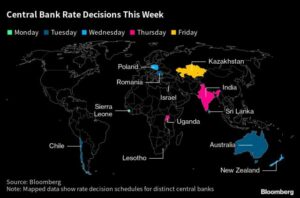
The monthly jobs report is also expected to show the jobless rate held close to historically low levels. Other US data on the agenda include February job openings and March purchasing managers surveys in manufacturing and services. Fed Governor Lisa Cook and regional Fed bank presidents Loretta Mester and James Bullard are among the central bankers speaking in the coming week. Further north, the Bank of Canada will release two closely watched surveys of business and consumer sentiment, along with a fresh batch of labor-market data to inform trader bets for the central bank’s April 12 rate decision. And further afield, the Bank of Japan will get a new governor, while central banks from India to New Zealand may hike rates while peers in Chile and Poland probably keep borrowing costs on hold. Australia’s policy decision hangs in the balance.
Stay up to date
More Newsletter to Check



SUBSCRIBE TO NEWSLETTER
Subscribe to download our daily economics and business roundup


×
![]()