
BRICS Bloc Extends Invitations to New Members, Including Egypt, Iran and Saudi Arabia and the UAE in Second Wave Of Expansion

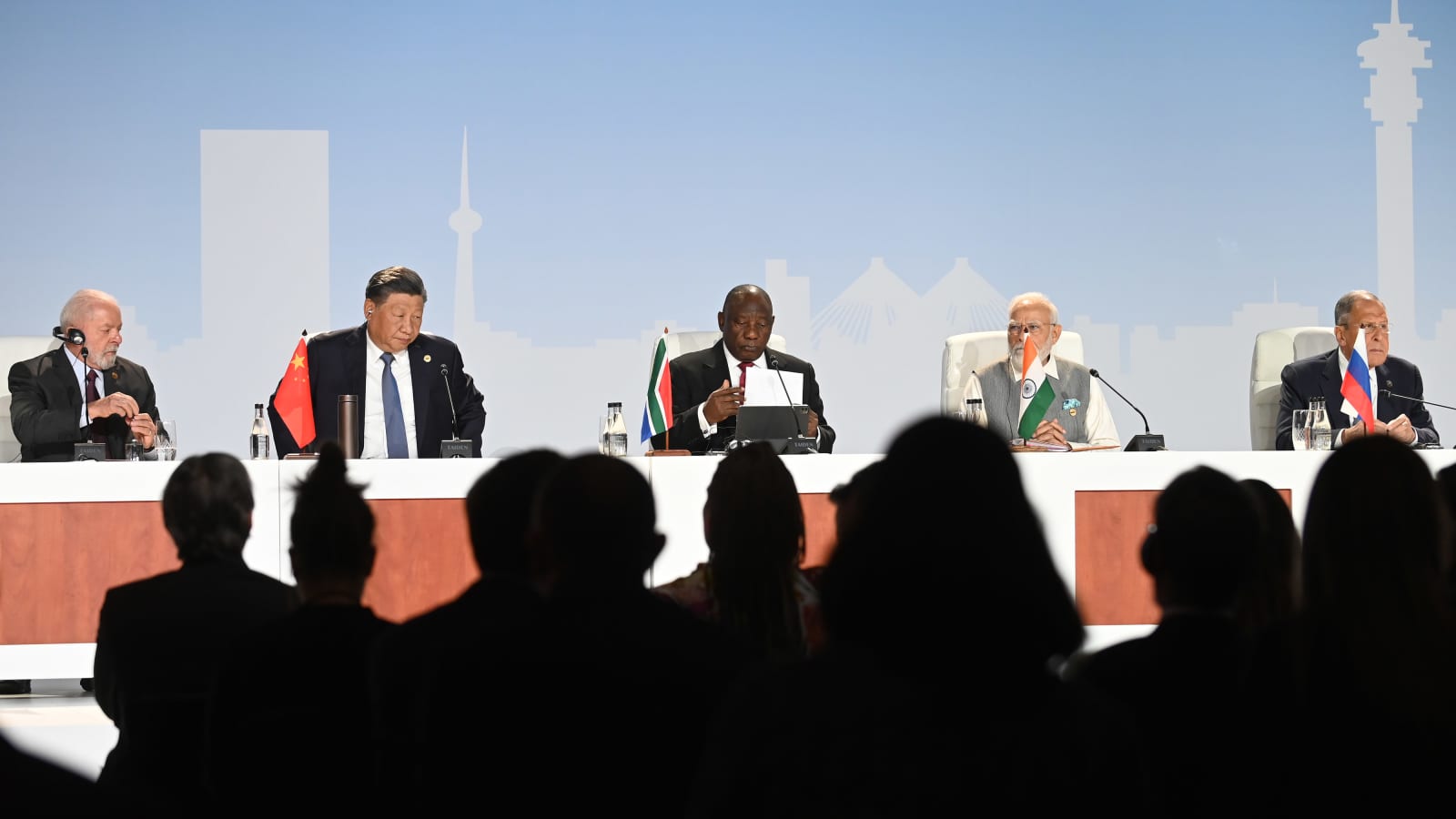
BRICS Bloc Extends Invitations to New Members, Including Egypt, Iran and Saudi Arabia and the UAE in Second Wave Of Expansion. The BRICS Bloc of emerging economies, including Brazil, Russia, India, China, and South Africa, has greenlit invitations for Argentina, Saudi Arabia, Egypt, Ethiopia, the United Arab Emirates, and Iran to join its ranks. South African President Cyril Ramaphosa made the announcement during the culmination of the 15th Summit of Heads of State and Governments in Johannesburg, a gathering attended by other BRICS leaders. This marks the second wave of BRICS expansion, with the first occurring after its establishment in 2009. (Bloomberg)
- The Bloc Aims to be a new force reshaping the World’s Economic Powers
The BRICS alliance is collectively representing approximately 40% of the global population and contributing over a quarter of the world's GDP. The consortium aims to bolster its influence within international institutions, historically dominated by Western powers. Formal expressions of interest to join BRICS have been submitted by 23 countries, which include Argentina, Iran, Saudi Arabia, Bolivia, Cuba, Honduras, and Venezuela, among others. While the economic bloc has yet to divulge its specific membership criteria, this expansion underscores its ambition to establish a more inclusive and diversified global economic landscape. (Bloomberg)
- Zilla Capital asserts that Egypt's inclusion in the BRICS bloc has the potential to significantly reduce its reliance on the US dollar on several fronts.
Firstly, bilateral trade with BRICS member countries will partially shift to local currencies instead of relying on the US dollar only. This shift could provide Egypt with a degree of insulation from the volatility and fluctuations often associated with dollar-denominated transactions. In addition, the invitation to join BRICS offers Egypt an opportunity to negotiate the use of its local currency in settling debts owed to fellow member nations. This strategic move would not only diminish the constraints imposed by dollar-dependent debt obligations but also enhance Egypt's financial sovereignty. (Zilla Capital)
- Egypt's Ministry of Transport Inks Deal with MEDLOG MSC for Innovative Dry Port and Logistics Center.
The Egyptian Ministry of Transport has entered into a contract with the logistics services provider MEDLOG MSC. This strategic agreement encompasses the financing, design, establishment, operation, and maintenance of a cutting-edge dry port and logistics center in the 10th of Ramadan city, as per an official statement released on August 24th. Spanning a 130-feddan area, the forthcoming dry port will integrate with a vast 120-feddan logistics center. The venture holds potential to revolutionize trade traffic dynamics, effectively curbing congestion, optimizing logistics services, streamlining transport costs, enhancing connections between manufacturing and consumption hubs, and mitigating the impact of environmental factors. (Al Ahram)
- El-Sisi ratifies increase to EBRD’s technical assistance grant for Cairo Metro line 1.
President Abdel Fattah El-Sisi of Egypt has officially ratified a resolution aimed at augmenting the technical assistance grant from the European Bank for Reconstruction and Development (EBRD) to support the upgrading of Cairo Metro line 1. The grant increase effectively raises the overall funding to €3.356 million. This endorsement comes subsequent to the parliamentary approval of the resolution in April, underlining the nation's steadfast dedication to bolstering its vital transportation network. (Al Ahram)
- Canada's TransGlobe Energy mulls boosting investments in Egypt.
Egypt's Minister of Petroleum and Mineral Resources, Tarek El-Molla, engaged in discussions with TransGlobe Energy Corporation's CEO, George Maxwell, in a bid to bolster the company's investments within Egypt, with a particular focus on untapped regions. A statement released on August 23rd highlighted their deliberations, which encompassed the prospect of conducting a seismic survey aimed at bolstering reserves and production. The meeting also delved into the productive outcomes stemming from collaborative drilling operations executed by Egypt's petroleum sector in conjunction with the Canadian firm. The results of this collaboration translated into a notable 25% upswing in oil production within TransGlobe's concessions during the present fiscal year. Impressively, the company's crude production from its Egyptian concessions has achieved a daily output of 12,500 barrels. (Arab Finance)
- GAFI approves establishing Tarboul Industrial City
The General Authority for Investment and Free Zones (GAFI) has accredited the request submitted by GV Developments to build Tarboul Industrial City, as per a statement on August 23rd. The project’s implementation is pending the Prime Minister’s approval. The project aims to establish an integrated regional development community on a 26,000-feddan area near Atfih city in Giza, featuring economic, industrial, and logistic activities. It will also include financial, business, commercial, and administrative centers, in addition to residential areas and community services, healthcare, training, and technical centers. (Arab Finance)
- Egypt's National Railway Industries Company to Secure EGP 3 Billion Loan for Manufacturing Facility.
The National Egyptian Railway Industries Company (NERIC) is on track to secure a substantial EGP 3 billion loan through a consortium of banks, headed by the National Bank of Egypt (NBE). This loan is earmarked to partially underwrite the investment expenses associated with the establishment and operation of a manufacturing facility dedicated to electric railcars and locomotives. As per information shared by the sources, the repayment timeline for the loan could extend up to a span of 10 years, highlighting the long-term nature of the financial arrangement. (Bloomberg Alsharq).
- Fawry Inks Collaboration Agreement with BM Consumer Finance Souhoola to Increase E-Payment Solutions
Fawry, a key player in the realm of electronic payment services, has signed a collaboration protocol with BM Consumer Finance Souhoola, a prominent non-bank consumer finance entity. This strategic partnership, as conveyed through an official press release on August 24th, aims to bolster e-payment services tailored for merchants. Central to this alliance is the provision of Fawry Accept's comprehensive suite of e-payment choices to customers of BM Consumer Finance Souhoola. This symbiotic arrangement falls squarely within Fawry's overarching mission to foster financial inclusivity, foster the expansion of digital transformation initiatives, and advocate for the adoption of cashless payment methods. Through this collaboration, both entities strive to offer an enriched e-payment ecosystem that aligns seamlessly with evolving market dynamics. (Mubasher)
- Egypt's Real Estate Sector Thrives Amid Soaring Inflation.
In the midst of an economic landscape marked by annual inflation rates surpassing 40%, Egypt's real estate market has showcased resilience by witnessing a surge in demand, even in the face of elevated prices. According to Hazem Badran, the CEO of Palm Hills Development Company (PHDC), this phenomenon has translated into notable sales figures for real estate developers. In an exclusive interview with Asharq Business on August 23rd, Badran emphasized that despite high inflation and a substantial depreciation in the local currency's exchange rate, the real estate sector's appeal remains undiminished. This remarkable phenomenon can be attributed to several factors. Chief among them is Egypt's burgeoning population, which serves as a steadfast driver for robust demand in the housing sector. Additionally, the Egyptian populace's inclination towards real estate as a paramount investment tool and a safeguard against inflation has significantly bolstered the sector's vitality. Providing further insights, Badran disclosed that Palm Hills is contemplating a potential price increase ranging between 13% and 14% for its residential units within a year's time. This strategic move reflects the company's strategic response to the evolving market dynamics. (Bloomberg Alsharq)
Stay up to date
More Newsletter to Check


SUBSCRIBE TO NEWSLETTER
Subscribe to download our daily economics and business roundup


×
![]()