
BOE intervention prevented further carnage

BOE intervention prevented further carnage
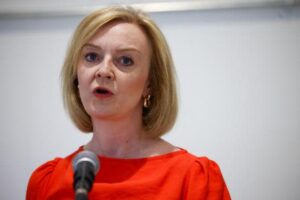
However, the QT to QE switch until October 14 may only stave off volatility temporarily as Prime Minister Truss is adamantly focused on unfunded tax cuts.
The scrutiny is growing and the Tory government is slumping in the polls. Questions as to whether this was the UK gilt market’s “Lehman” moment continue. Some readers may disagree, but we can agree on market disorder with an effective margin call.
After the largest one-day move wider in gilts, we saw the largest one-day rally. On Sunday, the UK’s Chancellor of Exchequer doubled down on unfunded tax cuts and went one step further. The admission of further tax cuts in January triggered GBP to sell-off to 1.0327 on Monday. Downing Street showed no signs of retreating but after a BOE press release on Monday and intervention on Wednesday, the gilt market showed signs of relaxing.
The BOE also announced a £65bn QE program over 13-days, which comes out as £5bn in gilt purchases daily. This is stimulative as the BOE are not sterilizing to protect GBP, which explains the FX weakness. The immediate effect saw the 30-year gilt rally 138bps from the announcement into the end of the week. The government’s tax policy is being criticized more ardently by the IMF, Moody’s and even President Erdogan of Turkey. Such events seemed to overshadow Italian elections and even Russia’s scam-referenda in Ukraine.
Nevertheless, tensions with the West are growing after Nord Stream 1 and 2 were sabotaged, just as Ukraine submitted it fast-track application to NATO. Volatility in U.S. Treasuries was of course the theme of the week as the 10-year note broke above 4.0%, even EMFX volatility reached a post-pandemic high. In keeping with our previous comments of verbal FX intervention in DM (Japan), China’s PBoC went just as far. The offshore renminbi broke above 7.26 to its weakest level since 2011, while the onshore FX weakened to levels not seen since 2008. China’s FX markets eased on the threat of the reintroduction of counter-cyclical factors associated with the daily fixing, but such volatility added to tensions in global markets. As such tensions persist, the next major test will come with Brazilian elections which are due to take place on Sunday.
S&P puts UK credit rating on notice with ‘negative outlook’

Rather than threaten a material adverse change to the UK's creditworthiness and borrowing access, this rating reprimand is an embarrassment for the government; and areminder of the importance of restoring the credibility of the country's policymaking process.
The UK’s credit rating was threatened with a downgrade late on Friday when S&P, one of the world’s largest credit rating agencies, put the country on a “negative outlook” after chancellor Kwasi Kwarteng’s “mini” Budget last week. The rating agency maintained the UK’s double A investment grade credit rating but warned the outlook was negative. S&P said that after the chancellor’s statement, there were “additional risks” in lending to the UK. The threat of a ratings downgrade will prove embarrassing for the Truss government only a few weeks after the new prime minister took office. The “mini” Budget sent the pound falling and interest rates higher because financial markets thought it would stoke inflation at a difficult time.
S&P said its decision was based on the fiscal statement and the government’s plan to “reduce a range of taxes in addition to its previously communicated intentions to extend wide-ranging support for households on energy bills”. Credit rating agencies have lost some of their power since the 2008-09 financial crisis when they failed to warn of the risk in many complex products, they had given top triple A ratings. But their sovereign ratings are still closely watched. Most experts in public finances have been more relaxed about the decision to spend billions on a temporary scheme to keep electricity and gas bills down this winter than the permanent cuts to national insurance and income tax, including the highest rate, and the decision not to raise the main level of corporation tax.
In the past week, the pound has hit an all-time low against the US dollar, before recovering, the cost of government borrowing has risen more than 0.5 percentage points, the Bank of England has had to intervene to protect the pension system and mortgage lenders have pulled most fixed-rate products from the market. S&P estimated that the UK’s budget deficit would widen by 2.6 percentage points of gross domestic product by 2025 as a result of Kwarteng’s package, making it very difficult for the chancellor to achieve his ambition of bringing public debt down as a share of national income.

Russia’s formal annexation of four Ukrainian regions after sham referenda ushers in a new riskier phase in Ukraine war
On Friday, President Putin signed documents proclaiming the annexation of four occupied Ukrainian regions (Donetsk, Luhansk, Zaporizhzhia, and Kherson) to the Russian Federation following Kremlin-organized referenda, which is unrecognized by most of the international community. It is expected that two houses of Russia’s parliament will approve the treaties by October 4th, ratifying them into law.
We believe these developments mark the “end of the beginning” in the Ukrainian war and introduce a new, potentially more dangerous phase in which market risks emanating from the conflict might increase. Support for the war effort is strong on both sides, which carries significant escalation risks, especially if Ukrainian leadership decides to respond to Putin’s move by intensifying its counteroffensive against the now annexed territories before winter conditions settle in. In this context, we expect that Moscow will inevitably resort to more frequent and open references to its nuclear capabilities in order to “defend” the annexed territories, periodically sending shivers through global markets.
We believe that the risk of nuclear weapons being used in/on Ukraine remains low but could grow higher if the chain of events unleashed by the annexations and Ukraine’s momentum on the battlefield puts President Putin “in a corner” over the coming months. As the situation in Ukraine becomes more challenging to manage, we expect the Kremlin will intensify its “proxy wars” against Europe, mostly via energy policy hoping to break the West’s resolve to maintain financial and military support for Ukraine. We believe this is unlikely to happen, which anchors our expectation for a protracted military conflict with significant escalation risks in early 2023 when the weather conditions improve.
Why the dollar is strong and why that is a problem
Here are a few familiar descriptions of the dollar: “the cleanest shirt in the laundry basket”, “the least-ugly mug in a beauty contest”, “the one-eyed man in the kingdom of the blind”. Nobody, it seems, loves the dollar; they just really dislike the alternatives. And that aversion is only growing. The dxy, an index of the dollar against half a dozen major currencies, is at a 20-year high. Among the dirtiest of the dirty linen are sterling, the euro and the yen.
Much of the recent rise reflects differences in monetary policy. At the turn of the year, the Federal Reserve became more determined to tackle inflation. A series of interest-rate increases since then, with more expected, has turned the dollar into a high-yielding currency. Lofty interest rates are a draw to global capital, which in turn has pushed up the dollar. The dollar is also a refuge in troubled times. Scared investors tend to reach for the currency. And high oil and gas prices are generally bad for energy importers, such as Europe, but good for energy exporters, such as America. The handful of currencies that have kept pace with or beaten the dollar this year tend to be those of energy-producing countries.
In short, the dollar is the go-to currency largely because America has proved a reliable source of economic growth. That is particularly true now. Europe is edging closer to recession. The closely watched purchasing-managers’ index suggests the euro-zone economy shrank in August. Less noticed is that Asia is also losing steam. Sluggish export growth is the latest worry for China’s economy, the vitality of which has been sapped by a property hangover and the country’s zero-covid policy. China’s weakness is apparent across Asia. Industrial output fell sharply in South Korea, Taiwan and Japan in July. Export orders have slumped. High energy costs have not helped. The currencies of these countries have wilted against the dollar. In Japan, where the central bank has stuck with ultra-low interest rates, the authorities have hinted that they may intervene to halt the yen’s slide. In China there has been renewed action to support the yuan.
So is the dollar now a problem? In principle, its strength is a remedy for unbalanced global growth, since it gives European and Asian exporters an edge over domestic producers in the stronger American market. In practice, a strong dollar makes matters worse. It squeezes global credit, because countries and companies beyond America’s borders borrow in dollars. So when the dollar rises, it becomes more expensive to pay back debts out of local-currency revenues. For many emerging-market economies, the higher cost of dollar borrowing trumps the boost to exports they get from a weaker currency. Dollar strength may not even be a boon for rich countries, says Steve Englander of Standard Chartered, a bank. Exporters in Europe are hamstrung by energy disruptions, so cannot take full competitive advantage of a favorable exchange rate.
Will the dollar ever weaken? For that three conditions need to be met. First, the global growth gap has to narrow. A hard landing in America won’t do the trick. A synchronized downturn in all regions of the world would only spark a run to the safety of the dollar (although the beleaguered yen might finally catch a bid). What is needed is for growth prospects outside America to improve. A second condition is a rapid reduction in price and wage pressures in America. This would allow the Fed to ease off the monetary brake, withdrawing some yield support from the dollar. The third condition is related to the first two: a weaker dollar requires some kind of good news on global energy. Absent that, it is hard to see Europe closing the growth gap with America.
Stay up to date
More Newsletter to Check



SUBSCRIBE TO NEWSLETTER
Subscribe to download our daily economics and business roundup


×
![]()