
Another bank warning about the US economic outlook — and this despite the continued strength of the labor market

Another bank warning about the US economic outlook — and this despite the continued strength of the labor market
The more the banks act on such warnings, including by tightening lending terms, the higher the risk of a US recession moving from being a risk scenario to more of a baseline.
Citigroup Inc. Chief Executive Officer Jane Fraser said the US will have difficulty avoiding a recession, though a severe downturn is not the bank’s “base-case” scenario. “Europe definitely felt more likely to be heading into a recession than you see in the US,” Fraser, who just returned from a trip to Europe and Asia, said at an investor conference Friday. Still, even in the US, a recession is “not easy to avoid.”
Fraser’s comments added to a flurry of pessimism among banking executives in recent days. Jamie Dimon, her counterpart at JPMorgan Chase & Co., said Wednesday that he sees an economic “hurricane” approaching. And Goldman Sachs Group Inc. President John Waldron called the number of shocks facing the economy “unprecedented.” The data still don’t support predictions of looming catastrophe. Friday’s jobs report showed bigger-than-expected payroll gains, and economists see a recession as unlikely next year. A Bloomberg survey estimates a 30% chance of recession in the next 12 months, up from 15% in March.
Fraser said Citigroup’s traders are dealing with a burst of activity from corporate clients looking to place bets on Group of 10 rates and foreign exchange. But that volatility may soon subside as investors adjust to the pace of rate hikes the Federal Reserve has laid out for the US, she said.
On the other hand, the European Central Bank is finally about to join the global bandwagon of monetary policy tightening, spurred into action by repeated record highs in inflation. Almost three months since the US Federal Reserve delivered a first interest-rate hike, its euro-zone counterpart will this week announce an end to bond purchases and formally begin the countdown to an increase in borrowing costs in July. The ECB has hesitated to remove stimulus while gauging the fallout from the war raging just over the frontier of its currency area in Ukraine.
By contrast, most major central banks are now further down the road with tightening, and some are even ratcheting up the pace. The Fed doubled the speed of rate hikes last month with a half-point increase, and policy makers in Australia on Tuesday and India on Wednesday could follow suit with faster moves too. Against that backdrop and with euro-zone inflation now at 8.1%, there’s a clear consensus at the ECB on the need to get started. The argument now within the Governing Council centers on whether quarter-point increases are enough, and on how high to ultimately bring rates next year. Austrian central bank Governor Robert Holzmann says anything less than a half-point move “risks being seen as soft,” and colleagues from the Netherlands, Slovakia and Latvia have openly called for such an increment to at least be considered.
Fed’s Mester May back half-point September hike if prices don’t cool

Federal Reserve Bank of Cleveland President Loretta Mester confirmed her support for raising interest rates by a half point in June and July and said she would back be doing the same again in September if inflation is not retreating.
“I’m going to come into that September meeting and if I don’t see compelling evidence, then I could easily be a 50 basis-point in that meeting as well,” Mester said Friday during an interview with CNBC. “There’s no reason we have to make that decision today, but my starting point will be do we need to do another 50 or not.” Mester, who votes in monetary policy decisions this year, said she might support a smaller quarter-point rate increase in September if officials see “compelling evidence” that inflation is on a downward path. Her remarks are the final scheduled public comments from a Fed official before the start of their pre-meeting blackout period at midnight.
Fed officials raised interest rates by a quarter of a percentage point in March and by a half point in May. Policy makers expect that those higher borrowing costs will help them combat inflation by cooling the housing market and lowering demand for goods and services. The central bank has signaled that it will make half-point increases in June and July. Some officials, including Mester, say the pace of rate increases could accelerate, or slow down, in September based on what happens with inflation and the broader economy.
The US labor market added 390,000 jobs last month and wage gains held firm, the Labor Department reported earlier on Friday. Traders interpreted the data as a sign that the Fed will keep its policy tightening on track. “I think that having the headline number come in a little bit lower than the previous month is a good thing,” Mester said. “But it’s too soon to say that that’s going to change our outlook, or my outlook on policy.” Policy makers will meet again on June 14-15.
 " />
" /> The "economic experiment" continues in Turkiye as the central bank maintains ultra-negative interest rates in the face of high and still rising inflation
Turkish inflation hits 23-year high of 73.5%.
Turkey’s official inflation rate hit a 23-year high last month as President Recep Tayyip Erdoğan’s unorthodox strategy for managing the country’s 790 billion USD economy continued to backfire. The consumer price index rose 73.5% year on year in May, according to data from the country’s statistical agency, the highest level since October 1998 when Turkey was reeling from a period marred by unstable coalition governments and economic turmoil.
Food prices, which have become a growing source of discontent among the Turkish public, rose 91.6% year on year. Erdoğan, a staunch opponent of high interest rates, had ordered the central bank to repeatedly slash borrowing costs in the final months of last year, despite rising inflation. The president claimed he was embarking on a new economic model that would harness a cheap lira and a boom in exports to bring down inflation by eliminating the country’s longstanding trade deficit. Even before the war in Ukraine, critics had described the plan as a high-risk economic “experiment” that risked causing a collapse in the value of the Turkish lira and ushering in runaway inflation. The Turkish currency ticked slightly lower after the inflation data on Friday, weakening past TL16.5 to the US dollar and bringing its fall for 2022 to almost 20 per cent. The lira tumbled 44% in 2021.
Russia’s invasion of Ukraine has increased the challenges for Turkey’s economy, as a rise in global energy prices has pushed up the cost of the country’s already large energy import bill and further stoked inflation. While Turkey has enjoyed rapid economic growth thanks to ultra-loose monetary policy, the soaring cost of living has contributed to an erosion of popular support for Erdoğan ahead of presidential and parliamentary elections scheduled for June next year. Erdoğan last month said those who drew a link between interest rates and inflation were either “illiterate or traitors”. Growth topped 11% last year but it has shown signs of slowing as rampant inflation and the weak lira have taken their toll.
China May PMI data points to a recovery, although remains in contractionary territory
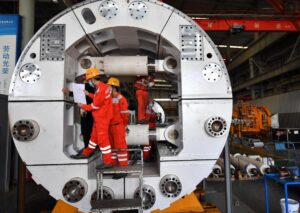
The May NBS Composite Index recovered by 5.7pts to 48.4pts, following April’s print which was the lowest level since 2020 on the latest virus surge.
Manufacturing and services indices exceeded expectations by 0.6pts and 2.3pts, respectively. While the Caixin manufacturing index missed consensus estimates by 0.9pts at 48.1pts, it rebounded by 2.1pts on the month. New orders, exports, price inputs, and supply time components improved in both manufacturing indices to varying degrees. Employment, which often lags, weakened in the Caixin survey but showed some slight improvement in NBS.
The data is in line with an expected gradual recovery as the current virus wave ebbs, with less than 10% of GDP under lockdown conditions and case levels back near lows. While we expect the authorities to take a cautious approach to reopening, the aforementioned data suggests that the continued improvement will likely push the economy back into expansionary territory for June, assuming no reversal in high-risk jurisdictions and lockdowns in the coming weeks. We believe growth can still be in the 3.5-4.5% range, depending on the development and evolution of policy levers between now and year-end. Given that tourism and outbound travel restrictions will likely still face elevated regulation in the near-term, erosion of the current account surplus should be gradual and CNY pressures dictated largely by capital flows, appear to have stabilized.
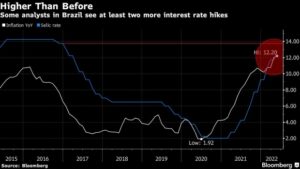
Brazil’s Rate Is Headed to 14% From Just 2% in Depth of Pandemic
Central bank says rate hikes ending, with inflation above 12%, key rate seen back at 2016 peak
Brazil’s inflation is running so hot that a growing number of economists now expect the central bank to increase interest rates far beyond what policy makers deemed necessary just a few months ago. Economists at Credit Suisse Group AG and BNP Paribas SA are among those who expect Brazil’s benchmark interest rate, now at 12.75%, to end the current monetary tightening cycle at or near 14.25%, matching its latest peak in 2016. Most economists surveyed by Bloomberg still see it ending the year at 13.25%.
Bets on higher interest rates show just how difficult it will be for the institution led by Roberto Campos Neto to fine tune monetary policy at times of war and supply-chain disruptions. Policy makers had signaled they’d like to stop tightening at 12.75%, but had to call another 50 basis points hike as “likely” following disappointing price data. They’ve already boosted the key rate by 10.75 percentage points since last year -- among the most aggressive campaigns in the aftermath of the pandemic.
Despite the bank’s efforts, prices continued to rise more than expected, driving inflation estimates further above target and hurting President Jair Bolsonaro’s re-election chances in October. Nearly a third of his supporters said they could change their vote if inflation continues accelerating in the next few months, according to last week’s Datafolha poll, which showed former President Luiz Inacio Lula da Silva extending his lead in the race. Rising consumer prices are a headache for nearly every world leader nowadays, but they have a disproportionate impact on the poor, which in Brazil make up most of the population.
Campos Neto, trying a balancing act between curbing price increases and protecting growth, said on Tuesday he’ll do “whatever is possible” to meet the bank’s inflation target with the “minimum cost” for the economy. Traders interpreted his remarks as another signal that the central bank will try to end the tightening campaign this month, sending swap rates lower. But inflation has yet to give him a reason to stop. Consumer prices soared 12.2% a year by mid-May, above economists’ expectations, with increases widespread across nearly all baskets of goods and services tracked by the national statistics institute.
Stay up to date
More Newsletter to Check



SUBSCRIBE TO NEWSLETTER
Subscribe to download our daily economics and business roundup


×
![]()