The U.S. government shutdown has now lasted fourteen days, making it the fourth-longest in history and highlighting the growing divide between politics and economics. What started as a budget dispute is now affecting U.S. markets, Federal Reserve policy, and global confidence in America’s fiscal stability. The impact is increasingly visible in political, economic, and financial areas, with four major channels showing how the standoff influences the U.S. economy and beyond.
1. The Immediate Triggers: Political Paralysis and Fiscal Friction
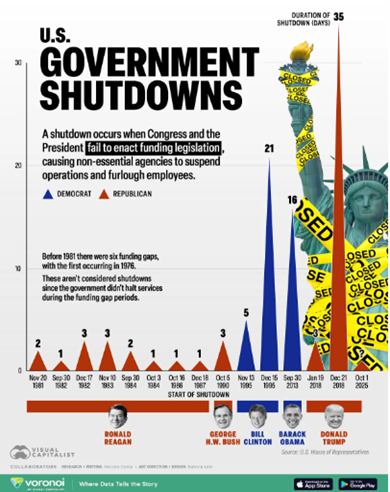
The shutdown began on October 1, following Congress's inability to agree on a spending bill. Several efforts to approve temporary funding were unsuccessful, illustrating ongoing divisions in Washington. This situation reflects broader challenges in consensus-building, which have affected fiscal governance.
In the past, shutdowns have often resolved without significant economic impact. However, current conditions differ: the U.S. is facing higher interest rates, slower economic growth, and increased political activity ahead of upcoming elections. These elements may turn what is usually a temporary disruption into a longer-lasting economic challenge.
As the shutdown continues, attention is shifting from when it will conclude to the extent of its effects on confidence, consumption, and policy credibility.
2. Economic Channels: From Household Income to Market Visibility
The immediate consequences are already visible. Hundreds of thousands of federal workers are without pay, suppressing household incomes and curbing consumption. Government contracts have been delayed, weighing on private-sector liquidity. Each additional week of paralysis trims output and adds friction to the economy’s short-term recovery path.
Yet, the larger concern lies not in the direct loss of activity but in the loss of information. With key data releases—such as jobs, inflation, and retail sales—delayed, both markets and the Federal Reserve are left navigating without critical indicators. This “data blackout” introduces uncertainty into monetary policy expectations, undermining the Fed’s data-dependent strategy and increasing volatility in bond and equity markets alike.
In effect, the shutdown has blurred the visibility of the world’s most-watched economy. The timing of rate cuts, the outlook for inflation, and the assessment of growth momentum are now all subject to greater uncertainty—precisely at a time when policy clarity is most needed.
3. Structural Implications: From Furloughs to a Smaller Government Footprint
Beyond these short-term distortions, a deeper debate is emerging. The political narrative surrounding the shutdown has revived talk of a permanent downsizing of government employment, sometimes referred to as DOGE 2.0. While furloughs have traditionally been temporary, this discourse signals a shift toward a leaner federal apparatus.
If such structural cuts were to materialize, they would not only suppress public-sector wages but also reduce aggregate demand—prolonging the effects of today’s disruption. The result would be a more persistent headwind for growth, one that reshapes the balance between public and private sector roles in sustaining U.S. economic momentum.
This transition—if sustained—would mark a fundamental recalibration of the American economic model, where government spending becomes less of a stabilizer and private consumption carries a heavier burden.
4.The Broader Context: When Fiscal Dysfunction Meets Monetary Responsibility
The 2025 shutdown also exposes a broader paradox: an economy demonstrating resilience on the surface but facing deeper institutional fatigue underneath. Corporate earnings remain strong, inflation is easing, and unemployment remains low. Yet these indicators mask a growing fragility—one rooted in the erosion of fiscal discipline and political cooperation.
Every episode of fiscal dysfunction places more pressure on the Federal Reserve to act as the de facto stabilizer of the U.S. economy. However, monetary policy cannot permanently substitute for a credible fiscal framework. Prolonged political gridlock risks blurring the boundaries between the two, leaving the Fed to manage not only inflation but also the consequences of legislative inertia.
In global markets, this pattern gradually undermines confidence in U.S. policymaking. Treasury yields begin to embed a “political risk premium,” the dollar’s safe-haven appeal faces intermittent challenges, and investors question whether the world’s largest economy can remain insulated from its own governance shortcomings.
Conclusion: The Cost of Normalizing Dysfunction
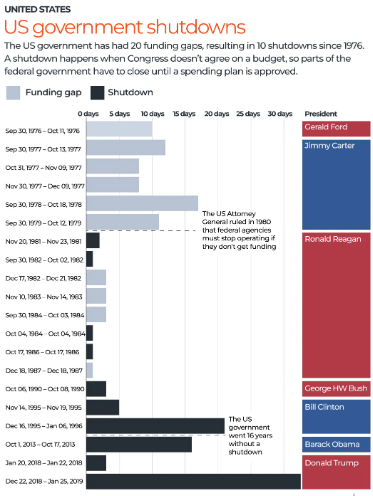
The shutdown will eventually end, as they always do. But each recurrence leaves deeper marks. What was once seen as an occasional political tactic is now evolving into a cyclical feature of American governance—a normalization of dysfunction.
The economic cost is measurable in lost output and delayed spending, but the political cost is more profound: a gradual erosion of trust in the U.S. government’s ability to manage its own finances. If that erosion continues, the credibility of both fiscal and monetary policy could weaken, altering global perceptions of the United States as a source of economic stability.
In the end, the shutdown is more than a temporary impasse; it is a mirror reflecting a structural challenge—how long the world’s most dynamic economy can remain resilient while its political system repeatedly undermines the very stability on which that resilience depends.


