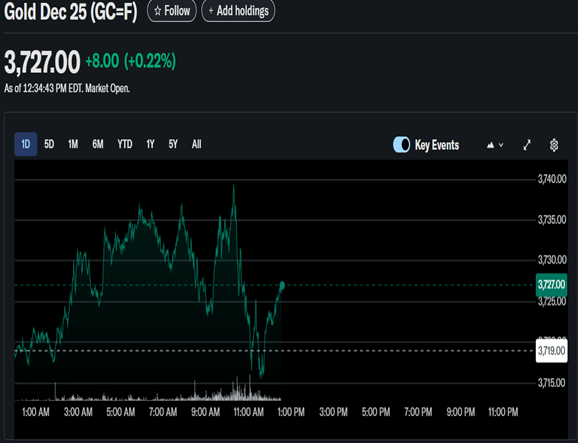
Gold rose to USD3,695.30 per ounce on September 16, 2025, up 0.43% from the previous day, with current trading showing prices reaching USD3,732.70, extending its remarkable run to new all-time highs. Over the past month, gold's price has risen 10.89% and is up 43.56% compared to the same time last year. But this isn't your grandfather's gold rally driven by jewelry demand or mining supply shocks. We're witnessing the opening act of a structural regime change that's rewiring how institutional capital thinks about portfolio insurance.
Gold hit an all-time high on Monday, underpinned by a softer dollar and lower Treasury yields, as investors positioned ahead of a pivotal Federal Reserve meeting this week. While the financial media fixates on headline numbers, smart money is reading between the lines. This breakout signals something far more profound than another commodity Supercycle.
The Structural Shift Nobody Saw Coming
Three forces are converging to create what I'm calling the "Great Portfolio Rebalancing":
1. Fed Policy Capitulation
This week's FOMC meeting represents a critical inflection point. The market has shifted from pricing cautious cuts to expecting aggressive accommodation. When the world's most important central bank pivots this dramatically, institutions start hoarding real assets fast.
2. The De-Dollarization Acceleration
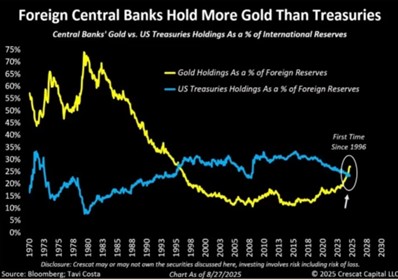
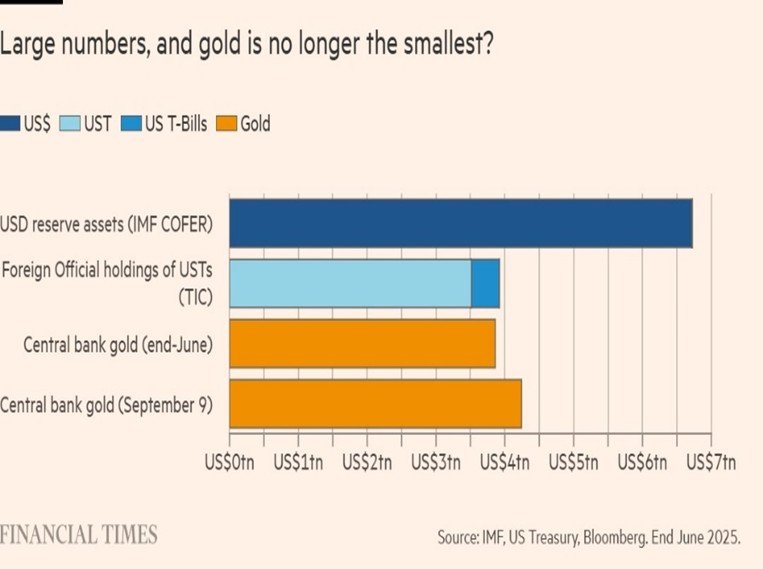
Here's the kicker most analysts are missing: central banks now hold more gold than US Treasuries for the first time since Bretton Woods collapsed. IMF data shows global central bank gold reserves at USD4.2 tn versus USD3.9 tn in US Treasury holdings. This isn't portfolio rebalancing—it's a systematic rejection of dollar hegemony.
The World Gold Council forecasts another 900+ tons of central bank buying this year. That's institutional capital voting with their vaults, not their mouths.
3. The "Trump-Proofing" Trade
Giant Research houses aren’t mincing words: gold could hit USD5,000 if political pressure on Fed independence persists. Institutional investors are buying gold as insurance against central bank capture—a risk premium that didn't exist in previous cycles.
4.China Leading the Central Bank Gold Rush
China's central bank has extended its gold buying spree to 10 months, with bullion holdings rising by 0.06 mn troy ounces to 74.02 mn troy ounces, accumulating a total of 1.22 mn troy ounces over this period. After taking a six-month pause in 2024 following an 18-month purchasing spree, the People's Bank of China resumed buying gold in November when Donald Trump won the U.S. presidential election.
China's gold reserves increased to 2,298.53 tonnes in the second quarter of 2025 from 2,292.31 tonnes in the first quarter, demonstrating the world's second-largest economy's commitment to diversifying away from dollar-denominated assets. This systematic accumulation by China, combined with similar moves by other major central banks, underscores the fundamental shift in global monetary architecture.
Why USD4,000 Is Just the Beginning
Recent research from leading institutions indicates that gold would reach USD 3,700 by year-end 2025—a 40% increase based on January's opening price of USD 2,633. Given current momentum, this target looks conservative. Despite the Fed maintaining restrictive interest rates, gold has rallied approximately 27% year-to-date in 2025, reflecting persistent inflation concerns, geopolitical uncertainties, and massive central bank gold purchases.
The technical setup screams continuation of momentum. Gold futures opened Tuesday up 1% from Monday's close of USD3,682.20 per ounce, with Tuesday's opening price up 2% from the previous opening, with institutional flows accelerating into the Fed meeting.
The Fed Meeting That Changes Everything
This week's FOMC meeting isn't just about 25bp versus 50bp. It's about whether the Fed maintains credibility as an independent institution or capitulates to political pressure. Either outcome is bullish for gold:
- Dovish surprise: Confirms inflation will run hot, making gold's zero-yield irrelevant
- Hawkish hold: Accelerates fiscal crisis as Treasury yields spike further
The market has already chosen sides. Gold regains its traction and holds on to marginal gains near USD3,650 on Friday ahead of next week's critical Fed policy meeting.
Bottom Line: A Structural Transformation Underway
The world's central banks are on track to buy 1,000 metric tons of gold in 2025, which would be their fourth consecutive year of substantial accumulation. This level of institutional demand, led by major economies like China, suggests a permanent shift in how nations view monetary reserves.
The convergence of Fed policy uncertainty, accelerating de-dollarization, and geopolitical tensions has created conditions where gold serves as more than just an inflation hedge—it's become essential monetary infrastructure. Central banks understand this reality, which is why they continue accumulating despite record prices.
The USD4,000 signal Wall Street is missing isn't about gold going up. It's about everything else becoming systematically riskier, and institutional recognition that traditional monetary assets may no longer provide the security they once did. In this environment, gold's role as a monetary anchor becomes not just valuable, but indispensable.


