The oil market has entered another sharp correction. Brent crude, which was trading above USD 74 just weeks ago, dropped to nearly USD 66, and is on track for its second consecutive weekly loss. While the pace of the decline may seem sudden, the reasons behind it have been building for months and the implications for Gulf economies are growing by the day.
So, what is behind the drop?
At the core of this selloff are two forces: demand fears and policy surprises. On the demand side, markets are increasingly pricing in a global slowdown. The return of Trump-era tariffs — particularly a 145% surcharge on Chinese imports — has reignited concerns over trade fragmentation and industrial deceleration. China’s retaliation with a 125% tariff on U.S. goods has deepened these fears, just as the IMF and IEA revised down oil demand growth expectations for both 2025 and 2026. For energy markets, this spells a clear message: consumption is going to be softer than expected, especially from the U.S. and China — the world’s two largest crude consumers.
Then came the supply shock. In an unexpected move, OPEC+ announced an acceleration in its planned output increases, effectively signaling that more barrels are coming online just as global demand weakens. This undermined any sense of market discipline. Traders quickly shifted from concerns about tight supply to worries about oversupply, pushing Brent into a deeper contango and driving down prices.
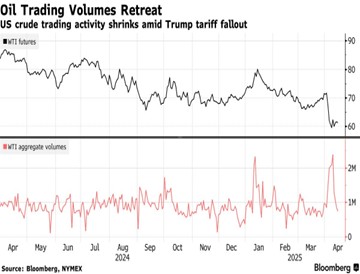
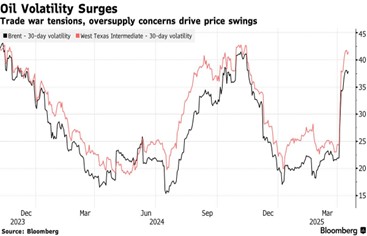
The result? Brent lost nearly USD 10 in less than two weeks and even with a mild rebound, most institutions now expect average prices for the rest of the year to hover in the USD 63–68 range.
What does this mean for the Gulf?
For the Gulf’s major oil exporters, the drop in prices couldn’t have come at a worse time. After a year of building momentum in non-oil sectors, stabilizing debt levels, and pushing forward with diversification agendas, the region now faces a new fiscal stress test. And not all economies are equally prepared.
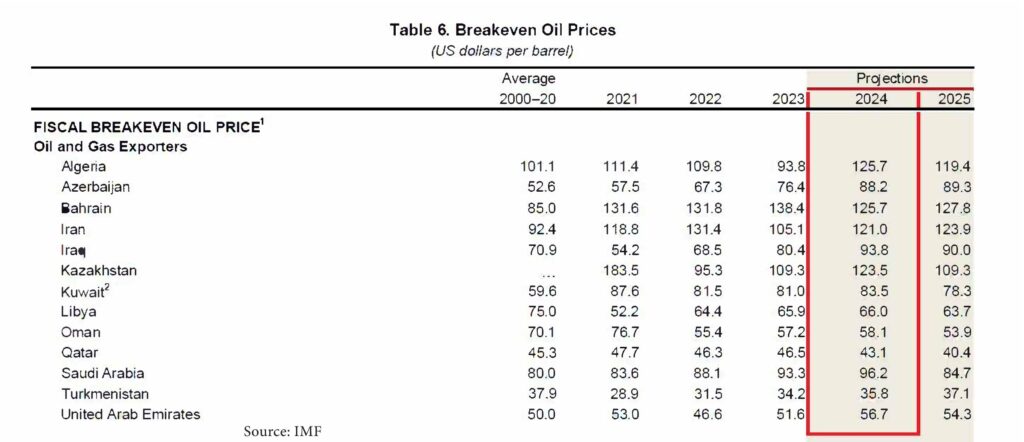
Saudi Arabia is the most closely watched. The IMF estimates that it needs oil at above USD 90 a barrel to balance its budget, especially when including outflows linked to Vision 2030. At USD 66 oil, the shortfall is significant. Goldman Sachs now forecasts a budget deficit of USD 67 bn this year, more than double previous projections. Lower dividend guidance from Aramco — down to USD 85 bn from USD 124 bn — only adds to the pressure.
While Saudi has fiscal space and market access, the government now faces difficult choices: maintain spending and absorb the shortfall through borrowing, or slow capital outlays and risk delaying key projects. According to reports from contractors, some NEOM and Red Sea projects have already been scaled back, while infrastructure for Expo 2030 and the World Cup appears to be prioritized.
Other Gulf states are in varying positions. Qatar and the UAE are best insulated. With breakeven prices between USD 45 and USD 60, both countries can continue spending without major disruption. Kuwait is near balance but hampered by internal gridlock that limits fiscal flexibility. Oman and Bahrain, meanwhile, face the greatest vulnerability — their breakevens are significantly higher, and buffers far thinner. Without external support or higher prices, their options are limited.
And what about Iraq?
The pressure is just as real, if not more acute. Iraq has announced it will lower its oil price assumption in the federal budget for 2025, after initially basing multi-year spending plans on USD 80 oil. With Brent now under USD 65, the assumptions no longer hold. And unlike Gulf states, Iraq has fewer tools and a more fragile fiscal base to respond with. Restarting exports from the Kurdish region remains unresolved, and revenue volatility may force Baghdad to scale back capital spending or increase borrowing.
Final Thought: This is not just volatility — it’s a structural wake-up call.
The current oil selloff has revealed how fragile the Gulf’s fiscal outlook remains despite years of diversification efforts. The region’s two pillars — fiscal buffers and global demand — are both being tested. A trade war-fueled slowdown, coupled with a looser supply strategy from OPEC+, could keep oil prices under pressure longer than expected.
The same challenge is facing the whole region: countries like Saudi Arabia are trying to push forward with big changes while still keeping their budgets in check, and others like Iraq are lowering their expectations for oil income. Oil at USD 66 isn’t a disaster, but it’s a wake-up call. The GCC isn’t in crisis, but it does need to adjust. The sooner that adjustment happens, the better prepared the region will be for the future.


