
Italy installs six grain storage silos after cancelling 100 million USD in debt owed by Egypt

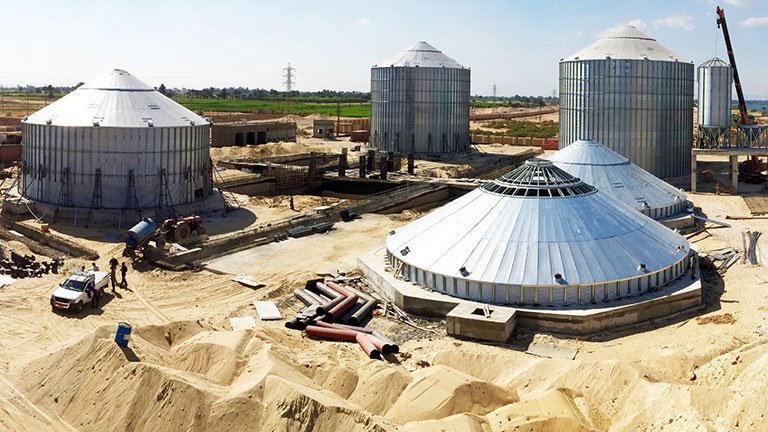
Italy installs six grain storage silos after cancelling 100 million USD in debt owed by Egypt. The Italian Ambassador to Cairo, Michele Quaroni, announced on Sunday that Italy has cancelled 100 million USD of debts owed by Egypt due to the Italian debt swap program. Quaroni explained that 75 million USD was allocated for a program to develop six advanced technological silos for storing grain in Egypt with support from the Italian government. (Egypt Business Daily News)
- Egypt to launch national strategy for green hydrogen production.
The national strategy will leverage Egypt's competitive capabilities to achieve its ambitious plans in the hydrogen sector, targeting up to 8% of the global tradable market by 2040. Green hydrogen production can also support Egyptian industrial energy needs while reducing dependence on petroleum imports. (Egypt Business Daily News)
- The Electricity Ministry could bring an end to the rolling blackouts in the middle of October as temperatures dip.
The government will bring an end to the load reductions which have been in place since mid-July. The ministry was forced into a program of rolling daily blackouts across most of the country in July as a prolonged heatwave combined with lower fuel supplies to put pressure on the electricity grid. Previous pledges to restore full power service (ranging from the end of July to the middle of September) have failed to transpire, with the country still suffering daily blackouts of at least an hour. (Al Borsa News)
- Egypt has bought new hedging contracts to protect itself from rising oil prices.
The derivatives will remain in place until the end of the current fiscal year in June, he said, without providing further information. The contracts lock in crude purchases at around 75-80 USD per barrel, below the 85 USD price assumed in the FY 2023-2024 budget. The country will need to import around 150 million barrels of oil. This is higher than the 100 million figures recently reported in the press. Oil prices have surged to their highest levels since November in recent days, fuelled by Saudi Arabia’s and Russia’s supply cuts and rising demand in Asia. The price of Brent has risen almost 30% over the past three months, closing at 92.51 USD last Tuesday, squeezing the finances of oil importers such as Egypt. (Asharq Business)
- The IMF is starting to believe the government is serious about its ambitions to sell down state assets,
a change in sentiment that it says could ease the path towards the all-important review of our 3 billion loan program. A number of recent agreements with Gulf and local investors have been met with a positive response from the Fund. The IMF has postponed the first and second reviews of the reform program after we fell short of complying with key conditions of the loan, including an acceleration of the government’s privatization plans as well as properly floating the EGP. Passing these two reviews would unlock almost 700 million USD in fresh financing and, perhaps most critically, provide a confidence-booster to investors that we’re on the right track to exit the current economic crisis. (Bloomberg)
- The IMF is now focusing on what will happen with the currency and is trying to obtain more information about the government’s expenditure on infrastructure projects.
Under the program, the government committed to transitioning to a fully flexible exchange rate as well as slow infrastructure spending, which has been blamed on raising inflation, using up FX resources, and increasing national debt. Authorities are unlikely to move to devalue the currency before the presidential vote, and even though this has been brought forward to December, there remains little time for the IMF to complete the review this year. Government officials have reportedly expressed confidence to the news outlet that a breakthrough can be made this year, though they didn’t disclose any information about a potential devaluation. (Bloomberg)
- Saudi Arabia’s Public Investment Fund (PIF) is interested in acquiring the Arab African International Bank’s (AAIB) 13% stake in Palm Hills Developments (PHD).
Talks between began about a month ago and are expected to wrap by the end of the year, adding that the transaction will be executed in USD. Mansour-Maghraby Investment and Development Company (MMID) is the single-largest shareholder with 41.9%, followed by the AAIB with a 13% stake. Palm Hills chairman and group CEO Yassin Mansour has a 7.3% stake in the company and the rest of the company distributed between other minority shareholders and freefloat shares on the EGX. (Al Borsa News)
- Egypt negotiates 1 million tons of wheat from Russia.
Egypt is currently in talks with the Russian government to buy 1 million tons of wheat. Talks have taken place regarding delivery for the current season. On September 25th, it was reported that Egypt in talks over a loan facility from an Abu Dhabi-based bank to pay for wheat imports from Kazakhstan. (Bloomberg)
- Chinese Chexim lends Egypt 400 million USD for LRT’s 3rd phase.
The Export-Import Bank of China (Chexim) will provide Egypt with a new loan worth 400 million USD to finance the construction works of the Light Rail Transit (LRT) project’s third phase. The third phase of the LRT project extends over 20.4 kilometers covering four stations. The loan is expected to get Egypt’s Parliament approval in early 2024. (Asharq Business)
- Egypt and Croatia sign double taxation avoidance agreement.
The move is aimed at stimulating trade and enhancing investment between both countries. Maait encouraged Croatian investors to expand their investments in Egypt and to benefit from the measures taken by the government to boost exports in various fields. (Arab Finance)
- Orascom Construction and Metito have reached financial close for their 2.2 billion USD water treatment project in Abu Dhabi.
The two contractors will establish a desalination plant with a capacity to treat more than 500k cubic meters per day and a 75-km water transmission pipeline. The project will be developed under a 30-year build-own-operate-transfer (BOOT) concession agreement in collaboration with the Abu Dhabi National Oil Company (Adnoc) and Abu Dhabi National Energy Company (Taqa). Commercial operations are set to commence in June 2026. A syndicate of eight Gulf lenders and French bank Natixis is providing non-recourse financing. (Arab finance)
- Banque Misr plans to establish an ESG green index fund in 1Q 2024 based on S&P’s sustainability index.
The state-owned lender will start by investing in EGX-listed companies that report on their ESG commitments and later expand to unlisted companies. It is still waiting to receive the necessary approvals, including from the Central Bank of Egypt (CBE). Information about the size of the fund wasn’t disclosed. The bank is also considering the listing of its Misr Real Estate Investment 1 fund launched in 2022, which reached 360 million EGP first close and has a target capital of 500 million EGP. (Al Borsa News)
- Marsa Alam airport scheduled to receive 27,000 tourists in a week.
The Marsa Alam airport receives flights throughout the week from 11 European countries including Germany, Italy, Poland, and the Czech Republic. Marsa Alam International Airport is scheduled to receive 135 tourist flights coming from European airports, carrying about 27,000 tourists of different nationalities from Saturday until Friday, according to the flight operating schedule of the airport. (Egypt Business Daily News)
Stay up to date
More Newsletter to Check



SUBSCRIBE TO NEWSLETTER
Subscribe to download our daily economics and business roundup


×
![]()