
The ECB raised interest rates for a tenth consecutive time to 4.0%. That’s 450bps in 15 months and the highest since the ECB’s creation, as well as the fastest pace of tightening ever

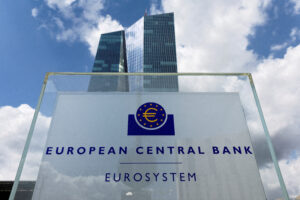
The ECB raised interest rates for a tenth consecutive time to 4.0%. That’s 450bps in 15 months and the highest since the ECB’s creation, as well as the fastest pace of tightening ever
For those who were surprised, Governor Klaas had said on Tuesday that investors were “maybe” underestimating the likelihood of an increase in borrowing costs. A weaker EUR remains the status quo nevertheless.
With more noise around 1.05, the focus shifts to oil becoming a material drag and the next major risk, along with elevated natural gas prices. The weak growth picture is already well understood. The Bank of Japan’s governor had also expressed a more hawkish view and implied an early end of the negative interest rate policy. Expectations of ending the yield curve control policy have subsequently been brought forward, just as the five-year JGB auction recorded its best metrics since 2021. U.S. Treasuries generally edged up through the week, as crude oil made fresh YTD gains, just as the USD rose for a ninth consecutive week.
For oil, the IEA stated that Saudi oil cuts could threaten a surge in price volatility, while also noting that inventories are at 13-month lows. This statement corroborated with OPEC noting that the oil market will likely face a 3.3m barrel per day shortfall in the fourth quarter. Should oil continue to build on the near 10% monthly move, then U.S. break-evens could risk breaking to the upside. Indeed, the story of CPI beating expectations is noteworthy, as further upside in retail sales and PPI stood out. Meanwhile, UK GDP missed expectations and came in negative at 0.5%, just as GS and JPM downgraded 2023 growth forecasts. German growth predictions for 2023 were revised down to -0.3% and the ECB now forecasts inflation remaining above 3% in 2024. These were not surprising developments, given the German ZEW survey fell to a 3-year low.
Positive tailwinds were associated with Turkey as Fitch revised the rating outlook to stable from negative, just as the Central Bank raised the RRR for FX-linked deposits to 25%. The key will be whether the CBRT increases interest rates again on Thursday. South Korea’s unemployment rate on a seasonally adjusted basis unexpectedly dropped to a record low of 2.4%. Sri Lanka’s local bond restructuring scheme is progressing well as the first review of the IMF program is underway. Senegal’s President Sall has backed his Prime Minister Amadou Ba to succeed him after the 2024 elections, which paves the way for a smooth transition. On the flipside, Ecuador Presidential Candidate, Daniel Noboa, did say he would use 1.5 billion USD of foreign reserves to help offset the effects of El Niño.
Inflation speeds up as gas prices climb, and some details could keep the Fed wary
While the dollar’s pre-eminent role in global trade and finance could diminish with time, recent fears about its demise seem overblown.
Federal Reserve officials are likely to remain wary about the outlook for inflation following a report released Wednesday: Overall price increases sped up because of a pop in gas prices in August, and a more closely watched index that strips out volatile food and fuel prices climbed at a faster monthly pace than expected. The Consumer Price Index rose 3.7% in the year through August, the report showed. That was both faster than the 3.2% July reading, and slightly quicker than the 3.6% that economists had expected.
After removing food and fuel costs, both of which can jump around a lot from month to month, a core price index increased 4.3% from a year ago. That was less than the previous reading. But on a monthly basis, the core measure climbed faster than economists expected — rising 0.3%, up from 0.2% in each of the previous two months. That monthly reading matters because we watch it for a hint of how much momentum inflation has. The slight pickup came as purchases like car insurance and airfares became more costly.
This report, which is the last major data release the Fed will receive before its Sept. 19-20 policy meeting. While central bankers are widely expected to leave interest rates unchanged at their gathering next week, they will probably debate whether one more rate move might be warranted later this year. Fed officials have already raised interest rates to a range of 5.25 to 5.5%, up sharply from near-zero as recently as March 2022. Those higher borrowing costs are meant to gradually slow the economy — but they take time to have their full effect, and are still trickling through to make it tougher and more expensive to use credit to buy a house, lease a car or expand a business.
Policymakers at the Fed want to avoid raising rates by so much that the delayed effects add up to tank economic growth. But they also want to avoid doing too little and allowing inflation to become a lasting feature of the American economy. Central bankers will release a fresh set of economic projections following their meeting next week. Those could show that they still expect to make one more quarter-point increase this year, before lowering rates by the end of 2024. But the bar for lifting borrowing costs seems to have climbed as inflation has slowed. John C. Williams, the president of the Federal Reserve Bank of New York and an influential official, recently said that policy is in a “good place” and that the question is “do we need to maybe raise rates” again.

Turkey floats alternative to G20’s India-Middle East trade corridor plan
Ankara seeks to emphasise its traditional role as a route for goods moving from Asia to Europe.
Turkey is in “intensive negotiations” with regional partners over its alternative to the India-Middle East trade corridor plan that was agreed at this month’s G20 summit, as the country seeks to bolster its historic role as a transport route for goods moving from Asia to Europe. Ankara has pushed back against the proposed India-Middle East route that would transport goods from the subcontinent through the United Arab Emirates, Saudi Arabia, Jordan and Israel to European markets. The mooted corridor, backed by the US and EU as they attempt to repel China’s growing influence, would completely bypass Turkey.
Recep Tayyip Erdoğan, president of Turkey, said after the G20 that “there can be no corridor without Turkey”, adding “the most appropriate route for trade from east to west must pass through Turkey”. His foreign minister Hakan Fidan has since doubled down on the scepticism, insisting this week that “experts had doubts that the primary goal [of the India-Middle East corridor] was rationality and efficiency” and suggesting “more geostrategic concerns” were at play. “A trade route does not only mean meeting trade alone. It’s also a reflection of geostrategic competition,” Fidan said in response to a question from the Financial Times.
Turkey is keen to emphasise its traditional role as a bridge between east and west, a history that dates back centuries to the silk roads. Ankara has instead touted an alternative called the Iraq Development Road initiative, with Fidan insisting “intensive negotiations” were under way with Iraq, Qatar and the UAE about a project that would be forged “within the next few months”. The proposed 17 billion USD route would take goods from the Grand Faw port in oil-rich southern Iraq through 10 Iraqi provinces and into Turkey. The plan would rely on 1,200km of high-speed rail and a parallel road network. The scheme has three phases, with the first aiming for completion in 2028 and the last in 2050.
The EU and China clash on electric vehicles
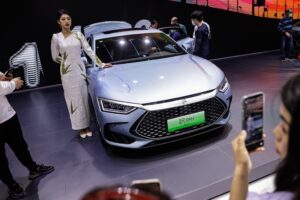
The International Motor Show, Europe’s largest automobile exhibition, is usually dominated by the continent’s top combustion engine brands, including BMW, Mercedes and Porsche. At the most recent expo in Munich last week, the spotlight was firmly on electric vehicles — a sector in which the EU’s auto industry has fallen woefully behind China.
The bloc is determined not to let car production go the way of its solar industry, which was overwhelmed by fierce competition from cheap Chinese imports a decade ago. On Wednesday, European Commission President Ursula von der Leyen announced an anti-subsidy probe into China’s electric vehicle industry, marking an escalation of tensions with Beijing as the bloc aims to reduce its dependence on China. It should come as no surprise that the Chinese state has heavily subsidised its electric vehicle industry. From raw materials through to production, it has been cornering the supply chain for decades. It has acted in an anti-competitive manner and it is fair for the EU to investigate Chinese practices. But, ultimately, retaliatory measures would not be in its interests.
First, if it is serious about its goal to lower carbon emissions as quickly as possible, it should not matter where EVs are being produced — particularly as the EU intends to ban the sale of new combustion engine cars from 2035. There is also no clear national security risk from China’s presence in the European EV market and it already faces a 10 per cent tariff. Indeed, Brussels imposed tariffs in 2013 on Chinese solar panels but lifted them five years later because it could not reach its renewable energy targets without them.
Further tariffs on Chinese imports would also coddle European carmakers, which have dawdled on EVs for years. German manufacturers have long been resistant, with trade unions and car lobbies reluctant to shift away from internal combustion engines — where European industry has prowess, and which are also more labour-intensive. EU tariffs on Chinese EVs would also sour relations and risk triggering retaliation from Beijing, which could be harmful to European interests; on Thursday, China’s commerce ministry attacked the EU’s probe as a “naked protectionist act”. Cheap imports from China during a cost of living crisis benefit the EU, particularly while European production is less efficient.
The probe itself may merely be von der Leyen’s response to political pressure. Nonetheless, Europe still needs to accelerate the development of EV models and knowhow, to ensure it does not become overly reliant on Chinese production. Indeed, given prospective levels of EV demand, there will be a large enough market for domestic manufacturers even if Chinese EVs continue to flood in. Imports of Chinese EVs are only a small share of the bloc’s market, though forecast to rise to 15 per cent in the coming years.
China has created an uneven playing field, but the gap between European and Chinese EV makers cannot be entirely ascribed to Beijing’s actions. Europe has dallied over the transition and lacked foresight. The bloc needs to increase its foothold in EVs — improved tax incentives and building charging infrastructure could help. But resorting to protectionism is not the answer. Industries are always evolving and for automakers it is now the battery, not the engine, that offers the added value. Europe has learnt that the hard way. Perhaps competitive pressures can help its manufacturers to finally make the leap.
Stay up to date
More Newsletter to Check



SUBSCRIBE TO NEWSLETTER
Subscribe to download our daily economics and business roundup


×
![]()