
Switzerland prepares emergency measures to deliver UBS takeover of Credit Suisse


Switzerland prepares emergency measures to deliver UBS takeover of Credit Suisse
Daily deposit outflows at troubled Swiss bank topped SFr10bn last week as fears for its health mounted.
Switzerland is preparing to use emergency measures to fast-track the takeover by UBS of Credit Suisse, as the banks and their regulators rush to seal a merger deal before markets open on Monday. Under Swiss rules, UBS would typically have to give shareholders six weeks to consult on the acquisition, which would combine Switzerland’s two biggest lenders. Three people briefed on the situation said UBS had indicated that emergency measures would be used so that it could skip the consultation period and pass the deal without a shareholder vote. The details are still being worked out.
UBS wants to be allowed to phase in any demands it would face under global rules on capital for the world’s biggest banks. Additionally, UBS has requested some form of indemnity or government agreement to cover future legal costs. Credit Suisse set aside SFr1.2bn in legal provisions in 2022 and warned that as yet unresolved lawsuits and regulatory probes could add another SFr1.2bn. UBS’s leadership team have concerns about taking on Credit Suisse’s investment bank, which has been the source of many of its scandals and losses in recent years.
The race for a deal comes days after the Swiss central bank was forced to provide an emergency SFr50bn ($54bn) credit line to Credit Suisse. This failed to arrest a slide in its share price, which has fallen to record lows after its largest investor ruled out providing any more capital and its chair admitted that an exodus of wealth management clients had continued. Deposit outflows from Credit Suisse topped SFr10bn ($10.8bn) a day late last week as fears for its health mounted. Shares of other European banks were also hit hard by the crisis in confidence which was triggered by the collapse of Silicon Valley Bank last weekend.
A full merger between UBS and Credit Suisse would create one of the biggest global systemically important financial institutions in Europe. UBS has $1.1tn total assets on its balance sheet and Credit Suisse has $575bn. However, such a large deal may prove too unwieldy to execute. The Financial Times has previously reported that other options under consideration include breaking up Credit Suisse and raising funds via a public offering of its ringfenced Swiss division, with the wealth and asset management units being sold to UBS or other bidders.
Fed will keep raising rates despite bank turmoil
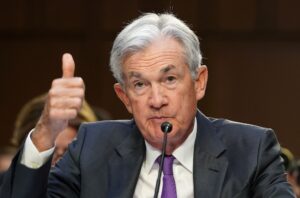
The Federal Reserve will keep raising its benchmark policy rate, holding it above 5.5 per cent for the rest of the year, despite turmoil across the US banking sector.
Between March 15 and 17 — just days after US regulators announced emergency measures to stem contagion and fortify the financial system — 49% forecast the federal funds rate to peak between 5.5% and 6% this year. That is up from 18 per cent in the previous survey in December and compares to the rate’s current level of between 4.50% and 4.75%. Another 16% estimated it would top out at 6% or higher, while roughly a third thought the Fed would stop short of these levels and cap its so-called “terminal rate” below 5.5%. Moreover, nearly 70% of the respondents said they did not expect the Fed to deliver cuts before 2024.
The policy path projected by most of the economists is markedly more aggressive than current expectations reflected in fed funds futures markets, underscoring the uncertainty clouding not only the Fed’s rate decision on Wednesday but also the trajectory over the coming months. Traders have since last Friday scaled back how much more the Fed will squeeze the economy given concerns about financial stability. They now wager the central bank will only lift its policy rate by another quarter of a percentage point before wrapping up its tightening campaign. That would translate to a terminal rate just below 5%. They also increased bets the central bank would rapidly reverse course and implement cuts this year.
They have to continue fighting inflation but now they have to do that against the background of elevated stress in the banking sector.” A slim majority expect the National Bureau of Economic Research — the official arbiter of when US recessions begin and end — to declare one in 2023, with the bulk holding the view it will occur in the third or fourth quarter. In December, a majority thought it would occur in or before the second quarter. Still, the recession is forecast to be a shallow one, with the economy still growing 1 per cent across 2023. The unemployment rate, meanwhile, is projected to rise to 4.1% by year-end, up from its current 3.6 per cent level. It will eventually peak between 4.5% and 5.5%, 61% of the economists reckon.

Goldman Sachs no longer sees oil reaching $100 this year
The reaction by stocks and bonds to his remarks is more than just noise. Undue tumult increases the risk of economic and market accidents.
Goldman Sachs Group Inc., one of the most bullish banks on its outlook for oil, has nudged its forecasts down as worries over the banking sector and the potential for recession outweigh a surge in demand from China. The bank’s analysts now see Brent reaching $94 a barrel for the 12 months ahead, and $97 a barrel in the second half of 2024, versus $100 a barrel previously. “Oil prices have plunged despite the China demand boom given banking stress, recession fears, and an exodus of investor flows,” the bank said in a March 18 note. “Historically, after such scarring events, positioning and prices recover only gradually, especially long-dated prices.”
Global markets have been roiled this week as turmoil at Credit Suisse Group AG triggered panic across markets. Oil has slumped to a 15-month low, with Brent dropping 12% this week to below $73 a barrel. Following the decline in prices, the bank now expects OPEC producers to only increase output in the third quarter of 2024, versus in the second half of 2023 which Goldman had estimated before the price rout.
In that vein and the systemic global risks, it was somewhat surprising that the ECB pressed ahead by raising policy rates by 50bps when 25bps seemed more prudent. Perhaps this is a further indication of just how far behind the curve the ECB is. Needless to say, the ECB’s terminal rate was revised down from 3.75% to 3.50% by HSBC and GS and more are likely to follow. The market has now begun to price in 21bps ahead of the FOMC on Wednesday, which steadily increased through last week from as low as 8bps. Meanwhile, China cut its RRR cut by 25bps, Goldman upgraded the country’s 2023 GDP growth to 6% from 5.5%, and improved Chinese demand expectations lifted crude oil briefly. Crude oil was still down 12% last week but dwarfed by the largest fall in yields in U.S. Treasuries since 1982 on Monday and the largest fall in German bund yields since German reunification on Wednesday.
Argentina reaches staff level agreement on fourth EFF review
The authorities and IMF concluded negotiations over the fourth review under Argentina’s EFF program which will trigger a $5.3bn disbursement upon board approval.
The press release commended the authorities for prudent macroeconomic management in 2H22, including moderate outperformance relative to targets on fiscal and external measures. Additionally, the IMF team agreed to amend the net FX reserves target for this year due to the ongoing extreme drought, which is set to weigh on export receipts. At the same time, the IMF alluded to its disagreement with the multiple FX rate regime as well as the use of FX reserves for parallel market intervention. Meanwhile, inflation continued to accelerate in February, reaching 6.6% on a monthly basis and 102.5% in y/y terms. The Central Bank of Argentina (BCRA) responded with a 300bps hike in its policy, bringing the rate to 78%.
Gramercy commentary: We see continued compliance with the IMF program and flexibility with respect to criteria waivers by the Fund as constructive in preventing worst case macroeconomic conditions. We expect the market’s focus to deepen on electoral dynamics in the coming weeks and months with candidate announcements forthcoming and gubernatorial elections getting underway. Additionally, macroeconomic data will continue to be closely watched as pressure on net FX reserves, local rollovers, and very high inflation continue to pose challenges. Massa’s latest domestic debt swap has helped to alleviate, but not fully eliminate, risks in the local market while growing inflationary pressures will likely increase the demand for a change in policy approach.
Stay up to date
More Newsletter to Check



SUBSCRIBE TO NEWSLETTER
Subscribe to download our daily economics and business roundup


×
![]()