
Lagarde Says Croatia Joining the Euro Shows the Currency’s Appeal Endures

Lagarde Says Croatia Joining the Euro Shows the Currency’s Appeal Endures
Croatia becomes 20th member of world’s biggest currency zone. ECB’s Governing Council will increase to 26 policymakers
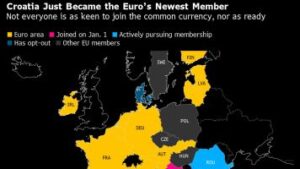
European Central Bank President Christine Lagarde said the currency union’s newest member proves that the euro has lasting appeal. “Croatia worked hard to become the 20th member of the euro area, and it succeeded,” Lagarde said in a statement on Sunday. “It shows the euro is an attractive currency, which brings stability to its members.” The transformation and became the latest country to join the world’s biggest currency zone. It also means the ECB Governing Council increases to 26 policymakers, with Croatian National Bank Governor Boris Vujcic joining the ranks of rate setters.
Two other euro hopefuls aren’t so fortunate. Romania’s bid for membership has been hampered by internal squabbling, evidenced by the highest turnover of governments in the European Union. Bulgaria, the bloc’s poorest country, wants to join in 2024, but wary European officials aren’t convinced that its economy and scandal-plagued banking system are ready for currency prime time.
Ultimately adopting the euro is actually a condition of signing up to the EU, though the Czech Republic, Hungary, Poland and Sweden don’t seem interested. Denmark, which clinched an opt-out on acceding before the dawn of the currency, isn’t budging either. “Only six EU member states are not members of the club,” excluding Denmark, Lagarde said separately in an interview with Croatian newspaper Jutarnji list published on Saturday. “If they need more time, that is fine. When they meet the criteria and wish to join, we will be happy to increase the number of euro-area countries.”
Pension funds must take ‘extreme care’ with liquidity risks, OECD warns

Rising interest rates and falling stock markets have changed the picture for retirement schemes
Pension funds should be “extremely careful” when investing in illiquid assets, as rising interest rates and falling stock markets increase the likelihood of their having to access cash quickly, the OECD has warned. In the recent era of low interest rates, pension funds poured money into alternative investments, such as infrastructure projects and private equity, in an effort to escape the low yields available on government bonds. But such investments are typically illiquid, meaning the funds cannot quickly convert them into cash if needed. While there has been little need for funds to do that over the past decade, the UK pension crisis in October exposed how a sharp rise in interest rates can change that.
Alongside the liquidity risks, the OECD cautioned that the level of due diligence required on alternative investments is likely to be beyond the reach of many smaller funds. When you have a big pension fund, with a large investment team, which is more highly qualified, they can afford to make those choices and assess those illiquids quite well to introduce them. But small and medium-sized pension funds can’t and they need the financial instruments to invest . . . What we have seen is there are not many financial instruments out there to invest in illiquids and infrastructure.
The warning comes as pension funds’ appetite for alternative investments show little sign of slowing. In December, BlackRock, the world’s largest asset manager, said the role of private assets, which span everything from infrastructure to private credit, is becoming “more important than ever” as more companies turn to them for returns. Allocations to alternative assets have brought benefits to global public pension plans.
For example, the Virginia Retirement System, which has 778,000 members, reported its holdings of public stocks and fixed income were down 14.8% and 10.6% respectively for its 2022 fiscal year. In contrast, its real assets and private equity returned 21.7% and 27.4% over the same period. Almost half of public pension funds globally with more than 3 trillion USD in assets plan to increase their exposure to alternatives. Assets that provide a hedge against inflation, including infrastructure and some real estate, were among those most favoured.
Turkish stocks soar as local investors seek refuge from blistering inflation
Istanbul bourse has surged more than 100% in US dollar terms since end of 2021
Turkey’s stock market notched up a world-leading rally in 2022 as a painful spell of inflation sent local savers rushing to equities in search of returns and companies boosted their profits despite the economic headwinds. The Borsa Istanbul 100 equities index has soared almost 200 per cent this year. Even in US dollar terms, which take into account a steep fall in the lira, Turkish stocks rallied 110%, compared with a fall of 22% for MSCI’s broad gauge of emerging market equities. The largely domestically driven boom in Turkish equities highlights how the government’s unorthodox management of the country’s 800 billion USD economy is rippling into asset markets. Inflation reached a high of 85.5% this year as the country’s central bank, which is effectively controlled by Turkish president Recep Tayyip Erdoğan, sharply reduced interest rates at a time when most other countries are raising them.
With inflation and a sagging lira rapidly eating away at Turkish residents’ purchasing power and the government pushing back against holding foreign currencies, many are betting on the stock market. There is a lack of alternatives to make money. People who want to protect their savings from inflation and to increase the value of their investments in real terms don’t have many other places to turn. Turkey’s lira has tumbled 29% against the US dollar this year as the rate cuts have plunged the returns that investors can earn on Turkish fixed-income assets deeply into negative territory.
Asset manager Schroders said in a report last month that the primary driver of the [stock] market performance this year has been high domestic inflation. With interest rates so deeply negative, and government yields unattractive, local investors have been forced into the market to try to protect their savings from rampant inflation. The number of investors in Turkey’s stock bourse has jumped to 3.8mn this month from 2.4 million at the end of last year, according to data from Turkey’s Central Securities Depository.
The gains have been broad for Turkish equities this year: every stock in the benchmark Bist 100 index — except for two — has posted year-to-date gains. Publicly traded Turkish companies have also posted robust profit growth in 2022 despite the economic headwinds. Earnings per share for Bist 100 companies are forecast to rise more than 200% in 2022 compared with 2021. The increases in earnings have helped to restrain valuations on Turkish stocks. The Bist 100 trades at about six times expected earnings over the next year, compared with the 15-year average of eight times.
Despite this year’s upbeat performance, foreign investors have been withdrawing from Turkish markets for the past four years as the lira has tumbled, inflation has soared and concerns have grown about Erdogan’s unconventional economic policies. International investors have also complained that some of the government’s policies, including moves to make it difficult to bet against the lira, have made it difficult to hedge their holdings against currency fluctuations.
US jobs report likely to show still-tight labor market

Solid hiring and robust employment backdrop expected in data. Euro-area inflation probably slowed; Israel seen raising rates
The latest US employment report is anticipated to highlight the resilience of the nation’s labor market through 2022, despite the most aggressive pace of monetary tightening in decades. Payrolls are projected to have risen by about 200,000 in December, according to government data to be released Friday. While that would mark a deceleration from the prior month, that pace of job growth still points to solid hiring and an overall robust labor market.
The persistent mismatch between labor demand and supply — something that will likely be evident in the latest job openings data on Wednesday — continues to put upward pressure on wages. Average hourly earnings are seen rising 5% in December from a year earlier in Friday’s jobs report, well above a pace that would be consistent with the Federal Reserve’s 2% inflation goal. The unemployment rate is seen holding at a historically low 3.7%. Meantime, the record of the Fed’s December meeting, out Wednesday, could help explain the evolution of the committee’s view toward more heightened inflation risk even amid signs that it’s cooling off. Elsewhere, euro-zone inflation will probably show some slowing, and central banks in Israel and Sierra Leone may deliver the first interest-rate hikes of 2023.
China’s purchasing managers indexes will be closely scrutinized to assess the damage to the economy from a surge in coronavirus infections in December. The government’s official PMI on Saturday showed that China’s abrupt reversal of its Covid Zero policy pushed economic activity — its service sector in particular — to the slowest pace since February 2020. Those data will be followed by a private industry PMI on Monday, which is expected to reveal a deeper contraction in manufacturing in the final weeks of the year. South Korean data Sunday showed that exports continued to decline in December in a sign of cooling global demand as higher interest rates weigh on consumption. Meanwhile, Governor Rhee Chang-yong said in a New Year speech that the Bank of Korea should keep its policy focus on fighting inflation and be ready to help stabilize markets.
Wage figures in Japan are expected to show pay falling further behind inflation. At the end of the week, Taiwan will release its trade data, with export orders already plunging following a slump in global demand for chips.

Ronaldo quits top-level football with move to Saudi Arabia
Portuguese star signs for Al Nassr FC after airing dissatisfaction with Manchester United
Cristiano Ronaldo has signed for a Saudi Arabian football club in a move that brings his career at the top level of the game to an end and highlights the oil-rich country’s growing ambition in sport. Ronaldo, 37, has joined the Riyadh-based Al Nassr FC on a two-and-a-half-year contract, weeks after terminating his second spell at English Premier League side Manchester United, where he spent much of this season on the bench. Ronaldo said he was “eager to experience a new football league in a different country”.
While it is common for older players to wind down their careers at clubs in North America’s Major League Soccer, Ronaldo’s move could help to establish Saudi as a challenger. Saudi Arabia has made a series recent investments in sport. The kingdom’s sovereign wealth fund owns a majority stake in English side Newcastle United after a 305 million EUR takeover in 2021 and bankrolled LIV Golf’s efforts to challenge the US PGA Tour’s dominant position in golf. State oil company Aramco is a major sponsor of Formula 1, which first raced in Jeddah in 2021.
The Public Investment Fund said in October that it had agreed sponsorships with a number of football clubs amounting to 8.75 billion SAR [2.3 billion USD] in the first eight months of 2022, mostly for domestic teams. Al-Nassr signed a strategic partnership with the fund’s portfolio company Qiddiya in February. “History in the making,” Al Nassr tweeted. “This is a signing that will not only inspire our club to achieve even greater success but inspire our league, our nation and future generations, boys and girls to be the best version of themselves.”
Ronaldo is one of the best players in the history of football. Although he is nearing the end of his playing career, he has a huge public profile off the pitch. He is the most-followed person on Instagram with 526 million followers, and has signed commercial partnerships with the likes of Nike, crypto group Binance and Herbalife Nutrition.
Stay up to date
More Newsletter to Check



SUBSCRIBE TO NEWSLETTER
Subscribe to download our daily economics and business roundup


×
![]()