
Crypto’s Lehman moment: Sam Bankman-Fried’s 32 billion USD FTX crypto empire files for bankruptcy


Crypto’s Lehman moment: Sam Bankman-Fried’s 32 billion USD FTX crypto empire files for bankruptcy
Collapse comes after digital assets group failed to meet surge in customer withdrawals
FTX, the once high-flying cryptocurrency group, has filed for bankruptcy protection in the US, marking a stunning collapse of the $32bn empire built by the colourful 30-year-old entrepreneur Sam Bankman-Fried. The filing in Delaware federal court on Friday included the main FTX international exchange, a US crypto marketplace, Bankman-Fried’s proprietary trading group Alameda Research and about 130 affiliated companies. FTX’s failure came after Bankman-Fried desperately sought billions of dollars to save the exchange this week after it was unable to meet a torrent of customer withdrawals in a run prompted by concerns over its financial health and links to Alameda.
The collapse of such a prominent group, which advertised during the US Super Bowl and whose shorts-wearing, charismatic founder was a leading donor to the Democratic party, has rocked the notoriously volatile crypto industry. Bitcoin dropped 5% to a fresh two-year low of 16,492 USD after the FTX bankruptcy was announced. Changpeng Zhao, chief executive of Binance, earlier on Friday said the fall of FTX left crypto facing a financial crisis akin to 2008 and that more businesses could fail in its wake. Bankman-Fried, who one week ago was among the most respected figures in the sector with a 24 billion USD personal fortune and close links with Wall Street and celebrities, resigned as FTX’s chief executive on Friday. John J Ray, a restructuring specialist who oversaw the Enron and Nortel Networks bankruptcy cases, will take the reins.
In just over three years, FTX had secured a 32 billion USD valuation and had wooed a roster of blue-chip investors, including Paradigm, SoftBank, Sequoia Capital and Singapore’s Temasek. Venture capital firms Sequoia and Paradigm have in recent days marked their investment down to zero. The sprawling business empire run by a tight-knit group of longtime associates around Bankman-Fried, many of whom lived together in a Nassau penthouse in the Bahamas, has about 100,000 creditors and 10 billion-50 billion USD of assets and liabilities, according to the filing. The US Securities and Exchange Commission is investigating FTX, which includes examining the platform’s cryptocurrency lending products and the management of customer funds, according to a person familiar with the matter.
US S&P 500 ends week nearly 6% higher as inflation data raise investor hopes
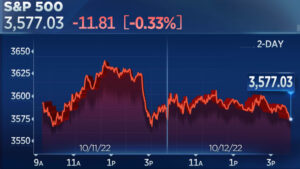
Dollar index slips as investors bet the Fed will increase interest rates by 0.5 percentage points in December. Good news: US CPI inflation came in better than expected, both for headline (7.7%, 0.4%) and core (6.3%, 0.3%). Points to some easing in the cost-of-living pressures that hit the poor particularly hard. Supports some easing of what has had to be a very frontloaded Fed hiking cycle. What a memorable day for markets with every asset — stocks, bonds, precious metals and, yes, even crypto— registering massive gains. To state the obvious, the CPI numbers triggered a strong technical that incentivized all types of investors to scramble for more immediate market exposure.
US stocks had their biggest weekly rise in months and the dollar declined after cooler than expected inflation data released on Thursday fuelled speculation that the Federal Reserve would slow the pace of interest rate tightening later this year. Wall Street’s benchmark S&P 500 added 5.9% over the week, the largest increase since June. It gained 0.9% on Friday, following its best day in two-and-a-half years on Thursday, when it jumped 5.5%. The tech-heavy Nasdaq Composite rose by the most since March, increasing 8.1% for the week, driven by a 7.4% rise on Thursday and a 1.9% gain on Friday. The dollar index is up 10.8% this year but slipped on Friday as investors dialled back expectations for further aggressive interest rate rises in the US. The dollar fell 1.7% on the day against a basket of six peers, extending a decline since a peak in late September.
And for the week ahead, the main predicament for global investors at the moment is whether or not the Fed will be in a position to slow the pace of rate hikes in December. As such, the key U.S. data release next week will be month-on-month core CPI on Thursday. Beyond economic data releases, markets will also be focused on the U.S. mid-term elections on Tuesday and implications for the policy outlook in Washington, DC. In Asia, trade data from China and Taiwan will be published that may indicate slowing global trade. EM central bank meetings next week will be held in Poland, Romania, Mexico and Peru. In all four cases, the market consensus expects further rate hikes, but some of the central banks may signal a reduction in the pace of tightening going forward.
The moves came after data on Thursday that showed the annual rise in the US consumer price index came in at 7.7% in October, the smallest 12-month increase since January and down from an annual rate of 8.2% in September. Markets are now betting there is a roughly 70% chance the Fed will raise its benchmark interest rate by 0.5 percentage points when it meets in December, breaking a run of four consecutive 0.75 percentage point rises. US government bond markets, which are closed on Friday for Veterans Day, had rallied strongly immediately after Thursday’s CPI release. The yield on two-year US Treasuries fell 0.29 percentage points to 4.33%, its largest daily drop in more than a decade. The yield on the benchmark 10-year Treasury note dropped 0.33 percentage points to 3.81%, down from a peak of 4.25% in October. Yields fall as prices rise.

Recession-Hit UK finally confronts its fiscal abyss: eco week
Britain’s plan to repair its damaged public finances and market credibility will finally emerge this week in the wake of data showing an intensifying cost-of-living shock in a recession-stricken economy.
Spending cuts and tax increases may feature heavily in the program that Chancellor of the Exchequer Jeremy Hunt will unveil on Thursday. He is expected to announce measures totalling at least 50 billion EUR (59 billion USD) to bridge a budget chasm. Compounding the challenge is an ever-worsening economic squeeze. A lengthy recession is now likely under way, as signaled by gross domestic product data released last Friday, and inflation numbers for October due on Wednesday will probably show the highest outcome yet seen in the current energy crisis. The median forecast is for a jump in consumer-price growth to 10.7%.
The choices taken by Hunt and Prime Minister Rishi Sunak will determine how far Britain can weather that storm, and also move on from its remarkable financial-market debacle of recent weeks. A package of unfunded tax cuts unveiled by former Chancellor Kwasi Kwarteng and then-premier Liz Truss in September prompted a loss of confidence in the UK economic framework that has become a parable for other countries to avoid. The new government that took office after them has two years left to restore perceptions of the ruling Conservative Party’s economic competence at a time when some voters are increasingly questioning the wisdom of its signature policy, exiting the European Union. The next general election is due by January 2025. In the meantime, the Bank of England is likely to keep raising interest rates to bring inflation under control. Clues on its intentions may emerge on Wednesday as Governor Andrew Bailey testifies in Parliament alongside three of his colleagues.
The global housing market is heading for a brutal downturn

At the end of 2021, things looked rosy for the global housing sector. Across the 38 countries in the OECD, house prices were growing at the fastest pace since records began 50 years earlier.
In 41 countries, from Norway to New Zealand, house prices were rising, bolstered by record low borrowing costs and buyers with savings to spend. Arguably, there had never been a better time to own a home. Not even a year later, and the picture is completely different. While homeowners around the world are reckoning with increasingly unaffordable mortgage payments, prospective homebuyers are facing house prices that are rising faster than incomes. In the background, a global cost of living crisis deepens.
What has changed, of course, is the spectre of rising prices and the economic shock of Russia’s invasion of Ukraine. This fuelled a surge in inflation — now at multi-decade highs in many countries — which prompted central banks around the world to sharply tighten monetary policy. The OECD also predicts that real-term wages are likely to fall next year. The upshot is that a pandemic-induced housing boom in the world’s richest countries is likely to be followed by the broadest housing market slowdown since the financial crash. This, in turn, could add further pressure on to flagging economies.
A housing market slowdown is also likely to depress broader economic activity, hurting the construction sector and its suppliers. Slater predicts that the housing downturn could shave off 0.2 percentage points from global growth as a result of reduced spending and another 0.6 percentage points owing to lower residential investment. The Bank of Canada estimates that the housing downturn will reduce economic growth by 0.6 percentage points to 0.9% next year. This dynamic is already playing out in China where a property crisis has intensified in recent months and its economy this year has grown at its slowest pace since records began in 1992, excluding the pandemic period. Housing floor space sold is down 26 per cent in the year to September compared with the same period last year. Because the sale of properties not yet built is a major source of funding for developers, the sharp decrease as the country presses on with its zero-Covid policy has created self-reinforcing liquidity pressures and harmed the economy.

Erdogan shakes up statistics agency as inflation soars
Turkey’s official statistics agency is undergoing a major reshuffle under President Recep Tayyip Erdogan, fueling a controversy about its independence and the accuracy of its inflation data as consumers face runaway costs.
In the latest twist, Deputy Chairman Fatih Sahin was removed from his post, according to a decree published late in the official gazette. He had served in the role for eight months. The Turkish Statistical Institute, known as TurkStat, has seen a massive overhaul in its management since the start of the year. The chairman and three out of six deputies were replaced after being in their positions for no more than 18 months. Two department heads in charge of inflation data have also resigned. Meanwhile, inflation in the country has roared. Consumer prices rose by annual 85.5% through last month, while producer prices increased 158%, according to TurkStat. There has been a discrepancy between the agency’s inflation figures and calculations from the Istanbul Chamber of Commerce and independent groups.
TurkStat’s critics in the opposition have previously said its figures aren’t trustworthy, hiding true inflation to please Erdogan as the economy suffers. The agency has denied the accusation, saying it operates without political intervention and that its data are in line with European peers.
Stay up to date
More Newsletter to Check



SUBSCRIBE TO NEWSLETTER
Subscribe to download our daily economics and business roundup


×
![]()