
Who will be Britain’s next leader?


Who will be Britain’s next leader?
Liz Truss quits. She has a strong claim to be the least successful prime minister in British history.
It was the shortest premiership on record. It was also one of the most chaotic. On October 20th, just her 45th day in office, Liz Truss said she would resign as Britain’s prime minister (see chart). In doing so, she opened the way for Britain to get its third prime minister this year. Boris Johnson, Britain’s ex-prime minister, and Rishi Sunak, the former chancellor, reportedly held talks ahead of Monday’s deadline for nominations in the contest to replace Liz Truss as prime minister. According to Bloomberg, the pair discussed running on a joint ticket to prevent a divisive runoff vote. Neither have formally announced that they are in the race and the only declared candidate at this stage is Penny Mordaunt.
Conservative MPs are declaring who they want to succeed Liz Truss as their party’s leader and UK prime minister. Under the leadership contest rules, an MP must receive 100 nominations from colleagues by today, Monday at 2pm to become a candidate. If there are three candidates who secure the minimum 100 backers, they will be whittled down to two by MPs in a vote later in the day. If only two candidates reach the threshold of 100 supporters, Conservative party members will vote online to determine the winner by next Friday. If only one candidate obtains 100 nominations, they will be declared party leader and prime minister on Monday.
The potential contenders for the Tory leadership: Rishi Sunak: The 42-year-old former chancellor reached the final round of last summer’s leadership race thanks to his slick communication skills and pro-Brexit credentials. He was defeated by Truss, who won 57 per cent of the vote after the Tory membership dismissed his warnings against her plans for unfunded tax cuts. His message of fiscal discipline may now receive a warmer welcome.
Penny Mordaunt: The leader of the Commons came close to seizing the leadership during the summer despite having had only a brief spell in the cabinet. Her pitch emphasised her pro-Brexit credentials and social liberalism, while playing on her experience in the Royal Navy. Despite her low profile, the 49-year-old came third in the ballot of Tory MPs.
Boris Johnson: The former prime minister has been the most effective election winner of his generation, twice becoming London mayor and securing an 80-strong Commons majority at the 2019 general election. Yet he was driven out of office in the summer by the resignation of 62 ministers — including Sunak — after a string of scandals. Despite this, Johnson remains popular with the party membership and could win the grassroots vote if he secured enough support to get on the final ballot.
Former UK chancellor Rishi Sunak is poised to formally enter the race to become Britain’s next prime minister after securing public backing from the 100 Tory MPs needed to enter the ballot. Sunak had 111 declared backers by Saturday evening; Conservative MPs had yet to decide whether to put former prime minister Boris Johnson on the ballot paper too. Johnson’s allies claimed that the ex-premier, who resigned in July following a series of scandals and more than 60 ministerial resignations, had secured more than 100 MP supporters. Sunak supporters asked to see the proof.
Uncertainty in the UK and Japan dominates the discussion
Five major events occurred in global FX other than with GBP this week.
First, JPY traded above 150 as the Bank of Japan (BoJ) defended “Yield Curve Control” that is proving anything but controllable. The next credibility test for the BoJ will come with the MPC decision on Thursday. Second, EURUSD fell through the 50-day moving average. Third, the Colombian peso was in free-fall but the finance minister had ruled out capital controls, although this didn’t stop the 5-year CDS breaking above 400 bps. Fourth, the Hungarian forint broke above 430, amid broader weakness within CEE. Fifth and finally, China’s CNH slumped to a record low of 7.28 while it kept the LPR rates unchanged this week after previously holding the MLF rate.
Meanwhile, U.S. Treasuries rose to 2008 highs as the Fed’s Harker reiterated that a policy rate well above 4% by year-end was likely and Governor Cook suggested that ongoing rate hikes were likely. Meanwhile, European rates widened on higher inflation break evens, rather than real yields, as natural gas prices rose sharply once again, and German PPI remained elevated at nauseous levels. Emerging markets were less volatile than developed markets, which we are all becoming accustomed to. In Turkey, President Erdogan goaded CHP President Kemal Kilicdaroglu to run against him in the 2023 election, who would in theory represent the “Alliance of Six”, yet the group of political parties are still divided. The CBRT also cut interest rates by 150 bps, but the main headline was the increase in the “securities maintenance ratio” from 3% to 5%. This caused Turkey’s local currency bonds to rally some 300 bps as banks are set to buy TRY88bn by month-end. This allowed the CBRT to be more aggressive than consensus and cues further tightening in November.
Finally, the Biden Administration announced the planned sale of 15m barrels from its strategic reserves, which is the final installment of the 180m release from March, although it does put the U.S. on a confrontational path with OPEC+ should the U.S. release more over winter. In strange fashion, markets seem to be under-reacting to U.S. midterm elections.
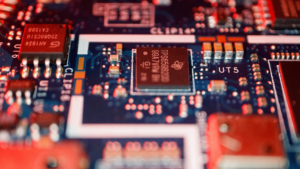
How the US chip export controls have turned the screws on China
Washington is trying to slow Beijing’s advanced semiconductor development and military modernization
The US in October introduced expansive chip export controls in an effort to slow China’s progress in artificial intelligence and super computers and make it harder for the country to manufacture advanced semiconductors. The controls are arguably the toughest measures President Joe Biden has taken against China and his first serious attempt to slow its military modernisation by targeting the technologies behind everything from nuclear weapons modelling to hypersonic weapons development.
How will they impact China’s semiconductor industry? China’s top chipmaker Semiconductor Manufacturing International Corporation, which makes logic chips that power computers, will be hit by the restrictions as they bar US companies from supplying technology for chips that are more advanced than 14 nanometres or, in some cases, 16nm. The rules will make it harder for SMIC to continue production at the 14nm level because they will impact areas like maintenance and equipment replacement.
Memory chipmakers such as Yangtze Memory Technologies Corp and ChangXin Memory Technologies will also be impacted. Their more advanced products already meet the thresholds the US has set for memory chips. In the case of YMTC, for example, the US has put restrictions on the export of technology to manufacture Nand memory chips with 128 layers or more — the level of the Chinese company’s most advanced chips. Without access to US technology, China will struggle to maintain its fast expansion in artificial intelligence and supercomputing — two areas important to the Chinese military — as well as cloud computing.
What US companies will be hit? The impact depends on how aggressively the US applies the controls. Many US firms that produce chips or chipmaking tools list China as their biggest market. China accounts for 33% of sales at Applied Materials, 27% at Intel and 31% at Lam Research. Applied Materials said the restrictions would cut about 400 million USD, or 6%, from next quarter’s sales. Nvidia, which will be unable to export its advanced GPUs (graphic processing units) used in machine learning systems to China, also put the quarterly impact on revenues at 400 million USD, or 7% of its sales.
China’s 20th Party Congress focused on tech self-reliance and national security
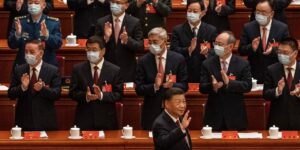
The 20th Party Congress began on October 16th with publication of a work report and speech from Xi Jinping which emphasized areas of national security, technology independence, and law-based governance.
Xi reiterated preference for peaceful reunification with Taiwan, and as largely anticipated, there has been no indication of evolution in Zero Covid Policy (ZCP). The closing ceremony will be held on Oct 22nd where the party will announce members of the 20th Central Committee. Meanwhile, 3Q GDP data has been delayed amid focus on the political event.
The report and speech delivered at the start of the Party Congress as well as likely forthcoming personnel appointments, including Xi as the new General Secretary, largely reinforces policy continuity, ideology, and cements Xi’s strength, despite a challenging economic backdrop. Structurally speaking, we continue to expect a reduced priority on fast paced growth in favor of better quality and inclusive growth which should guide the evolution of and commitment to existing policies led by the dual circulation model.
This prioritizes the strength of the domestic economy, innovation, and supply chain resilience while retaining access to global markets and investment. While the Party Congress itself is not typically a policy-specific event, its conclusion could create room for additional targeted measures and policy adjustment into the 2023 NPC. On the delay in GDP data, we see this as a prioritization of the Party Congress and associated events. We do not necessarily expect a particularly weak print once released, despite economic activity that remains under pressure, but the delay does dent credibility.
Turkey’s Central Bank cuts another 150bps, targets single digit policy rate
The Central Bank of the Republic of Turkey (CBT) lowered its main policy rate by 150 bps to 10.5% and signaled it will likely complete the latest monetary policy easing cycle that started in August with another 150 bps to 9% at the November meeting.
Against a backdrop of headline inflation (CPI) running at 83.5% YoY in September and producer prices (PPI) at 151.5% YoY, the CBT justified its policy decision with growth slowdown risks driven by external factors and stated that it was “critically important that financial conditions remain supportive to preserve the growth momentum”. Looking across emerging markets, almost all of CBT’s peers are aggressively hiking rates in an attempt to control inflation and support their currencies amid a “draconian” developed market policy tightening bias.
In the current global macro environment, CBT’s politically imposed uber-dovish monetary policy approach could be characterized as a car driving against traffic on the highway whose driver is convinced that it is actually all other motorists who are on the wrong side of the road. While a number of macro-prudential policies and other regulatory financial repression measures have been able to preserve relative optical stability in Turkish markets thus far, the ongoing economic policy experiment continues to exacerbate Turkey’s macroeconomic distortions and imbalances.
Those include, among others, completely unhinged inflation dynamics, ballooning real estate and equity prices (seen locally as hedges against skyrocketing inflation), high dollarization, and increasing medium-term fiscal risks. The Erdogan Administration’s ability to avoid a loss in confidence and to muddle through with current policies until elections in 1H 2023 hinges on securing additional external funding on an ad hoc basis (mainly from Russia and the GCC). However, as benign Current Account dynamics from the strong summer tourism season fade and global financial conditions continue to tighten, we expect BoP pressures are likely to increase into year-end and early 2023.
Stay up to date
More Newsletter to Check


SUBSCRIBE TO NEWSLETTER
Subscribe to download our daily economics and business roundup


×
![]()