
US CPI numbers are out. Every measure came in higher than consensus expectations.

US CPI numbers are out. Every measure came in higher than consensus expectations.
To add to the economic/social/political discomfort, the headline print is a new high for this inflation cycle, countering the claims made by others that inflation had peaked. If the first 10 days of June are anything to go with, the next monthly measure would be higher.
Bad news on inflation hardened expectations the Federal Reserve will keep raising interest rates in half-point steps through September, with talk of an even larger move mounting in the conversation. Investors increased bets on a 75-basis point hike after data Friday showed consumer-price growth accelerating to a fresh 40-year high and a separate report in which expectations deteriorated, though Fed watchers generally doubt Chair Jerome Powell would take that step next week. We believe that even in these fast-moving times, the Fed is likely to be reluctant to surprise markets, which keeps the chance of a 75 basis-point surprise at next week’s meeting small. However, we could see Chair Powell at the post-meeting press conference more clearly signal that 75 basis-point hikes are on the table for future meetings if we don’t see a let-up in inflation.
Powell will hold a press conference after the conclusion of the Fed’s two-day meeting on Wednesday. He’s already paved the way for 50 basis point increases this month and next and said officials will keep pushing until they see “clear and convincing” evidence prices are cooling. There was scant sign of that in Friday’s data. The consumer price index increased 8.6% from a year earlier in a broad-based advance. Core CPI, which strips out the more volatile food and energy components, rose 0.6% from the prior month and 6% from a year ago, also above forecasts.
The US central bank now has good reason to surprise markets by hiking more aggressively than expected in June. We realize it is a close call and that it could play out in either June or July. But we are changing our forecast to call for a 75-basis point hike on June 15. The last time the Fed raised rates by that amount was under then Chair Alan Greenspan in 1994. Americans are fuming over higher prices, caused by pandemic supply-chain tangles, surging energy costs due to the war in Ukraine, and too much stimulus from fiscal and monetary policy. Powell, who has acknowledged the Fed underestimated inflation and could have started to tighten sooner, can expect heavy questioning later this month when he testifies before Congress.
Fed’s Mester May back half-point September hike if prices don’t cool.
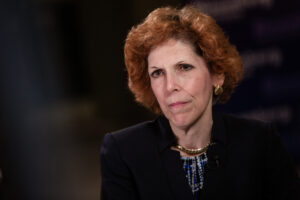
Federal Reserve Bank of Cleveland President Loretta Mester confirmed her support for raising interest rates by a half point in June and July and said she would back be doing the same again in September if inflation is not retreating.
“I’m going to come into that September meeting and if I don’t see compelling evidence, then I could easily be a 50 basis-point in that meeting as well,” Mester said Friday during an interview with CNBC. “There’s no reason we have to make that decision today, but my starting point will be do we need to do another 50 or not.” Mester, who votes in monetary policy decisions this year, said she might support a smaller quarter-point rate increase in September if officials see “compelling evidence” that inflation is on a downward path. Her remarks are the final scheduled public comments from a Fed official before the start of their pre-meeting blackout period at midnight.
Fed officials raised interest rates by a quarter of a percentage point in March and by a half point in May. Policy makers expect that those higher borrowing costs will help them combat inflation by cooling the housing market and lowering demand for goods and services. The central bank has signaled that it will make half-point increases in June and July. Some officials, including Mester, say the pace of rate increases could accelerate, or slow down, in September based on what happens with inflation and the broader economy.
The US labor market added 390,000 jobs last month and wage gains held firm, the Labor Department reported earlier on Friday. Traders interpreted the data as a sign that the Fed will keep its policy tightening on track. “I think that having the headline number come in a little bit lower than the previous month is a good thing,” Mester said. “But it’s too soon to say that that’s going to change our outlook, or my outlook on policy.” Policy makers will meet again on June 14-15.
The World Bank slashed its forecast of global gdp growth this year, to 2.9%.
It warned that the risk of stagflation was considerable and that the world should prepare for “several years of above-average inflation and below-average growth”.
Growth concerns are back in focus. The World Bank downgraded global growth to 2.9% from 4.1% (-1.2%), just as the OECD revised its 38-member countries down to 3.0% (-1.5%). Within that, Eurozone economic growth in 2022 is forecast at 2.3% and 2.6%, with inflation of 7.1% and 7.0%, across the ECB and OECD, respectively. Meanwhile, the OECD remains concerned that UK GDP could grind to a halt next year and record the second worst growth figures, only to Russia, across G20. This is likely to be exacerbated even as Boris Johnson narrowly clung onto power after a vote of no confidence (surviving by 211 votes to 148 against).
One trend over the past week was the synchronized G10 tightening across the Reserve Bank of Australia and ECB. The former hiked rates by 50bp, while the ECB announced intentions to hike rates by 25bp and end net asset purchases in July. Then, guidance for the September decision would be “gradual but sustained”, which meant the market began to price in closer to 50bp. The focus is also back on the Federal Reserve after U.S. CPI came in notably hot at 8.6% too. Within EM, the tightening cycle is already well underway. Brazil may have emerged as one of the first candidates to subsequently pause, while Chile and Poland increased policy rates by 75bp and India by 50bp. Though the inflation trend in Asia with Thailand and the Philippines is more striking. Headline inflation sharply increased to 7.1% in Thailand and 5.4% in the Philippines, although the latter seems more likely to raise rates. Elsewhere, the U.S. also tightened Russia’s access to the international debt markets. The latest guidance has effectively frozen capital markets and limited the ability to trade Eurobond debt. A full sovereign default later this month is increasingly inevitable, which incidentally has already been triggered by the CDS Committee given unpaid accrued interest associated with the late payment on the April 2022 bond (eventually paid on May 2).
ECB takes hawkish turn to counter record-high inflation
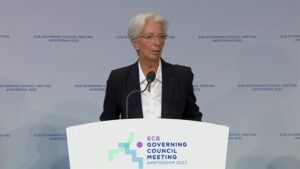
Central bank paves way for first rate rise in more than a decade and suggests pace could quicken in September
Christine Lagarde on Thursday sought to counter concerns that the European Central Bank was doing too little to fight surging inflation, announcing plans to lift interest rates above zero for the first time in a decade by September. The ECB surprised markets by signalling that it was likely to raise rates by half a percentage point in September, in addition to a planned quarter-point rise in July — a bigger increase than expected.
ECB of being asleep at the wheel after inflation soared to 8.1%— more than four times the central bank’s 2% target — in the year to May. The new plans will bring eurozone monetary policymakers closer in line with the US Federal Reserve and Bank of England, which have raised rates multiple times this year. It could leave the central banks of Japan and Switzerland as the last two major monetary authorities still deploying negative rates. Lagarde, ECB president, and chief economist Philip Lane had previously said rate rises of a quarter of a percentage point were the “benchmark” for its meetings in July and September.
However, Lagarde stressed on Thursday that risks to the inflation outlook were now “primarily on the upside”. Officials at the central bank are increasingly concerned that higher wages and disruption to global energy markets and supply chains will lead to inflation becoming entrenched. The bank last raised rates in 2011 and its deposit rate now stands at minus 0.5% after hitting zero in July 2012 and diving into negative territory in 2014, during a regional debt crisis. As planned, the bank announced it would end its remaining 20 billion EUR per-month bond purchases at the start of July. The sell-off in bond markets, however, underlined how the ECB’s plans to ditch its crisis-era stimulus could cause problems for countries with higher debt burdens, such as Italy.
Investors, meanwhile, were keen for the ECB to explain what it was planning to avoid the risk of a repeat of the financial market stress that led to bailouts of several countries, including Greece, Portugal and Ireland, during Europe’s debt crisis of 2012 that nearly destroyed the single currency.
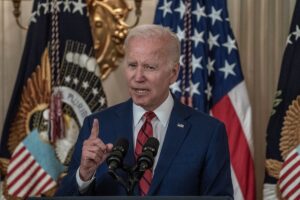
Biden says any Saudi visit would focus on more than energy.
President Joe Biden said he has “not yet” made a decision about visiting Saudi Arabia, but that if he went it would be to take part in meetings that go beyond energy topics.
While Biden didn’t specify the format, Saudi Arabia has been planning a summit of the Gulf Cooperation Council, a regional group that also comprises Bahrain, Kuwait, Oman, Qatar and the United Arab Emirates. Visiting Saudi Arabia would reflect a shift in diplomatic priorities by Biden and an effort to mend ties with a country he once pledged to make a “pariah” for its alleged human-rights abuses. Russia’s invasion of Ukraine and surging inflation -- exemplified by record US gasoline prices -- are putting pressure on the president to change tack and boost energy supplies. Saudi Arabia is the world’s biggest crude exporter.
Any trip to Saudi Arabia would be for a “larger meeting” on regional security, Biden told reporters Saturday at the end of a trip to California. The White House intends to announce the trip to Saudi Arabia as early as Monday, the Wall Street Journal reported on Saturday, citing two officials with knowledge of the plans. The agenda includes a meeting with Saudi Crown Prince Mohammed bin Salman, the newspaper said, adding that a stop in Israel is also planned.
Stay up to date
More Newsletter to Check



SUBSCRIBE TO NEWSLETTER
Subscribe to download our daily economics and business roundup


×
![]()