The Fed paused in October, but two dissents, rising inflation and market pricing all point to a hike in December. A stalling labour market is the one serious argument for waiting.
The Federal Reserve kept its policy rate at 3.75-4.00% on 28 October, six weeks after raising it for the first time since 2023. The vote, however, was 10-2: Governor Lisa Cook and Cleveland Fed President Beth Hammack both preferred another 25-bp hike, and markets now price a better-than-80% chance that the Fed delivers it on 9 December.
October did not settle the debate - it postponed it. The question for the next five weeks is whether the data justify a second hike, or whether a weakening jobs market gives the Fed a reason to stay on hold.
1. What the Fed Said - and What It Avoided Saying
The statement described the economy as ‘expanding at a strong pace’ and repeated that inflation ‘remains elevated’. Chair Kevin Warsh reinforced the message: there is ‘no soft inflation target’, the goal remains 2% on the PCE measure, and it is the Fed’s ‘responsibility to get inflation down’.
What he did not do was commit. Warsh declined to prejudge December and said the Committee wanted more information. The hold was a pause for evidence, not a change of direction. In September, 16 of 18 officials projected a year-end rate above today’s midpoint, and the median implied one more hike in 2026.
2. Inflation: Energy Is Leading, Core Is Following Slowly
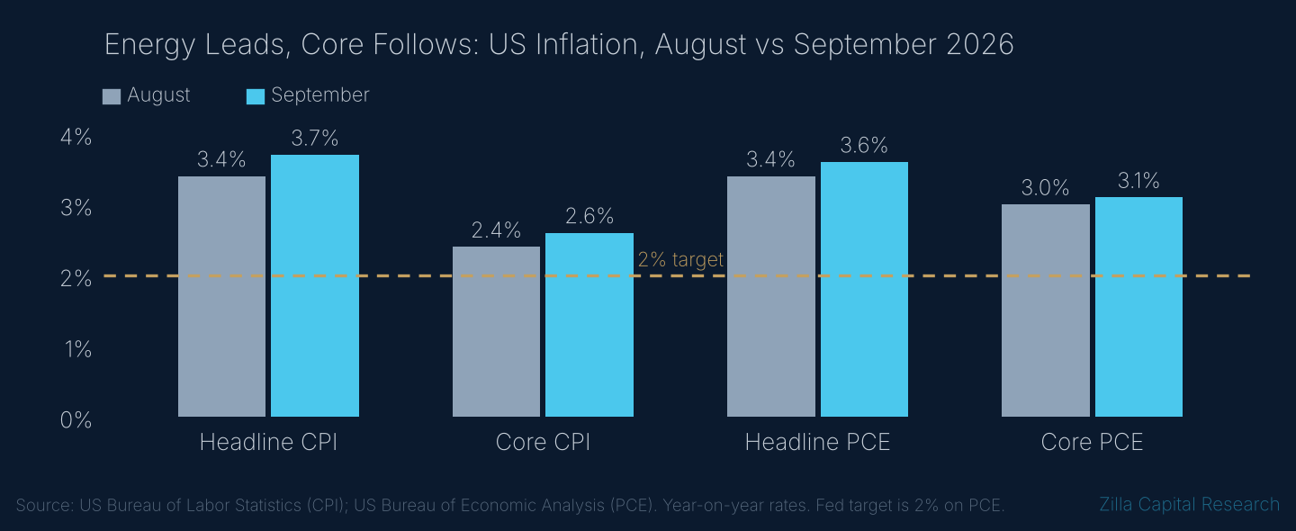
September’s data moved the wrong way. Headline CPI rose 0.6% m/m to 3.7% y/y, up from 3.4% in August, with gasoline alone up 9.1% and accounting for more than half of the monthly increase. Core CPI is still contained at 2.6% y/y, but it has risen 0.3% m/m in each of the past two months.
The Fed’s preferred measure tells a similar story at a higher level: headline PCE inflation reached 3.6% and core PCE 3.1%. Brent crude ended October at $113 a barrel, up 13.6% over the month, and one-year consumer inflation expectations stood at 4.7% in the University of Michigan’s October survey. This is the persistence risk the Fed hiked against in September - and it has not faded.
3. Jobs: The Case for Patience Is Getting Stronger
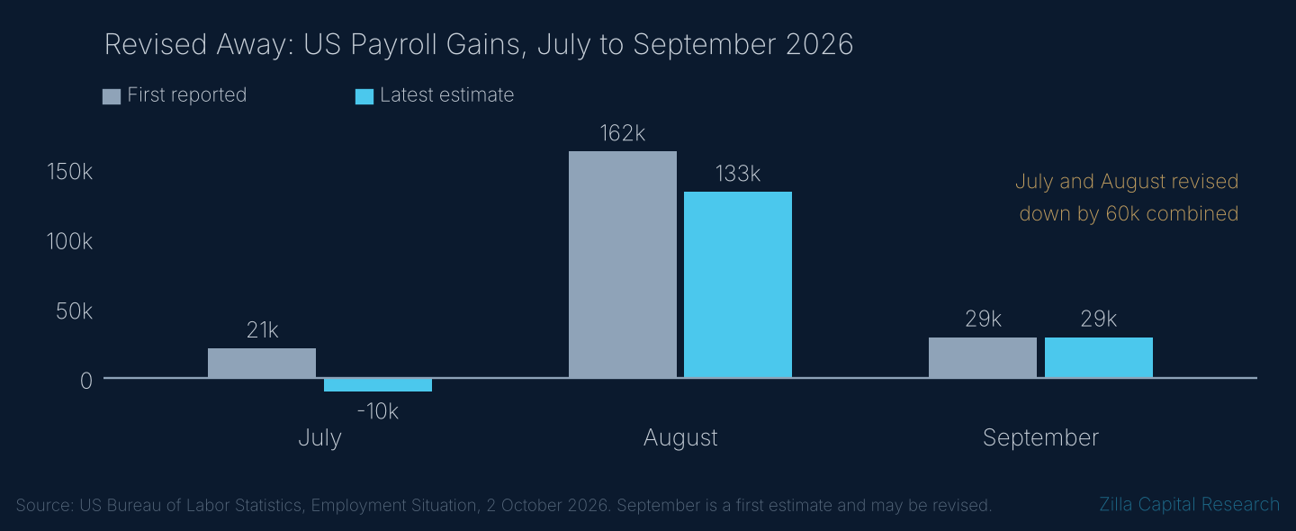
The labour market is where the argument for waiting lives. Payrolls rose by only 29,000 in September, and July and August were revised down by a combined 60,000 - July now shows a decline of 10,000. Unemployment rose to 4.2% and wage growth eased to 3.0% y/y. When we last wrote on the Fed in September, August payrolls stood at 162,000 and unemployment at 4.1%; both have since moved the wrong way.
The Fed statement nonetheless said job growth had ‘kept pace with the workforce’, and Warsh called the labour market ‘quite positive’. That gap matters. If the October jobs report on 6 November confirms the slowdown, the case for a December hike weakens; if hiring rebounds, the hawks gain the upper hand.
4. December: The Case For and Against Another Hike
The case for a December hike rests on four points. Headline inflation is rising again and has been above 2% for about six years; oil at $113 and consumer inflation expectations at 4.7% raise the risk that the energy shock spreads further; two officials have already voted to move; and with a hike more than 80% priced, a second hold would now be the surprise.
The case for holding is narrower but real. Core CPI is still only 2.6%, and most of the recent rise comes from energy, which higher rates cannot fix. Payrolls have nearly stalled, a 10-year yield near 5% has already tightened financial conditions, and the majority of the Committee chose to wait in October. The main risk on this side is tightening into a slowdown; on the other, letting inflation expectations drift higher.
5. Politics: A Hold Before the Midterms
The timing adds another layer. The decision came six days before the 3 November midterm elections, after the administration had called September’s hike a ‘rather unfortunate decision’. Warsh said politics ‘played no role’. But a hold ahead of an election is easy to read politically, which makes December - after the vote - the cleaner test: a hike would confirm that October was about data; another hold would invite the opposite reading, however well justified.
6. What It Means for the Region
For the GCC, a December hike would pass through quickly: dollar pegs mean regional policy rates usually follow the Fed, lifting funding costs just as high oil prices support fiscal revenues. Higher-for-longer US rates also keep Treasury yields - with the 10-year near 5% - competing with regional bonds and equities for capital. In Egypt, where the central bank raised rates by 100 bps on 29 October, a further Fed hike would add to the pressure on portfolio flows.
Bottom line: October was a hold, not a halt. Inflation is moving back up on energy, the Committee’s hawks are pushing for action and markets have priced a December hike. The one argument for waiting - a labour market that has nearly stopped adding jobs - is real, and the 6 November payrolls report is its next test. Unless that report or October’s CPI surprises to the downside, the Fed is more likely than not to raise rates to 4.00-4.25% on 9 December.


